
The class clown isn't joking
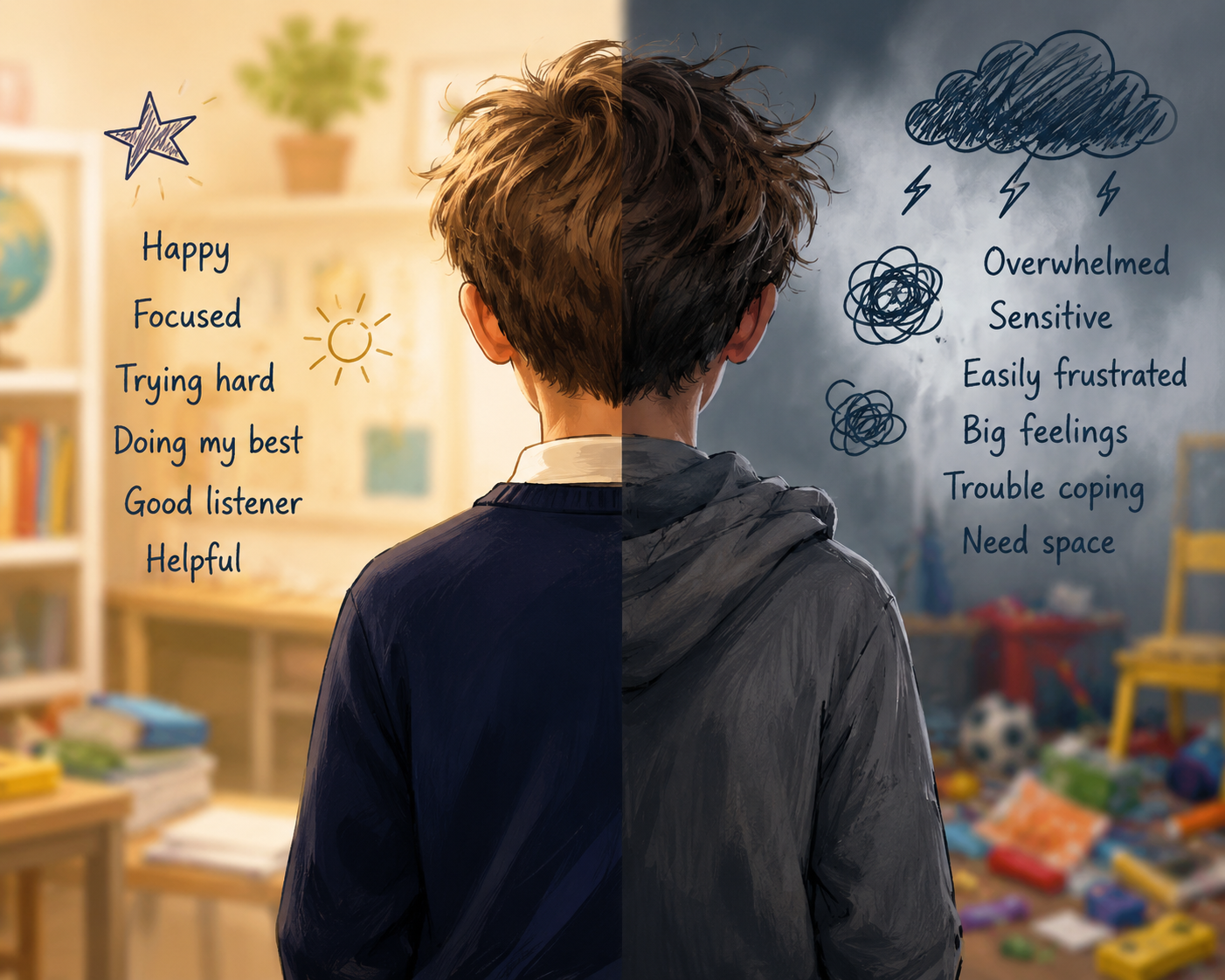
Masking a real behaviour
Every classroom has one. The boy who can land a one-liner from the back row with the timing of a man who has studied it. The one whose report says "a lovely sense of humour, but..." and you already know everything that comes after that "but" is going to be a list of things he did instead of the lesson.
He's the funny one. The disruptive one. The "he'd do so well if he just applied himself" one. The one who gets sent out so regularly he has a favourite spot in the corridor.
And here is the thing nobody writes on the report: the funny is not a personality. The funny is a job. A full-time, unpaid, exhausting job, and he is the only one clocked in.
The bit is the mask
Think about it from inside his head for a second. The work is hard. Not because he's not bright, but because sitting still, holding instructions, starting the task, and not getting distracted by the single most interesting thing in the room (a bee, a cough, the concept of Tuesday) is, for his brain, genuinely uphill.
So he has two options. He can be the boy who can't keep up, who might get found out, who feels the gap between himself and everyone else widening by the minute. Or he can be the boy who made everyone laugh and got sent out before anyone noticed he hadn't started question one.
One of those is humiliating. The other gets a laugh and a quick exit. He picks the exit every single time, and honestly, who wouldn't.
This is masking. We tend to think masking is a quiet, girl-shaped thing, all neat handwriting and people-pleasing. But a boy turning every lesson into the Edinburgh Fringe so nobody clocks the struggle underneath is masking just as hard. The disguise is just louder.
Partridge in the corridor
There's a very Alan Partridge (if you are old enough to remember him!) quality to it, if you've ever watched a man deflect with a bit because the alternative is being seen. The relentless patter. The joke deployed at exactly the moment a real feeling threatened to surface. Smell my cheese. Anything, anything, rather than sit in the discomfort of not coping.
The class clown is doing Partridge in a corridor in Stockport to Preston, well really anywhere in the UK. The performance is frantic because the thing it's covering is real.
"Capable but not trying" is the wrong reading
Here's where Russell Barkley earns his fee. His central point about ADHD is that it isn't a problem of knowing what to do. It's a problem of doing what you know at the moment it matters. A performance problem, not a knowledge problem.
So the class clown can absolutely tell you the rule. Can recite, verbatim, that he should be facing the front and not narrating the bee. He knows. He just cannot reliably deliver that knowledge in the half-second window where it counts, especially not while also holding down the second job of being funny enough to stay hidden.
"Capable but not trying" assumes the trying is the missing bit. It isn't. He is trying like mad. He's just spending all of it on the performance instead of the worksheet, because the performance is what's keeping him safe.
The bit where the criteria let him down too
Now, you'd think this boy would be easy to spot. Disruptive, can't sit still, blurts things out, sent out of class. That's the picture, isn't it. That's the boy the ADHD diagnostic criteria were largely built around, because the criteria came mostly from studying young, hyperactive, disruptive boys.
And yet he still gets missed, just down a different route. Because "disruptive boy" has a lazy first reading, and that reading is naughty. So instead of "this child might have ADHD," he gets "this child has a behaviour problem," a sticker chart, and a stern word about choices. He fits the textbook and still walks straight past the assessment, because the textbook gets read as a discipline issue rather than a clinical one.
That's the trap with a criteria set built around one type of child. Even the boy who matches the photo gets the wrong door, because matching the photo just makes adults reach for "naughty" faster.
What actually helps
Stop reading the funny as the problem to be stamped out. The funny is the smoke. Go looking for the fire.
Notice when the jokes spike. If the clowning reliably arrives at the start of writing tasks, or the moment something gets hard, that's not a coincidence, that's a flare going up. The bit is telling you where the struggle is.
Name it kindly, not as a telling-off. "I notice the jokes really get going when we start writing. I wonder if writing feels like a lot." A boy who's spent years being the funny one rarely gets asked what the funny is for.
And if it's a pattern, school after school, year after year, get it on the record in writing and ask the question out loud: could this be ADHD, not behaviour? Because a boy can be the funniest kid in the room and the one drowning quietest. Those are not opposites. They're the same boy, working two jobs, and only getting noticed for one of them.
Back of the net. And then straight back out into the corridor.
If the jokes always seem to fire up right when the work gets hard, that's worth a proper look, not another behaviour chart. I help parents tell the difference between "naughty"(I really hate that word) and "needs support," and get it on the record with school in a way that sticks. Book your free introductory call and let's work out how I can help you.
