

EHCP HELP & SUPPORT
Your child needs support. But what do you ask for, and where do you begin?
Perhaps school says everything is fine, but home tells a very different story.
Perhaps you've collected reports, attended meetings and sent emails, yet you're still wondering why nothing seems to change.
Or perhaps your child already has an EHCP, but the support written in it isn't happening as it should.
❤️ You shouldn't need a law degree and a filing cabinet full of paperwork just to understand what support your child needs.
What EHCP is right for you?
Three ways to get support
Whether you're noticing early signs, struggling with everyday challenges or trying to secure the right school support, get experienced guidance, practical solutions and a clearer way forward.
EHCP Clarity Consultation
£225
Not sure whether your child needs an EHCP or what to do next?
You’ll receive:
A 70-minute consultation to explore their needs, existing support and practical next steps.
Includes a follow-up email and a 20-minute review call.
EHCP Evidence Review
From £295
Already have reports, school records or EHCP paperwork? I'll help identify missing evidence, unclear provision and the questions that need answering.
You’ll receive
Includes document review, a consultation and written summary.
EHCP Meeting & Support Script
From £185
Preparing for a difficult school or EHCP meeting?
You’ll receive
A personalised script with focused questions, responses to likely objections and key points to help you communicate confidently.
✔️This could be a good fit if….
✔️You feel something isn't right, but you're struggling to explain why.
✔️You've been told to wait and see, but your concerns are growing.
✔️You're considering an EHC needs assessment and need help understanding the process.
✔️Your child has an EHCP, but you're unsure whether their needs and provision are properly reflected.
✔️You've received professional reports and don't know which recommendations matter most.
✔️You want to approach school confidently, clearly and constructively.
❎What I Don't Provide
It's important to be clear about the boundaries of my services.
❎I don't provide legal advice, tribunal representation, legal case management, crisis intervention or safeguarding services.
❎I don't attend school meetings or act as your representative. Instead, I help you prepare so that you can participate more confidently and communicate your concerns clearly.
❎ Unlimited or open-ended casework..
❎Where specialist legal advice or another professional service would be more appropriate, I'll be clear about that.
How I can help you.
Less confusion. More clarity. A plan that actually makes sense.
EHCPs, school meetings, assessment requests and specialist reports can feel overwhelming, particularly when you're also supporting a child who is struggling.
You may know something isn't right but find it difficult to explain exactly what needs to change.
Understand your child’s needs
Identify gaps in support
Make sense of the evidence
Prepare for conversations
Decide what comes next
What evidence do I need for an EHCP request?
Evidence does not have to be perfect, but it does need to build a clear picture.
SCHOOL EVIDENCE
SEN Support plans
provision maps
attendance
behaviour records
school reports
work examples
meeting notes
PROFESSIONAL EVIDENCE
ADHD/autism assessment
EP
CAMHS
GP
paediatrician
SALT
OT
dyslexia assessment
PARENT EVIDENCE
diary
emails
after-school patterns
homework
sleep
transitions
recovery time
CHILD'S VOICE
what feels difficult
what helps
worries
aspirations
experience of school
Parent Evidence Matters

ADHD itself doesn't automatically mean a child needs an EHCP. The important issue is the impact of the child's needs and the provision required to support them.
Free guides to support you and your family.

A practical UK checklist to help parents gather clear, real-life evidence before a school meeting, referral or ADHD assessment. Record patterns, impact, support needs and what helps across home, school and daily life. This is not a symptom quiz and cannot diagnose ADHD.
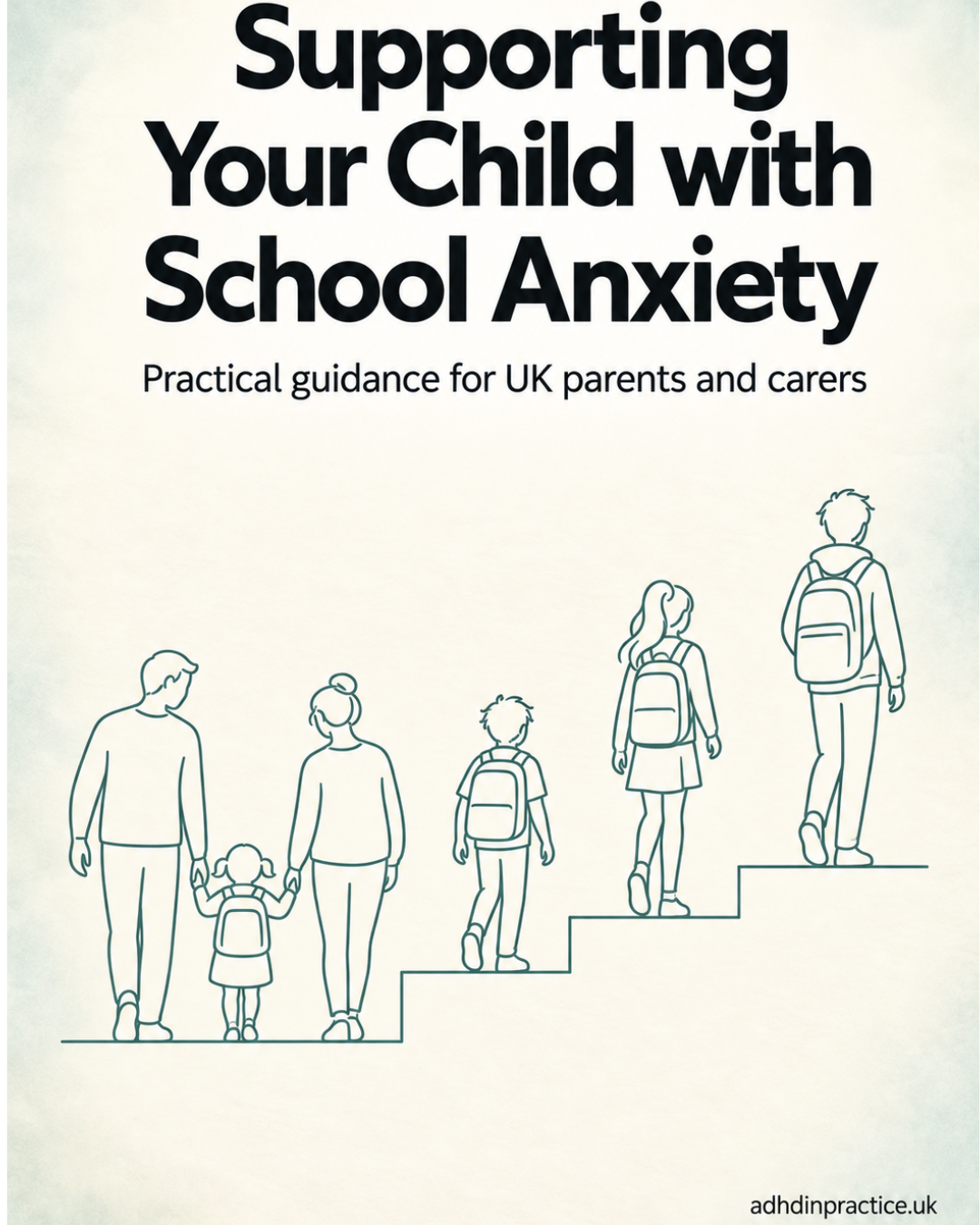
Practical guidance for UK parents and carers
I have created another free guide for parents/c arers to download and use. When a child is struggling to attend school, the problem is rarely solved by simply telling them they must go in.
School anxiety can appear as tears, anger, shutdown, physical symptoms, sleepless nights, difficult mornings or complete refusal. Some children manage to enter school and appear fine, only to fall apart when they return home.
This practical guide helps you look beyond the behaviour, identify what may be making school feel unsafe or overwhelming and take clear, manageable action.
Inside the guide
You will find:
Signs of school anxiety across different ages
Possible reasons behind distress and non-attendance
Questions to help you identify patterns and pressure points
Practical steps for difficult mornings and recovery after school
Ways to listen without turning every conversation into an interrogation
Reasonable adjustments that may reduce anxiety in school
Parent-teacher conversation scripts
Questions to ask the teacher, SENCo or pastoral team
Space to record concerns, agreed actions and review dates
Guidance on what to do when support is vague or progress stalls
This guide will help you
Describe what is happening clearly
Separate anxiety from assumptions about behaviour
Gather useful information from home and school
Prepare for a constructive school meeting
Ask for specific support rather than being told to wait and see
Keep your child’s experience at the centre of decisions
Who is it for?
This guide is for parents and carers of children and young people experiencing anxiety connected with school, including those with ADHD, autism, SEND, EBSA or no diagnosis at all.
You do not need to wait for a diagnosis before discussing your child’s needs or asking school what support can be put in place.
What this guide is not
This is practical general guidance, not individual legal advice, a diagnosis or a treatment plan. The conversation scripts are examples to adapt to your child, school and circumstances.
Education systems and legal duties differ across the UK. Year groups and statutory references within the guide follow England unless stated otherwise.
Free download
Download the guide, choose the section that matches what is happening now and begin with one action. You do not need to solve everything in one meeting.
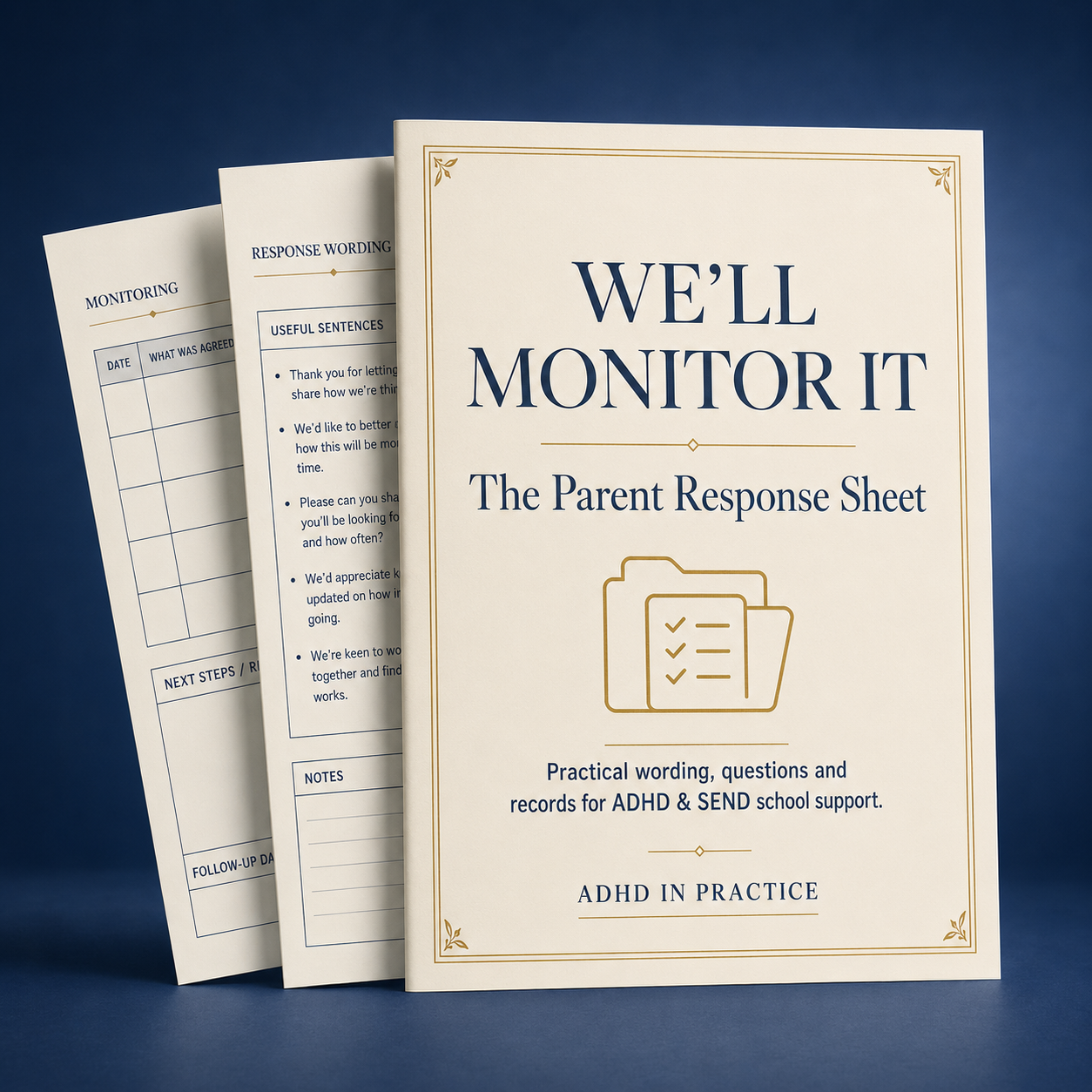
Has school said, “We’ll monitor it,” without explaining what will be monitored, what support will happen or when anyone will review it?
The free “We’ll Monitor It” Parent Response Sheet helps UK parents, grandparents and carers turn a vague promise into a practical, reviewable plan.
Created for families navigating ADHD, autism, dyslexia, dyscalculia, anxiety, sensory needs, emotional regulation, attendance difficulties and wider SEND concerns.
The resource includes:
a school-meeting preparation sheet;
questions to ask before the meeting ends;
an actions and responsibilities record;
space to record support and adjustments;
a review-date planner;
child-voice prompts;
home and school evidence logs;
follow-up email wording;
guidance about what to do if concerns continue.
Your child does not need a diagnosis before you can raise concerns or ask school to respond to identified needs.
Free download • UK-focused • Practical and easy to use
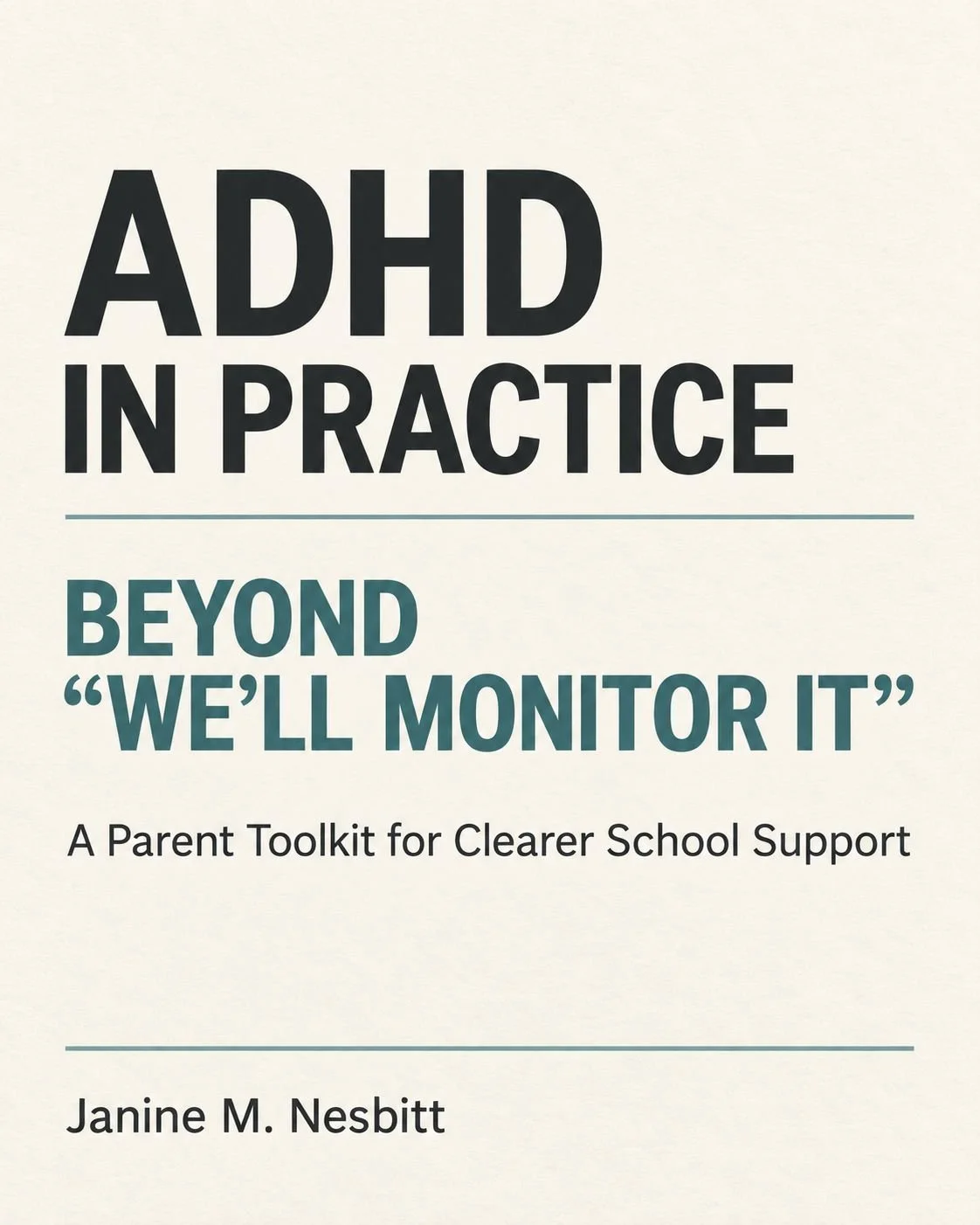
You have explained your concerns to school. Everyone has listened. Then the conversation ends with:
“We’ll monitor it.”
But what will be monitored? What support will happen now? Who is responsible, and when will it be reviewed?
Beyond “We’ll Monitor It” is a free 20-page ADHD and SEND parent toolkit designed to turn vague school conversations into clear, recorded next steps.
It helps you:
Choose up to three priorities.
Explain the difficulty and its impact on your child.
Prepare clear questions for the teacher or SENCo.
Record what support was requested and agreed.
Identify who is responsible for each action.
Flag questions that still need answering.
Request a start date and review date.
Send a clear follow-up email after the meeting.
Check whether the agreed support happened and helped.
By the end, you will have a practical one-page meeting record showing what was discussed, what was agreed, who will act and what happens next.
Suitable for parents of children with ADHD, autism or other SEND, including children without a diagnosis.
Format: Free 20-page digital toolkit
UK focus: School terminology and SEND guidance relate primarily to England
Created by: Janine M. Nesbitt, ADHD in Practice
Still unsure what to do.
Choose support for you, your school conversations or your child. You have to start somewhere. Start with a free 15 minute call.
A calm, no-pressure conversation giving you time to explain what is happening and work out what your next step could be.
This call is for parents, grandparents and carers of children with any diagnosed or suspected SEND—not only ADHD.
Your child may be experiencing difficulties connected with autism, dyslexia, dyscalculia, anxiety, sensory needs, communication, learning, school attendance, emotional regulation or executive functioning. They may have several overlapping needs, or no diagnosis at all.
Children’s needs rarely arrive in neat, separate boxes. ADHD may overlap with autism, dyslexia, anxiety or sensory differences. A dyslexic child may also experience frustration, emotional overwhelm, shutdowns or meltdowns when learning demands repeatedly exceed the support available.
This is not a sales call. There is no hard pitch, no awkward pressure and absolutely no “book before midnight” nonsense.
During the call, we can talk about your main concern which could be:
what is worrying you most right now;
what is happening at home, at school or both;
the difficulties or patterns you have noticed;
whether learning needs, masking, anxiety, sensory overload or emotional regulation may be part of the picture;
questions you may need to ask school, your GP, CAMHS or an assessment service;
which SEND, NHS or school-support pathway may be worth exploring;
whether ADHD in Practice is the right fit for your family.
Your child may already have a diagnosis, be waiting for an assessment or simply have you thinking, “Something isn’t adding up.”
You do not need to arrive knowing the correct terminology. You do not need to decide whether it is ADHD, autism, dyslexia or something else before speaking to me.
Just tell me what is happening. We can begin there.
BOOK A FREE 15-MINUTE CALL
Not sure what kind of help you need yet?
Start with a free 15-minute introductory call.
Tell me what is happening, what you are worried about and where you feel stuck. I’ll help you work out whether one of my services is the right next step for your family.
Already know the problem you need help with?
Book a Focused Parent Session.
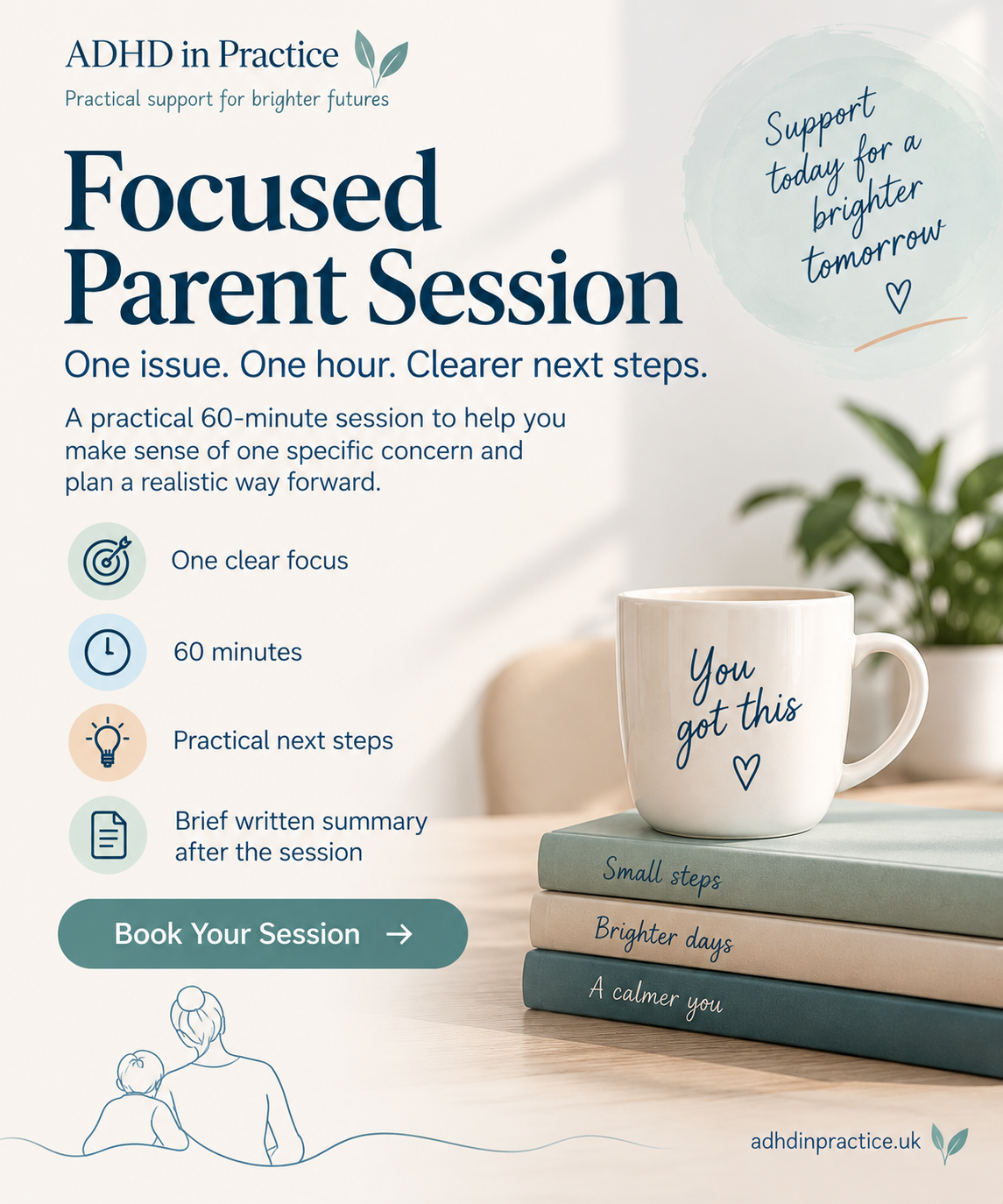
This is a 60-minute session for one clearly defined issue. We focus on the problem in front of you, work through what may be happening and identify practical next steps you can actually use.
£135 | 60 minutes | One issue | Clear next steps
Sometimes you do not need a full review of everything.
You may have one problem that keeps circling in your head.
Perhaps mornings are becoming impossible.
Perhaps your child is falling apart after school.
Perhaps school keeps saying they are fine.
Perhaps you have a meeting coming up and you are not sure what to ask for.
Perhaps you are stuck between “wait and see” and “something needs to change”.
The Focused Parent Session is designed for exactly that.
This is a practical 60-minute session centred on one clearly defined issue. Zoom or telephone call.
We will look at what is happening, what may be underneath it, what has already been tried and what would be most useful to do next.
This is not a full document review, EHCP review or wider case analysis.
It is a focused space to stop going round in circles and work out the next sensible step.
This may be right for you if...
You are dealing with one main concern and need help thinking it through.
That might be school morning distress, after-school dysregulation, masking, friendship difficulties, a difficult school conversation, reduced attendance, behaviour that does not make sense or simply not knowing what to do next.
You may already have spoken to school and still feel unclear.
You may have received lots of advice but no actual plan.
Or you may simply need an experienced outside view to help you separate what matters now from everything else competing for your attention.
What the session includes
Before the session, you will be asked to identify the one issue you most want help with and provide a short summary of what has been happening.
During the session we will explore the pattern, identify what may be contributing to the difficulty and look at what is realistic for home and school.
The focus is practical.
Not pages of theory.
Not another list of things you “should” be doing.
We will work towards a small number of useful next steps that fit your child and your situation.
After the session, you will receive a brief written action summary so you are not left trying to remember everything we discussed.
You will leave with
A clearer understanding of what may be happening.
A better idea of what needs attention first.
A small number of practical next steps.
Clearer wording for what to say or ask if school is involved.
And, importantly, less of that feeling of:
“I know something is not right, but I do not know what to do with it.”
This session is not designed for
Extensive document review.
EHCP evidence analysis.
Appeal preparation.
Complex multi-agency cases.
Or situations where several issues need to be worked through in depth.
If your situation is broader or more complex, the full Parent Clarity Consultation is likely to be the better fit.
Focused Parent Session
60 minutes
£135
Includes a brief written action summary after the session.
One issue.
One clear focus.
One practical way forward.
Online parent support across the UK, school and EHCP guidance focuses on England.
What parents say
-
"I was completely lost with the EHCP process and didn’t know what evidence mattered. Janine helped me organise everything, understand what school should be providing and prepare for the next meeting. I finally felt like I knew what I was asking for and why."
Emma, mum of a 7-year -old girl
-
"I finally understood what the EHCP process actually needed."
Jo, mum of 9 year old girl
-
"My son was in Year 6 and we were worried about the move to secondary school. Janine helped us look closely at his EHCP, identify what was too vague and prepare the points we needed to raise at review. It made the transition feel far more manageable."
Claire, mum of an 11 year old, boy
-
"By college, we had years of reports and reviews behind us, but support was starting to be reduced even though the needs had not disappeared. Janine helped me make sense of the paperwork, challenge what didn’t reflect my daughter’s current needs and go into the review much better prepared."
Sarah, mum of a 17 year old girl

A calm, no-pressure conversation giving you time to explain what is happening and work out what your next step could be.
This call is for parents, grandparents and carers of children with any diagnosed or suspected SEND—not only ADHD.
Your child may be experiencing difficulties connected with autism, dyslexia, dyscalculia, anxiety, sensory needs, communication, learning, school attendance, emotional regulation or executive functioning. They may have several overlapping needs, or no diagnosis at all.
Children’s needs rarely arrive in neat, separate boxes. ADHD may overlap with autism, dyslexia, anxiety or sensory differences. A dyslexic child may also experience frustration, emotional overwhelm, shutdowns or meltdowns when learning demands repeatedly exceed the support available.
This is not a sales call. There is no hard pitch, no awkward pressure and absolutely no “book before midnight” nonsense.
During the call, we can talk about your main concern which could be:
what is worrying you most right now;
what is happening at home, at school or both;
the difficulties or patterns you have noticed;
whether learning needs, masking, anxiety, sensory overload or emotional regulation may be part of the picture;
questions you may need to ask school, your GP, CAMHS or an assessment service;
which SEND, NHS or school-support pathway may be worth exploring;
whether ADHD in Practice is the right fit for your family.
Your child may already have a diagnosis, be waiting for an assessment or simply have you thinking, “Something isn’t adding up.”
You do not need to arrive knowing the correct terminology. You do not need to decide whether it is ADHD, autism, dyslexia or something else before speaking to me.
Just tell me what is happening. We can begin there.
BOOK A FREE 15-MINUTE CALL
Start with a totally free introductory call
A quick, no-pressure phone call to talk through what feels hardest right now and what your next step could be.
We are not going to change the world in 15 minutes but we can make a sensible start.
No judgement. No sales pitch. Just practical ADHD and SEND support for UK parents who need clarity.