
Why Your Child Can't "Just Get Ready" — And What Actually Helps
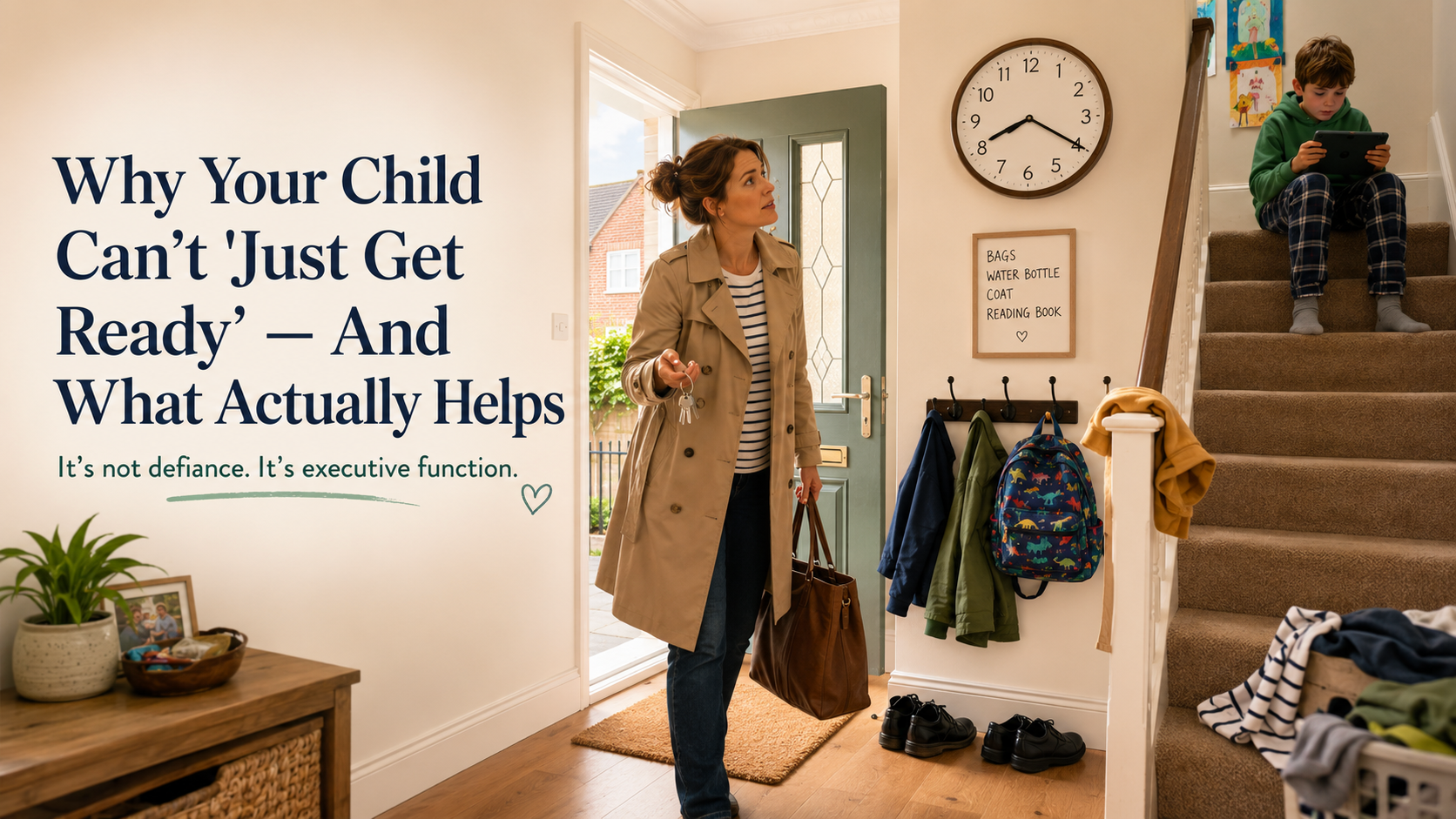
If you've ever found yourself standing at the front door, car keys in hand, quietly unravelling, while your child is still upstairs doing something entirely unrelated to putting their shoes on — this one's for you.
It's not defiance. It's not laziness. And it's definitely not a reflection of your parenting. What you're watching is a brain that genuinely struggles with the invisible scaffolding most of us take for granted: executive function.
What on earth is executive function?
Think of executive function as the brain's air traffic control system. It manages time, plans sequences, initiates tasks, regulates emotions, and switches smoothly between activities. In children with ADHD, this system is running about two to three years behind their chronological age — a finding consistently supported by research from Professor Russell Barkley, one of the world's leading ADHD researchers.
That means your ten-year-old's ability to self-organise is closer to that of a seven-year-old. Knowing that doesn't fix the school run, but it does reframe it considerably.
Why transitions are the real villain
Transitions, moving from one activity to another, are executive function in its most demanding form. Your child has to notice time is passing - what does time mean to a child with ADHD? They need to mentally disengage from what they're doing, hold the next task in mind, and initiate the shift. That's four separate cognitive steps, each one a potential derailment point for an ADHD brain.
A 2023 study published in the Journal of Attention Disorders found that children with ADHD showed significantly greater difficulty with task-switching compared to neurotypical peers, particularly when moving away from high-interest activities. (Translation: dragging them off Minecraft is neurologically hard, not just behaviourally inconvenient.)
What actually helps — practically
The good news is that structure works. Not as punishment or control, but as external scaffolding that replaces the internal scaffolding their brain hasn't yet built.
A few evidence-based approaches that make a genuine difference:
Transition warnings — give a five-minute warning before any change. Then two minutes. The ADHD brain doesn't track time intuitively, so you're lending yours.
Visual routines — written or picture-based checklists remove the need for your child to hold a sequence in working memory. What looks basic is actually neurologically generous.
First-then framing — "First shoes, then tablet" is a complete sentence. It's clear, predictable, and doesn't require negotiation. Brevity is a kindness here.
Consistent anchors — the same order, same place, same time, every day. Predictability reduces the cognitive load of every morning. If Tuesday looks different to Monday, that's already expensive for an ADHD brain.
And one thing that rarely helps
Telling them to try harder. Or reminding them again. Or taking away privileges for something that is, at its root, a neurological difference rather than a choice. Not because boundaries don't matter — they absolutely do — but because willpower cannot override a developmental gap. You wouldn't ask a child with poor eyesight to just look harder.
The most effective thing you can do is build the environment around your child rather than waiting for your child to rise to the environment. It requires more from you in the short term. It pays back considerably in the medium term.
And on the days it doesn't? The front door will still be there tomorrow.
Janine is the founder of ADHD in Practice and a former SENCo with over 30 years' experience. She works with parents navigating the UK SEND system — practically, honestly, and without the toxic positivity.
Free ADHD guidance for UK Parents - claim your free guides
