
What Should I Do When My Child With ADHD Has Emotional Meltdowns After School?
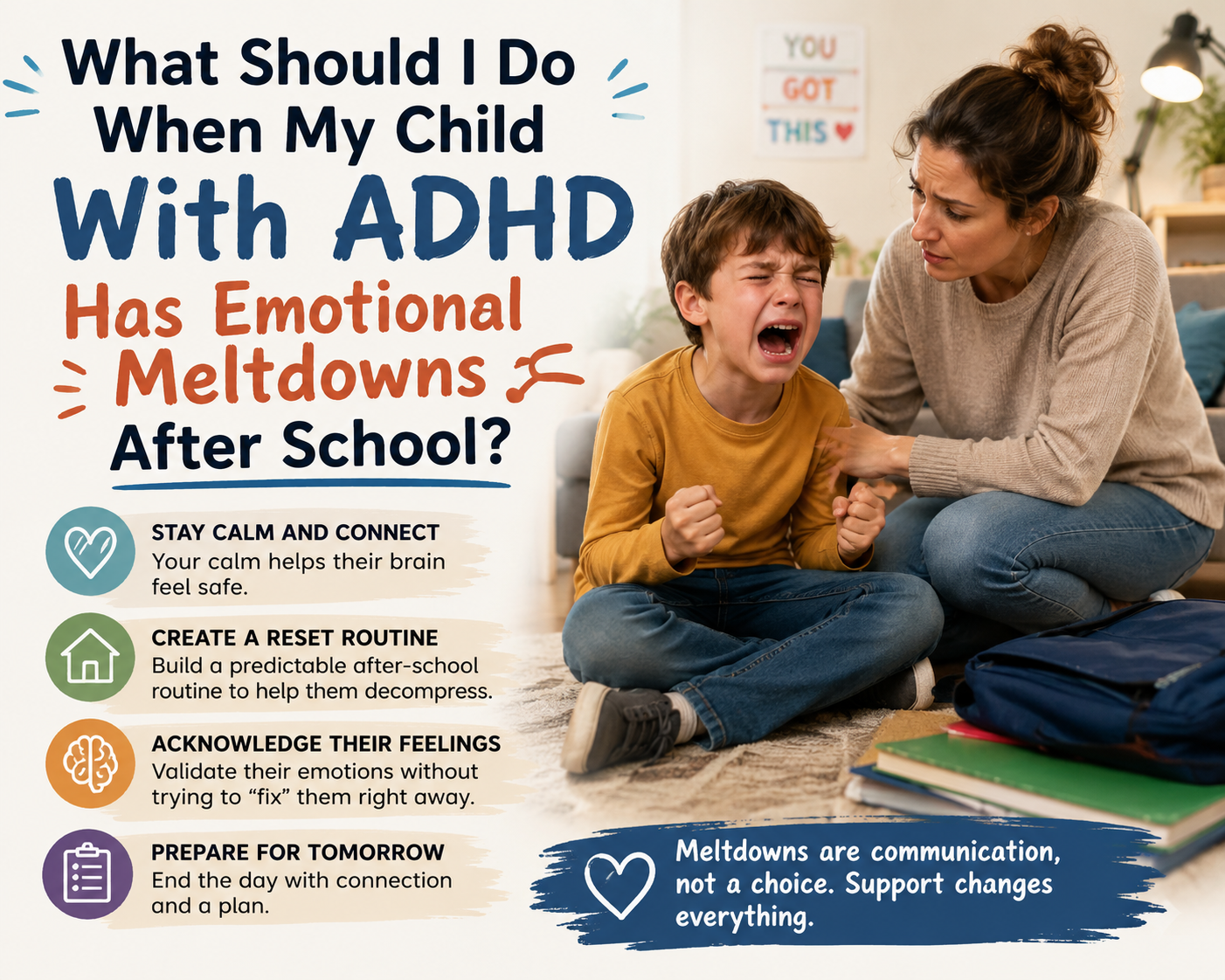
It is 3.45pm.
You have been looking forward to seeing your child all day. You have mentally prepared a snack. You have rehearsed a calm, warm greeting. You are going to have a nice afternoon.
They get in the car. You say "how was your day?"
Forty-five seconds later someone is screaming, someone is crying, and you are genuinely unsure how you got here.
Welcome to the 3.45pm witching hour. Population: every parent of a child with ADHD.
If this is your daily reality, this post is for you. Not the version where someone tells you to "stay calm and use a soft voice" — though we will get to that — but the real version. The one that acknowledges this is genuinely hard, happens for real neurological reasons, and can be made better with the right understanding and the right toolkit.
First: What a Meltdown Actually Is
Let's be precise about language, because it matters.
A meltdown is not a tantrum.
A tantrum is goal-directed behaviour. A child having a tantrum wants something and is using emotional escalation to get it. It is manipulative in the true sense — not maliciously, but strategically. A tantrum has an audience and a purpose.
A meltdown is a neurological event. It happens when the brain's emotional regulation system is overwhelmed and the prefrontal cortex — the thinking, reasoning, decision-making part of the brain — goes offline. There is no strategy. There is no goal. There is just a nervous system that has hit its limit and cannot cope.
The difference matters because the response is different.
A tantrum can be managed with boundaries, consistency, and not giving in to demands.
A meltdown cannot be reasoned with, bargained with, or disciplined out of existence — because the part of the brain that does reasoning and responding to discipline is not currently available. You are talking to the smoke alarm. It cannot hear you.
Why After School Is the Danger Zone
We covered this in depth in the companion post — Why Is My Child Fine at School But Falling Apart at Home? — but the short version is this.
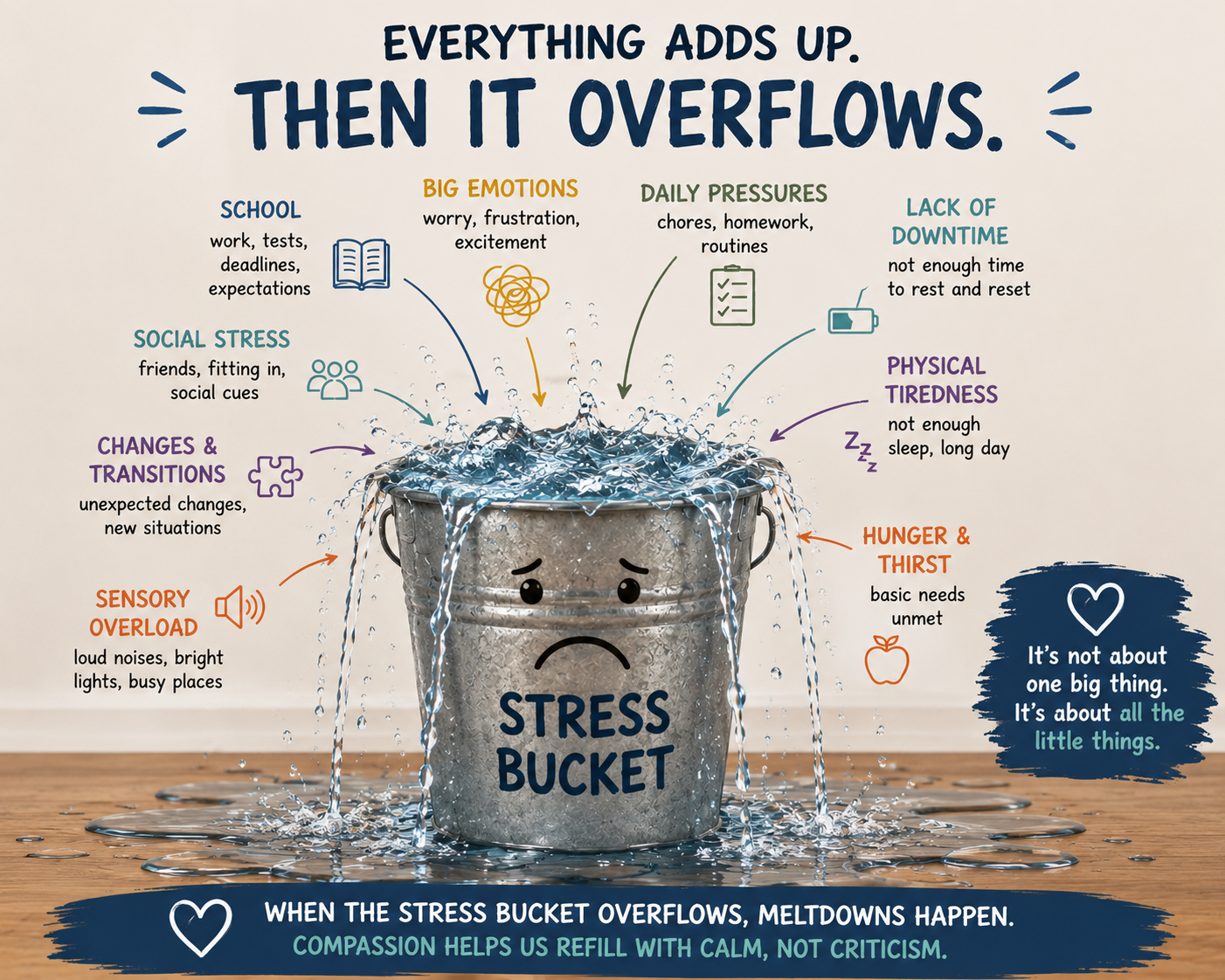
Your child has spent six hours doing something neurologically expensive. Every act of self-regulation — sitting still, waiting their turn, not saying the thing they desperately wanted to say, managing the noise of the corridor, coping with the unpredictability of the playground — costs executive function resources that ADHD brains have less of to begin with.
By 3.15pm, the tank is empty.
They have been holding the lid on all day. You are safe. You are trusted. The lid comes off.
This is not bad parenting. This is not your child being deliberately horrible to you. This is your child choosing, on a neurological level, to fall apart in the one place they feel safe enough to do so.
That is actually a sign of secure attachment. It does not feel like it. But it is.
Part One: In the Moment — What to Do When It's Happening
Step 1 — Stop talking
This is the hardest thing and the most important thing.
When a child is in meltdown, language processing is significantly impaired. They are not taking in what you are saying. More words make it worse. Your voice — however calm and measured — is additional sensory input hitting an already overwhelmed nervous system.
Stop. Talking.
This does not mean abandoning them. It means staying present without adding to the noise.
Step 2 — Reduce everything
Noise, light, demands, other people, other children, the television, the radio — reduce all of it. The nervous system is in crisis. The goal is to reduce incoming stimulation, not add to it.
If you are in a public place, get out of it. A car, a quiet corner, outside — anywhere with fewer inputs.
Step 3 — Stay regulated yourself
I know. I know.
But here is the science. The nervous system is contagious. When a dysregulated nervous system is in proximity to a calm one, the calm one pulls the dysregulated one toward it. This is called co-regulation and it is the most powerful tool you have.
Your child cannot regulate themselves right now. They need to borrow your regulated nervous system to do it.
This is why "staying calm" is not just a platitude — it is a physiological intervention. Your slow breathing, your quiet presence, your lack of escalation is actively helping their brain come back online.
It takes practice. It takes time. It is worth every bit of both.
Step 4 — Safety only, not discipline
During a meltdown your only job is safety. Yours and theirs.
Do not attempt consequences. Do not threaten. Do not reason, explain, or lecture. Do not bring up what happened at school or what needs to happen next.
All of that comes later — when the prefrontal cortex is back online and the conversation can actually land.
Step 5 — The comeback
Meltdowns end. They always end - eventually - patience. And the moment after is important.
Reconnect before you problem-solve. A hug, a quiet moment together, a drink and a snack — connection before correction, always. The relationship is the foundation everything else is built on. Protect it even when — especially when — it has just been tested.
Free ADHD Metdown guidance for UK Parents - claim your free guides
