
How to Advocate for Your ADHD Child at School - Part 1
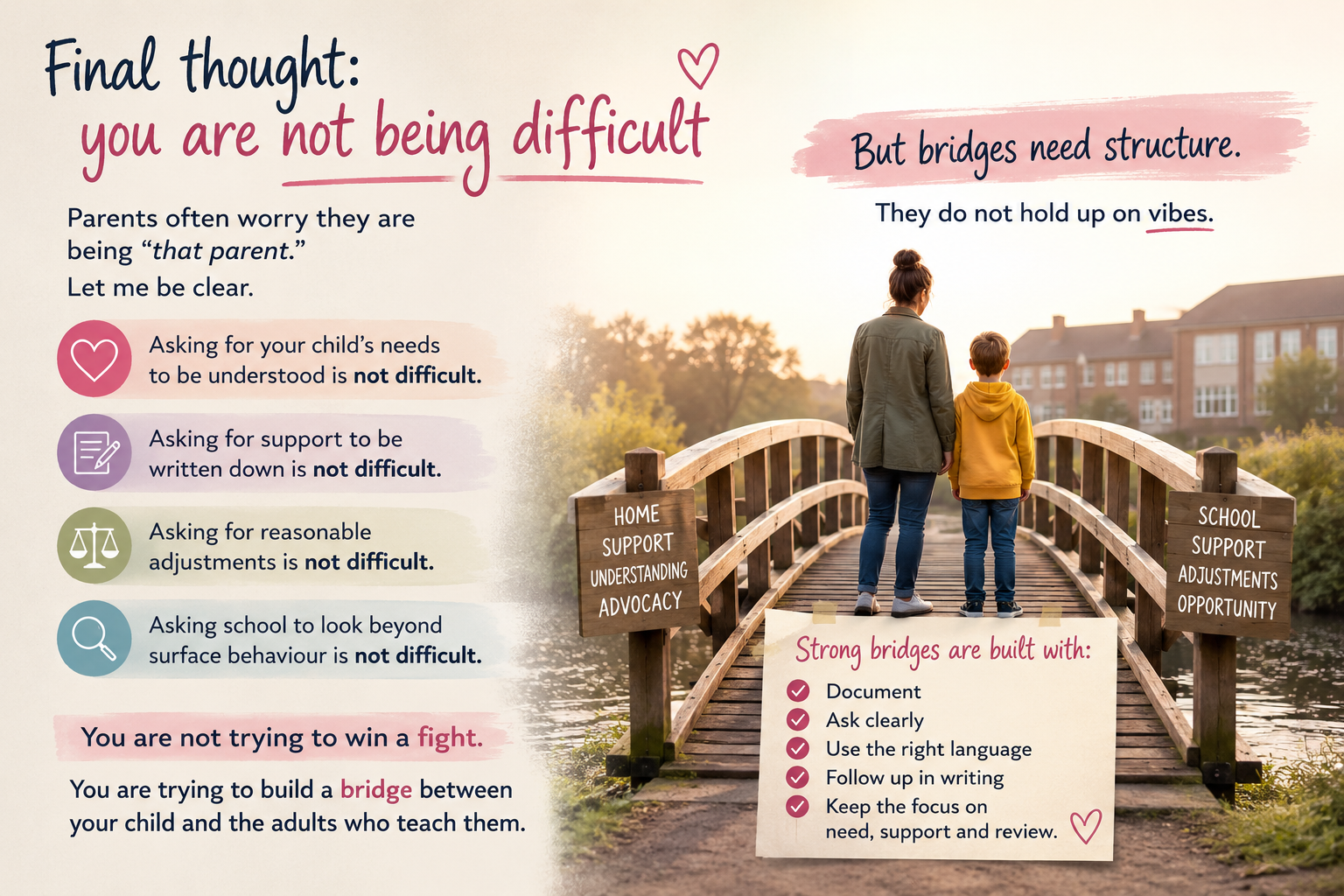
How to Advocate for Your ADHD Child at School: Part 1
What do you say when school insists "they're fine here"?
And how do you turn that into support that actually gets written down?
If you're parenting an ADHD child, chances are you've already had this exact conversation. The one where you explain that your child is melting down at home, refusing homework, losing sleep, crying before school, exploding once the mask finally comes off, or saying things that make your stomach drop.
And school says: "They're fine here."
There it is. The sentence that leaves parents feeling like they walked in with evidence and walked out holding a bag of invisible soup.
Because your child may genuinely look fine in school. Polite. Quiet. Bright. Funny. Helpful. Not "on the radar." Not disruptive. Not behind enough to worry anyone, not loud enough either.
But fine in school doesn't always mean fine.
For a lot of ADHD children, particularly the ones who mask, comply, people-please, or bury their distress rather than show it, school only ever sees the surface. Home gets the fallout.
This post will walk you through how to advocate for your ADHD child at school: what to document, what language actually lands, how to ask for support, and how to push back when your concerns get minimised. It won't hand you a full personalised script, because that has to be built around your child, your school, and what you're actually asking for. What it will give you is the groundwork, so you can walk into the conversation clearer, calmer, and considerably harder to brush off.
Need the exact words for your school meeting? See my personalised school meeting scripts here.
Why does advocating for your ADHD child feel so exhausting?
Parents are often told to "work with school," which sounds perfectly reasonable. In practice, it can feel like trying to stay calm while someone explains that your child can't possibly be struggling because they once completed a worksheet on Victorian drainage without incident.
ADHD isn't always obvious in a classroom. It can show up as difficulty starting work, emotional overwhelm, losing equipment, forgetting instructions, messy or inconsistent output, calling out, daydreaming, anxiety, perfectionism, friendship struggles, after-school meltdowns, school refusal, homework battles, low self-esteem, or plain exhaustion from holding it together all day.
Some children externalise their distress. Everyone sees it. Others internalise it, and nobody sees it until home. That's exactly why parent evidence matters. Not because parents are being dramatic, but because parents are usually the ones seeing the part of the iceberg school never does.
Why document patterns instead of single incidents?
One of the most useful things you can do is start a simple record. Not a colour-coded filing system with its own postcode, just a clear log of what's actually happening.
For each entry, note what happened, when, what came before it, what your child said, how long it lasted, what helped, and how it affected school, sleep, eating, homework, or family life.
For example:
"Monday. Refused school after PE day. Said they felt sick. Later admitted they were scared because they'd forgotten their kit twice before and thought the teacher would be angry. Took 50 minutes to leave the house."
That carries far more weight than "they hate school." Both might be true, but the first gives school something specific to actually respond to.
Related read: ADHD after-school meltdowns, why your child falls apart at 3:45pm.
How do you translate home reality into language school will respond to?
This isn't about pretending everything's calm when your kitchen currently resembles a behavioural incident report. It's about translating what's happening at home into the language school is trained to respond to.
Instead of "he kicks off every night because school is too much," try:
"I'm concerned that the demands of the school day are exceeding his capacity to regulate, and we're seeing the impact of that at home."
Instead of "she's falling apart and nobody's listening," try:
"I'm concerned there may be unmet SEND needs affecting her emotional wellbeing and access to learning."
Instead of "you keep saying he's fine," try:
"I understand he may appear settled in class, but the level of distress outside school suggests we need to look at the full picture across both settings."
None of this is about being fake. It's about being effective. Schools tend to respond better when concerns are tied to access to learning, emotional regulation, attention, executive function, reasonable adjustments, SEND support, pupil voice, parent evidence, review dates, and agreed actions.
One phrase worth keeping in your back pocket:
"I'd like us to identify what support is needed, what will be put in place, who will do it, and when we'll review it."
That sentence earns its keep every time.
Does being "bright" mean your child is coping?
One of the most common barriers ADHD parents run into is some version of "but they're very bright."
Lovely. So is a firework. Still needs careful handling.
Being bright doesn't cancel out ADHD. A child can be academically able and still struggle with organisation, starting tasks, written output, remembering homework, emotional regulation, sensory overwhelm, transitions, friendships, self-esteem, anxiety, and fatigue.
You can say:
"I understand my child is academically able. My concern isn't only attainment. I'm also concerned about emotional regulation, organisation, independence, and the cost of getting through the school day."
Or simply: "Being bright may be masking the level of difficulty."
That line does real work, because it reframes the issue. You're not saying your child can't learn. You're saying the way they're currently managing to learn is costing far more than it should.
How do you push back on "they're fine here" without sounding combative?
This is where a lot of parents get stuck, because nobody wants to walk into school like a one-person tribunal. But you also can't let "fine here" close the conversation down.
Try:
"I'm glad they appear settled in school. However, we're seeing significant distress at home. I'm concerned they may be masking during the day and releasing the pressure afterwards. I'd like us to look at the whole child, across both settings."
Or: "The absence of visible disruption doesn't necessarily mean the absence of need."
Or: "I'm not saying school is causing all of this. I'm saying school is part of the picture, and we need to understand why my child copes in one environment and falls apart in another."
That last sentence does the most work of all. It avoids blame, it invites curiosity, and it keeps the focus exactly where it belongs: on the child.
What if you asked school what evidence they're using?
If school tells you your child is fine, ask calmly:
"What evidence are we using to decide that?"
It's a genuinely powerful question, and not an aggressive one. School may be basing "fine" on no behaviour incidents, work completed some of the time, no teacher complaints, decent test scores, polite presentation, or a general absence of disruption.
What that can miss is how much adult prompting is actually needed, whether work is truly independent, whether instructions are understood, how transitions go, what happens after lunch, whether the child ever asks for help, whether they're anxious but quiet, whether homework is causing distress at home, whether friendships are shakier than they look, or whether the child is simply exhausted by home time.
Ask:
"Can we look at attention, task initiation, organisation, independence, emotional regulation, and transitions, not just behaviour incidents?"
That single sentence shifts the whole meeting from "are they naughty?" to "what support do they actually need?" Which is exactly where it should have started.
What does asking for support through the graduated approach actually mean?
In England, schools are expected to follow the SEND graduated approach: assess, plan, do, review. That means identifying the need, planning the support, putting it in place, and then reviewing whether it's working. The SEND Code of Practice sets this out for children and young people with special educational needs.
In plain terms, "we'll keep an eye on it" is not a support plan. It's surveillance with stationery.
Ask:
"Can we agree what will be assessed, what support will be put in place, and when we'll review whether it's working?"
Or: "Can this be recorded as part of the assess, plan, do, review cycle?"
Worth asking school to look at: classroom observations, attention and concentration patterns, work completion, sensory triggers, transition points, emotional regulation, friendship difficulties, homework systems, executive function support, movement breaks, written instructions, check-ins, safe exit strategies, and reasonable adjustments.
You don't need to diagnose the whole thing yourself. You just need to ask school to investigate the need properly.
Part 2 is here: How to Advocate for Your ADHD Child at School, Part 2.
