
"They're Fine at School" and Other Sentences That Make Me Want to Lie Down in a Field
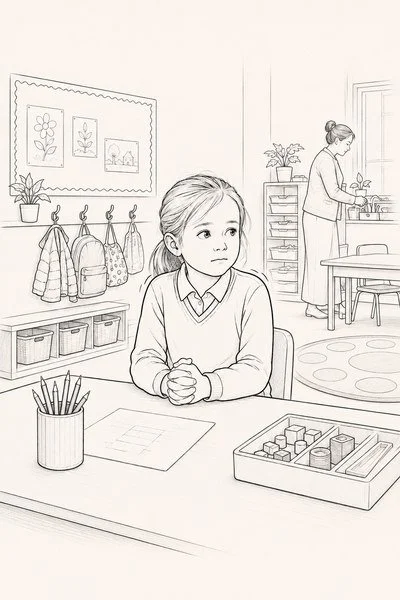
Fine in school!
There is a phrase that, when uttered in a parents' evening, has the same effect on me as a fire alarm going off mid-nap. Three words. Said warmly, often with a slight head tilt, usually while a tiny plastic chair slowly betrays your knees.
"They're fine here."
Fine. There it is. The most loaded four letters in the English language, narrowly beating "BOTH" on a Bargain Hunt scoreboard.
Because what you, the parent, are hearing is: Your child sat quietly, produced acceptable handwriting, and did not bite a teaching assistant. Job done. And what you are living, three hours later at 5:47pm, is a human child melting into the kitchen lino like a Calippo left on a radiator, because you asked them to take their shoes off and apparently that was the final insult in a long and cruel life.
Fine. Sure. Fine like Alan Partridge is "back of the net" relaxed about being moved to a graveyard slot on Radio Norwich. Fine on the outside. Internally, a man eating a Toblerone alone in a Travel Tavern.
The masking thing nobody warns you about
Here is the bit that took me years, two careers, and one late diagnosis of my own to properly understand.
A child holding it together all day at school is not the same as a child who is fine. It is a child running a full-day performance with no interval and no understudy. The technical term, the one you will hear from people like Dr Samantha Hiew of ADHD Girls, is masking: the enormous, invisible effort of looking "regulated" in an environment that demands it, while the actual nervous system is doing the equivalent of holding a beach ball underwater for six hours.
And where does the beach ball come up? Not in the classroom. The classroom is where the mask stays on, because school is the unsafe place to fall apart. Home is the safe one. You are the safe one. Which is a beautiful, devastating compliment delivered at high volume next to the fish fingers.
This is the part that gets missed for so many children, diagnosed or not. The quiet ones. The "no concerns here" ones. The ones who are absolutely shattered by the time they reach the cloakroom and cannot tell you why, because they are seven and the vocabulary for "I have been performing neurotypicality since 8:45" does not appear in a phonics scheme.
Barkley, briefly, because he is right
Russell Barkley, who has done more ADHD research than most people have done blinking, makes a point that reframes the whole thing. ADHD is not a deficit of knowing what to do. It is a deficit of doing what you know at the moment it matters. A performance problem, not a knowledge problem.
So a child can absolutely know the rules, recite the rules, win a certificate for the rules, and still be unable to deliver the rules at 5:47pm when their executive function has clocked off and gone home without them. They are not choosing the meltdown. The meltdown is the bill arriving for a day spent spending energy they did not have.
Which means "they're fine at school" and "they fall apart at home" are not a contradiction. They are the same sentence, told from two ends.
What "the school says they're fine" actually translates to
Let me offer some honest subtitles, the way you'd want for a film where you can't quite catch the dialogue:
"They're no trouble in class" usually means they are masking so effectively that they have become invisible, which is not a win, it is a missed flag.
"They have lots of friends" can mean they are working extremely hard to read every social cue in real time and will be on the floor by teatime.
"They just need to try a bit harder with focus" means nobody in this room has read Barkley and I would gently like to send them a reading list.
And "we don't see that behaviour here" means, more often than not, the safe place is home, and you are doing something right, even though it does not remotely feel like it at 5:47pm.
So what do you actually do
You believe your own eyes. That is the headline. If you are living the after-school fallout night after night, the fact that it is invisible at school is not evidence it isn't real. It is evidence of how hard your child is working to hide it. You are not imagining it, and you are not "creating it at home."
You name the gap, in writing, to the school. Calmly, specifically, with examples. "Fine at school, dysregulated at home" is a recognised pattern, not a parenting failure, and it belongs on the record. The masking is the SEND need, even when the classroom looks calm.
You protect the decompression. The walk home, the silence, the snack, the not-asking-twenty-questions. The transition from mask-on to mask-off needs space, and a child coming down off a full day does not also need a debrief.
And you stop measuring success by whether the explosion happened. The explosion is not the problem to be solved. It is information. It is the beach ball, finally allowed up, in the one place safe enough to let go.
The ADHD Chatter of it all
If you spend any time in the ADHD parenting community, on the ADHD Chatter podcast, in the comments under any post Dr Hiew has ever made, you will find the same story told a thousand ways. Diagnosed, undiagnosed, waiting-list-for-three-years-undiagnosed. The label is not the point. The pattern is the point. And the pattern is real whether or not a clinician has signed it off yet.
So the next time someone tilts their head and tells you your child is fine, you are allowed to smile, say thank you, and quietly know what you know. They are fine there. They are doing the work there. And the falling apart here is not the failure.
It is the safety. It just happens to arrive at 5:47pm, smelling faintly of fish fingers, with the volume turned all the way up.
Back of the net.
