
The Good Girl Who's Quietly Drowning
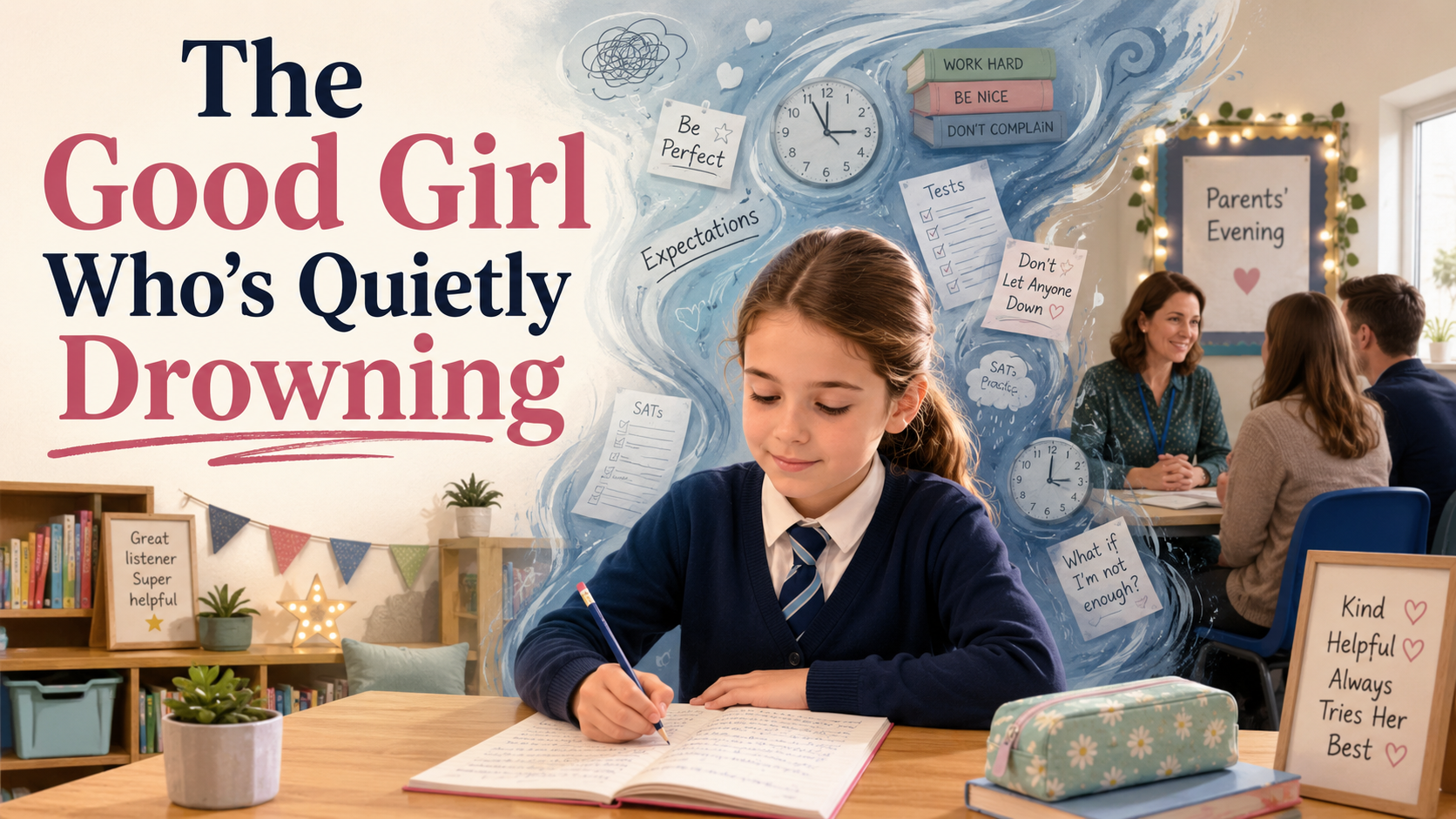
The quiet girl
Let me describe a child, and you tell me if any alarms go off.
She's polite. Her handwriting is the kind that gets held up to the class. She tidies the book corner without being asked. She's "such a help," "a real role model," "no concerns whatsoever." At parents' evening the teacher beams and you get four lovely minutes of nothing to worry about, and you go home and you do worry, because something doesn't add up and you can't say what.
No alarms went off, did they. That's the whole problem. That is the entire post.
The girl who is no trouble is sometimes in the most trouble
Here's the uncomfortable bit. A child who has made it their life's work to be no trouble is not necessarily a child who is fine. Sometimes she is a child who has correctly worked out, very young, that being good is the safest thing she can possibly be, and is now pouring every drop of energy she has into maintaining it.
She watches the room. She tracks what's expected. She gets it right, relentlessly, because getting it wrong feels unbearable. And it works. It works so well that she becomes invisible, and invisible children do not get flagged, do not get assessed, do not get help. They get certificates.
This is masking in its purest form, and it's exactly the territory Dr Samantha Hiew of ADHD Girls has spent years lighting up: the girl whose strategy is to disappear into "fine," who holds it together so completely at school that the need never surfaces where anyone official can see it.
And then 4pm happens
Because the mask doesn't come off for free. It comes off somewhere, and that somewhere is home.
So you get the girl who is angelic for six hours and then comes through the front door and falls apart over the wrong cup, the seam in the sock, the question "how was your day." The collapse looks wildly out of proportion to whatever triggered it, because the trigger isn't the cup. The trigger is six hours of performance finally being allowed to end, in the one place safe enough to end it.
You, by the way, are that safe place. Which is a beautiful thing dressed up as a nightmare, screamed at you next to the fridge.
The criteria were never looking for her
Now here's the part that should make every parent of a quiet girl quietly furious.
The diagnostic criteria for ADHD were built largely from studying young, hyperactive, disruptive boys. The boy climbing the furniture, blurting out, bouncing off the walls. That became the template. That became what ADHD "looks like."
So picture our girl, with her neat book and her helpful nature and her internal world doing seventy miles an hour, being measured against a yardstick shaped entirely around a boy doing the opposite of everything she does. She doesn't climb the furniture. She is the furniture, sitting perfectly still, looking like the model pupil, while inside she's running a marathon nobody can see.
She doesn't match the photo. So she gets turned away at the door, year after year, and the bill arrives later, often much later, as anxiety, as perfectionism, as a woman in her forties finally getting assessed, usually after her own child does. Hiew talks about this often, and it's true: late diagnosis in women isn't a quirk, it's a direct consequence of criteria that were never built to find them.
The dress code was written for someone else, and she's been turned away her whole school life for not matching a picture she was never in.
"But she's doing so well"
This is the sentence that keeps her stuck. Because by every visible measure, she is doing well. Good marks, good behaviour, good as gold.
But "doing well" measured by output tells you nothing about the cost of producing it. A child can hit every target and be running on empty to do it. The achievement and the struggle are not mutually exclusive. They're the same girl, and the achievement is sometimes built on the struggle: the perfectionism that's driving the lovely handwriting is the same perfectionism that's grinding her down.
When the only evidence anyone accepts is the output, the child who produces good output gets the least help and works the hardest for it. That's not a system working. That's a system rewarding the disappearing act.
What actually helps
Believe the home version. If she's calm at school and shattered at home, that gap is not a contradiction to be explained away. It's the single biggest piece of evidence you have, and it's evidence of how hard she's working, not proof she's fine.
Watch the cost, not just the output. Tiredness that doesn't match the day. Perfectionism that tips into distress over tiny mistakes. Stomach aches on school mornings. A child who unravels the second she's somewhere safe. These are the readouts the certificate can't show you.
Put it in writing to school, and put the masking in the words. "Coping at school, dysregulated at home" is a recognised pattern, not a parenting failure, and "no concerns here" is not the same as "no need here." Ask the question directly: could this be ADHD presenting quietly, rather than nothing at all.
And protect the landing. The girl coming home from a full day in the mask needs space to take it off, not a debrief. The snack, the silence, the not-twenty-questions. Let the mask come off gently, because the alternative is it coming off like a fire alarm.
She is not fine because she's good. She might be good because she's terrified of not being fine. Those are very different children, and only one of them gets noticed.
