
What is an EHCP and How Do I Apply?
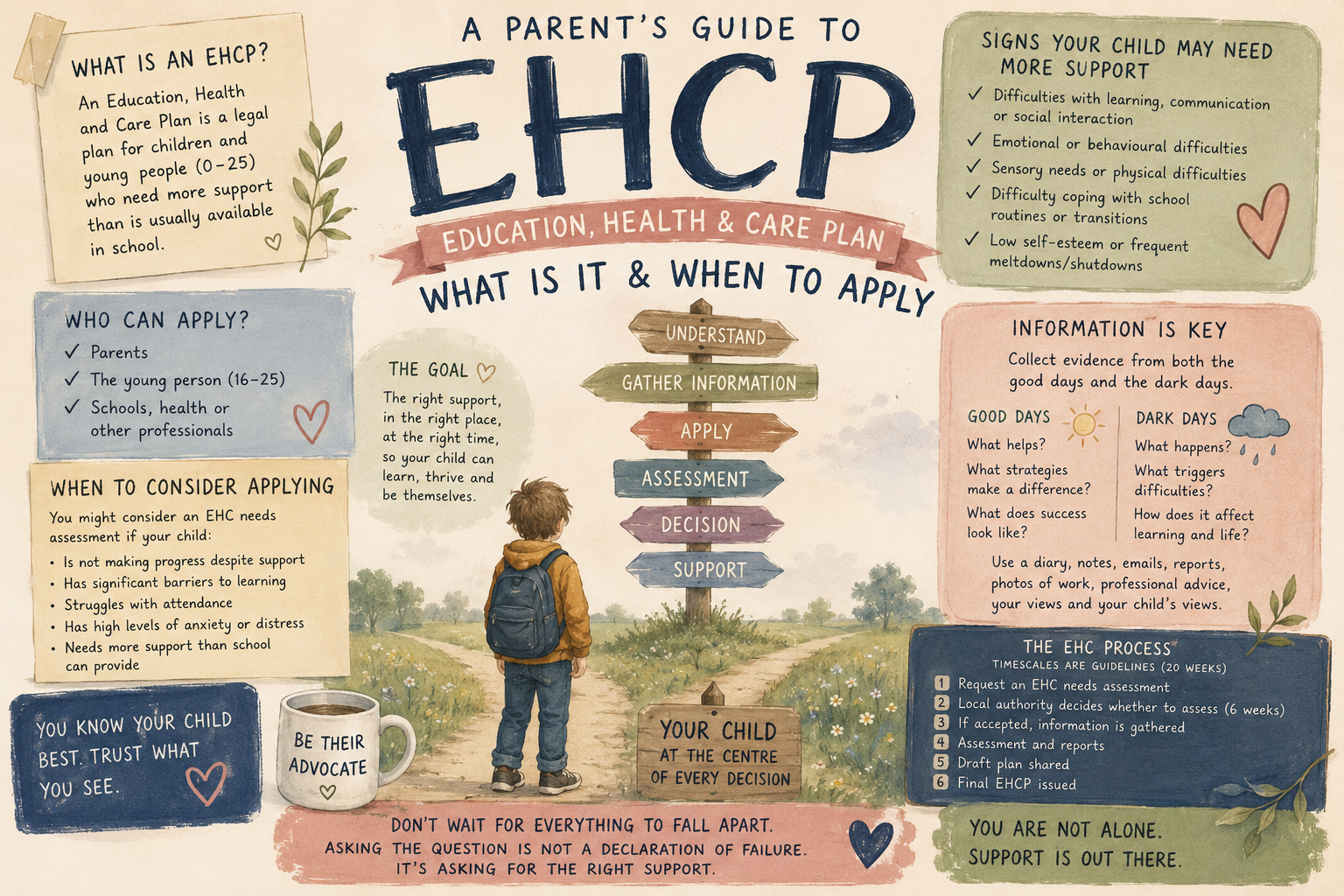
EHCP the process
Published on adhdinpractice.uk | By Janine Nesbitt — SENCo, ADHD Coach & Late Diagnosis Advocate
Four letters that can change everything.
Or four letters that can feel like banging your head against a wall for two years while your child falls further behind and nothing happens.
Which version you experience depends, in large part, on whether you understand the process — what an EHCP actually is, what it does, how to apply for one, and what to do when the local authority says no.
This post is the honest guide. Not the official version. The version a SENCo who has written hundreds of these, sat in hundreds of review meetings, and also fought for her own child's needs would tell you.
What an EHCP Actually Is
An Education, Health and Care Plan is a legal document.
Not a form. Not a recommendation. A legally binding document that sets out:
Your child's special educational needs
The outcomes they are working toward
The specific provision that must be put in place to meet those needs
Who is responsible for providing it
The word "must" is important. Once provision is written into an EHCP it is a legal requirement. School must provide it. The local authority must fund it. It cannot be quietly dropped when budgets are tight.
This is why an EHCP is worth fighting for when your child genuinely needs one. And it is why local authorities are reluctant to issue them.
An EHCP is not a diagnosis. You do not need a diagnosis to apply for one. You do not need school's permission to apply for one. You need evidence of need — and the right application.
Who Needs an EHCP
Not every child with ADHD needs an EHCP. Some children's needs are met effectively through SEN support — the provision available within school without an EHCP.
An EHCP should be considered when:
SEN support is not sufficient — the child is receiving support but not making adequate progress
The child's needs are complex — multiple areas affected, co-existing conditions, significant impact on daily functioning
The child requires provision that school cannot resource without additional funding
The child is at risk of exclusion, school refusal, or significant deterioration in wellbeing
Transition is approaching — particularly primary to secondary — and the level of need is likely to increase
The threshold for an EHCP is not about how severe the diagnosis is. It is about whether the child's needs can be met without one.
A child with a mild ADHD diagnosis and significant co-existing needs may require an EHCP. A child with a more complex diagnosis who is thriving with good school support may not — yet.
The Two Big Changes Coming — and Why 2029 Matters
Before we go into the application process, you need to know this.
The SEND system in England is under significant review. The government has announced reforms to the SEND framework with changes expected to come into effect around 2026–2029.
What this could mean:
The current system — widely acknowledged to be underfunded, inconsistently applied, and adversarial — is being restructured. The intention is to create a system where more children's needs are met earlier through improved mainstream provision, reducing the volume of EHCP requests.
What this means in practice for parents right now:
If your child needs an EHCP — apply now. Do not wait for the new framework to arrive. The transition period will be chaotic. Children with existing EHCPs will have greater security than children entering the system mid-reform.
The EHCP is already difficult to obtain. The new framework may change the threshold, the process, and the rights attached to it. What those changes look like in practice is not yet fully clear — and that uncertainty alone is a reason to act rather than wait.
The Application Process — Step by Step
Step 1 — The Request
Anyone can request an EHC needs assessment — parents, schools, or other professionals. You do not need school's agreement.
To request: Write to your local authority — specifically to the SEND department or the EHC team — requesting an EHC needs assessment for your child.
Your letter should include:
Your child's name, date of birth, and school
A brief description of their needs and why you believe they meet the threshold for assessment
The evidence you are attaching — reports, school records, your parental statement
Send it by email and keep a copy. The date of your request starts the legal clock.
The local authority has 6 weeks to decide whether to carry out an assessment.
Step 2 — The Decision to Assess
The local authority will decide whether to carry out a needs assessment. They will consider whether it is necessary to determine whether an EHCP is needed.
If they agree to assess: The formal assessment process begins. They will gather information from parents, school, and relevant professionals — educational psychologist, health, and social care where relevant.
If they refuse: You have the right to appeal to the SEND Tribunal. More on this below.
Step 3 — The Needs Assessment
The assessment involves gathering evidence from multiple sources:
Your parental views — this is your chance to set out in full what your child's needs are, how they present at home, what the daily impact is, and what you believe they need. This section matters more than most parents realise.
School's evidence — their observations, the support that has been in place, the progress or lack of it, their professional view of the child's needs.
Educational Psychologist assessment — an EP will assess your child directly. They will observe them in school, carry out cognitive and learning assessments, and write a detailed report.
Health evidence — relevant medical reports, reports from CAMHS, paediatric assessments, or other health professionals involved with your child.
Other evidence — speech and language therapy reports, occupational therapy assessments, any other professional involved with your child.
Step 4 — The Draft EHCP
If the local authority decides an EHCP is needed, they will produce a draft plan. You will receive a copy and have 15 days to comment.
Read it carefully. Challenge anything that is vague.
The most common mistake at this stage is accepting woolly language. Provision in an EHCP must be specific and quantifiable — not "access to support as required" but "one hour of 1-to-1 support from a qualified teaching assistant, three times per week, focused on reading fluency."
Vague provision is unenforceable. Specific provision is a legal requirement.
If the draft does not reflect your child's needs accurately — respond in writing, with specific proposed changes, and keep a copy of everything.
Step 5 — The Final EHCP
The final EHCP must be issued within 20 weeks of the original request.
Once issued it must be reviewed at least annually — the Annual Review. The purpose of the Annual Review is to assess progress toward outcomes and amend the plan if needed.
Annual Reviews matter. Do not treat them as a formality. They are an opportunity to update provision, add emerging needs, and strengthen the plan. Come prepared.
Your Parental Statement — The Most Important Thing You Write
The parental views section of an EHCP application is the part most parents underestimate and most local authorities underuse.
It is your opportunity to tell the complete story — not just the school story, but the home story. The morning story. The 4pm story. The weekend story. The story nobody else sees.
What to include:
The impact on daily life — not just learning. Friendships, sleep, family relationships, emotional wellbeing, independence.
Specific examples — not "she struggles with transitions" but "every morning getting ready for school takes over an hour, results in significant distress for my daughter and for the family, and she frequently arrives at school having already cried for 45 minutes."
What has been tried — at home and at school, what strategies have been attempted and what has happened.
Your child's strengths — an EHCP is not just a list of deficits. The strengths section matters for outcomes.
Your child's voice — what do they say about school? What do they find hard? What helps? If they are old enough to contribute, include their words.
The co-existing picture — if your child has multiple diagnoses or suspected additional needs, set them out clearly and explain how they interact.
The gap — what is the gap between what your child currently receives and what they need?
Write it in your own voice. Do not try to make it sound clinical. The personal, specific, evidenced account is more powerful than anything written in professional language.
When the Local Authority Says No
Local authorities refuse a significant proportion of EHCP requests. The refusal is not always the end.
Reasons commonly given for refusal:
Needs can be met through SEN support
Insufficient evidence of need
Progress is being made
What to do:
Request the reasons in writing — if you haven't received a detailed written explanation, ask for one.
Appeal to the SEND Tribunal — you have the right to appeal a refusal. The Tribunal is independent of the local authority and parents win a significant proportion of appeals. The process takes time but it is worth pursuing if your child genuinely needs an EHCP.
Get independent support — IPSEA (Independent Provider of Special Education Advice) provides free legal advice and support for families navigating the SEND system. SOS!SEN and the National Autistic Society also provide support.
Build more evidence — if the refusal is based on insufficient evidence, identify the gaps and fill them. A private educational psychology report, an occupational therapy assessment, or detailed parental evidence may strengthen a second application.
The Difficulty of Getting an EHCP — Honestly
I am going to be straight with you.
The EHCP process is difficult. It is slow. It is inconsistently applied across local authorities — the same child in two different counties may have completely different experiences. It is frequently adversarial — the system is underfunded and local authorities are under enormous financial pressure.
The families who get through it most effectively are not always the families with the most complex children. They are the families with the most evidence, the clearest applications, and the most persistent advocacy.
This is not fair. It should not be this way. A child's access to support should not depend on their parents' capacity to navigate bureaucracy.
But it is the reality of the system as it exists right now. And knowing that reality is the first step to navigating it.
How I Can Help
The EHCP process is one of the areas where expert support makes the most difference. Not because the system is impossible to navigate alone — but because knowing what to write, how to write it, and what the local authority is actually looking for can fundamentally change the outcome.
I offer:
EHCP Guidance Sessions — understanding the process, what evidence you need, and what your next steps are.
Parental Views Support — writing or substantially strengthening your parental views statement.
Full EHCP Application Support — end to end support through the entire application.
School meeting preparation — knowing what to say, how to say it, and what to ask for before you leave the room.
If you want to talk through where you are in the process:
Book your free 15-minute introductory call
No cost. No obligation.
Janine Nesbitt is a UK ADHD Coach, SENCo specialist with 34 years' experience, and late-diagnosed adult. Everything here is UK-specific, evidence-based, and written without toxic positivity or American frameworks.
Useful links: IPSEA (ipsea.org.uk) | SEND Tribunal (gov.uk/courts-tribunals/first-tier-tribunal-special-educational-needs-and-disability) | SEND Code of Practice (gov.uk)
