


Understanding what ADHD really is — and what it isn't
Practical guidance for parents from a former SENCo, dyslexia specialist and ADHD coach with 34 years of experience supporting children and families.
Button:
Start Understanding ADHD
If you've landed here, you're probably trying to make sense of things
Maybe your child:
forgets everything
loses everything
melts down over tiny things
never stops moving
seems constantly exhausted
struggles with friendships
appears fine at school but falls apart at home
Or perhaps somebody has mentioned ADHD and you're wondering whether that's really what is going on.
The truth is ADHD is one of the most misunderstood conditions in childhood.
It isn't a parenting problem.
It isn't caused by too much sugar.
It isn't laziness.
And it certainly isn't a child choosing to be difficult.
What Is ADHD?

Attention: More Than Just Paying Attention
One of the biggest myths about ADHD is that children cannot pay attention.
Most parents know that isn't true.
The same child who forgets three instructions before they've reached the kitchen can spend two hours building Lego, researching dinosaurs, learning football statistics or watching YouTube videos about their latest obsession.
The problem is not a lack of attention.
The problem is regulating attention.
Think of attention as a spotlight.
Most people can move that spotlight where they need it to go.
Children with ADHD often struggle to control it.
Sometimes the spotlight shines too brightly and becomes locked onto something interesting. This is often called hyperfocus.
At other times the spotlight jumps from one thing to another, especially when the task feels boring, difficult, repetitive or emotionally unrewarding.
This is why ADHD can look so confusing from the outside.
A child may appear capable one moment and completely unable to focus the next.
Parents are often told:
"But they can focus when they want to."
The reality is usually very different.
ADHD is not about choosing what to focus on.
It is about struggling to regulate attention consistently.
Research increasingly suggests that attention difficulties are closely linked to emotional regulation.
Children naturally pay attention to things that carry emotional importance.
Excitement, curiosity, novelty, urgency and interest can pull attention in.
Boredom, frustration, uncertainty and anxiety can push attention away.
This is why many children with ADHD seem highly motivated in some situations and completely overwhelmed in others.
The issue is rarely intelligence.
It is rarely effort.
More often, it is a brain that finds it difficult to regulate where attention goes, how long it stays there and how easily it can move on.
Understanding this changes everything.
Instead of asking:
"Why won't they pay attention?"
We start asking:
"What is making it hard for them to regulate their attention right now?"
That question often leads to much more helpful answers.

Impulsivity: When Thoughts Move Faster Than Brakes
Impulsivity is often misunderstood.
People imagine a child bouncing off walls, taking risks or constantly getting into trouble.
Sometimes that happens.
But impulsivity is much bigger than that.
At its heart, impulsivity is about timing.
It is the difficulty creating a pause between a thought, an emotion and an action.
For most people, the brain automatically asks:
"Should I say that?"
"Should I do that?"
"Is this a good idea?"
Children with ADHD often know the answer.
The challenge is that the action can happen before the thinking has fully caught up.
This is why impulsivity can look like:
blurting out answers
interrupting conversations
grabbing before asking
acting on a sudden idea
struggling to wait
taking social risks
speaking before considering consequences
making decisions quickly then regretting them later
It is not usually a lack of understanding.
It is often a lack of pause.
Impulsivity Isn't Always Visible
Many people picture impulsivity as physical behaviour.
In reality, some of the most significant impulsivity happens internally.
A child may:
jump rapidly between thoughts
make snap assumptions
react emotionally before processing information
become overwhelmed by frustration
abandon tasks quickly
struggle to tolerate uncertainty
This is why impulsivity and emotional regulation are so closely connected.
A child may not hit, shout or run.
But they may still experience intense impulsive reactions inside their own mind.
Boys and Girls Often Show Impulsivity Differently
Boys are more likely to show impulsivity in ways adults immediately notice.
This may include:
calling out
excessive talking
physical risk-taking
climbing, jumping and rough play
interrupting lessons
acting before thinking
Because these behaviours are highly visible, boys are often referred for assessment earlier.
Girls frequently show a different pattern.
Their impulsivity may appear as:
saying things they later regret
intense emotional reactions
impulsive friendships
falling out with peers quickly
oversharing personal information
spending impulsively as teenagers
social media difficulties
people pleasing without considering consequences
Many girls learn to suppress visible impulsive behaviour.
What remains is often emotional impulsivity.
The result is that their struggles can be missed because they look less disruptive.
The Emotional Side of Impulsivity
Perhaps the most overlooked aspect of impulsivity is emotion.
A child may know they are overreacting.
They may know the situation is small.
Yet in that moment, the emotional reaction feels enormous.
Research increasingly suggests that emotional impulsivity is one of the most significant challenges experienced by many people with ADHD.
This can look like:
instant frustration
explosive anger
overwhelming excitement
sudden tears
rejection sensitivity
difficulty calming once upset
These reactions are not signs of weakness.
They reflect a nervous system that struggles to regulate emotional responses in real time.
Looking Beyond Behaviour
When we understand impulsivity properly, the question changes.
Instead of asking:
"Why did they do that?"
We begin asking:
"What happened between the feeling and the action?"
That shift is important.
Because impulsivity is rarely about a child choosing to make life difficult.
More often, it is a child whose brain is still learning how to create the pause that many others take for granted.
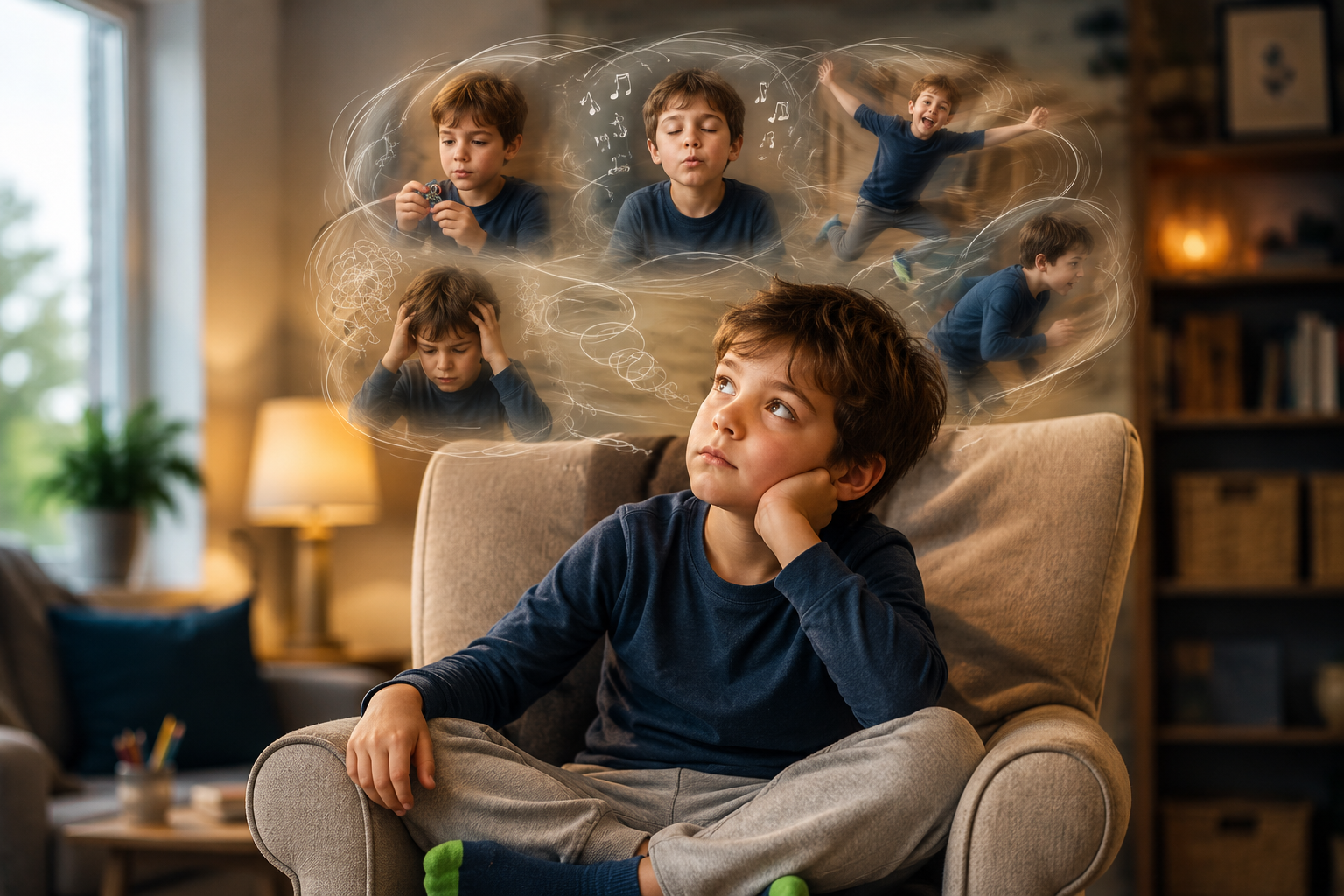
Hyperactivity: More Than Just Movement
When people hear the word hyperactivity, they often picture a child running laps around the classroom, climbing furniture or constantly bouncing from one activity to another.
Sometimes ADHD looks like that.
Often it doesn't.
In fact, some children with ADHD barely move at all.
The real question is not:
"How much is this child moving?"
The real question is:
"How hard is this child working to stay regulated?"
Hyperactivity is not simply about movement.
It is about energy.
It is about a nervous system that often feels permanently switched on.
Many children with ADHD describe feeling as though there is a motor running inside them.
Some show that energy externally.
Others keep it hidden.
Hyperactivity Can Be Loud
Some children:
run everywhere
climb constantly
talk non-stop
fidget continuously
struggle to remain seated
seek movement throughout the day
These are the behaviours most people recognise.
They are also the behaviours most likely to trigger concern from adults.
Hyperactivity Can Be Quiet
Other children appear calm on the outside.
Yet underneath, their minds may be racing.
Hyperactivity can look like:
constant internal chatter
daydreaming
mental restlessness
humming quietly
doodling
hair twirling
tapping feet
chewing sleeves
rocking on a chair
picking at fingers
repeatedly changing position
Many children become experts at disguising these behaviours.
Adults see a child sitting still.
What they do not see is the effort required to stay there.
The Hidden Hyperactivity Of Girls
Girls are often missed because their hyperactivity is less likely to be physical.
Instead it may appear as:
excessive talking
intense emotional reactions
racing thoughts
perfectionism
overthinking
social anxiety
constant mental activity
Many girls learn very early that obvious movement attracts attention.
So they suppress it.
The movement disappears.
The restlessness remains.
This is one reason girls are frequently diagnosed later than boys.
Movement Is Often Regulation
One of the biggest misunderstandings about ADHD is that movement is a problem.
Often movement is actually a solution.
Many children move because movement helps the brain focus.
They swing on chairs.
They fiddle with objects.
They pace while thinking.
They bounce a leg.
They doodle.
They hum.
They seek sensory input.
Adults often see disruption.
The child is often trying to regulate.
Removing all movement can sometimes make concentration harder rather than easier.
The Brain Never Seems To Switch Off
Parents often tell me:
"They never stop."
Sometimes they mean physically.
More often they mean mentally.
The child who cannot sleep because their brain is still discussing dinosaurs, football statistics, Minecraft strategies, friendship worries and what happened at break time is often experiencing hyperactivity too.
The body may be lying still.
The brain is still travelling at 70 miles per hour.
Looking Beyond Behaviour
Understanding hyperactivity changes the conversation.
Instead of asking:
"Why can't they sit still?"
We begin asking:
"What is helping this child stay regulated?"
That shift matters.
Because many ADHD children are not trying to be disruptive.
They are trying to cope.
The movement, the humming, the fidgeting, the talking and even the constant thinking are often signs of a nervous system working hard to find balance in a world that expects stillness.

ADHD Is More Than An Attention Problem
One of the biggest myths about ADHD is that children simply cannot pay attention.
If that were true, they wouldn't spend hours building Lego, memorising football statistics or talking endlessly about their favourite interests.
ADHD is not a lack of attention.
It is a difficulty regulating attention, emotions, motivation and behaviour.
The brain systems responsible for planning, organising, prioritising, remembering, managing emotions and getting started on tasks develop differently.
This is why a child may be highly intelligent yet constantly lose belongings, forget instructions or struggle to complete everyday tasks.
The problem is not ability.
The problem is regulation.
Researchers such as Russell Barkley describe ADHD as a condition affecting self-regulation and executive functioning rather than simply attention.
Many children with ADHD are:
creative
imaginative
curious
energetic
passionate
funny
innovative thinkers
The challenge is not understanding what needs to be done.
The challenge is consistently managing thoughts, emotions, attention and actions in a world that demands these skills every day.
ADHD is not laziness.
It is not poor parenting.
It is a different way of experiencing and navigating the world.



You Don't Need To Work This Out Alone
After 34 years working in schools, I know how confusing ADHD can feel for parents.
Whether your child has a diagnosis, is waiting for assessment, or you're simply trying to understand what is happening, support is available.
Buttons: