

ADHD Emotional Regulation in Children
Big feelings aren't simply bad behaviour. Understanding what is happening underneath can change how you respond.
Children with ADHD can experience emotions quickly, intensely and sometimes for longer than adults expect. Frustration can become fury. Disappointment can feel enormous. A small change can suddenly become impossible.
Emotional dysregulation is common in ADHD, although it is not one of the core diagnostic criteria. Difficulties with impulse control, attention, inhibition and shifting from one state to another can all affect how a child manages emotions.
How can I help you understand those emotions?
Choose support for you, your school conversations or your child. You have to start somewhere. Start with a free 15 minute call.
A calm, no-pressure conversation giving you time to explain what is happening and work out what your next step could be.
This call is for parents, grandparents and carers of children with any diagnosed or suspected SEND—not only ADHD.
Your child may be experiencing difficulties connected with autism, dyslexia, dyscalculia, anxiety, sensory needs, communication, learning, school attendance, emotional regulation or executive functioning. They may have several overlapping needs, or no diagnosis at all.
Children’s needs rarely arrive in neat, separate boxes. ADHD may overlap with autism, dyslexia, anxiety or sensory differences. A dyslexic child may also experience frustration, emotional overwhelm, shutdowns or meltdowns when learning demands repeatedly exceed the support available.
This is not a sales call. There is no hard pitch, no awkward pressure and absolutely no “book before midnight” nonsense.
During the call, we can talk about your main concern which could be:
what is worrying you most right now;
what is happening at home, at school or both;
the difficulties or patterns you have noticed;
whether learning needs, masking, anxiety, sensory overload or emotional regulation may be part of the picture;
questions you may need to ask school, your GP, CAMHS or an assessment service;
which SEND, NHS or school-support pathway may be worth exploring;
whether ADHD in Practice is the right fit for your family.
Your child may already have a diagnosis, be waiting for an assessment or simply have you thinking, “Something isn’t adding up.”
You do not need to arrive knowing the correct terminology. You do not need to decide whether it is ADHD, autism, dyslexia or something else before speaking to me.
Just tell me what is happening. We can begin there.
BOOK A FREE 15-MINUTE CALL
Not sure what kind of help you need yet?
Start with a free 15-minute introductory call.
Tell me what is happening, what you are worried about and where you feel stuck. I’ll help you work out whether one of my services is the right next step for your family.
Sometimes you do not need a full review of everything.
You may have one problem that keeps circling in your head.
Perhaps mornings are becoming impossible.
Perhaps your child is falling apart after school.
Perhaps school keeps saying they are fine.
Perhaps you have a meeting coming up and you are not sure what to ask for.
Perhaps you are stuck between “wait and see” and “something needs to change”.
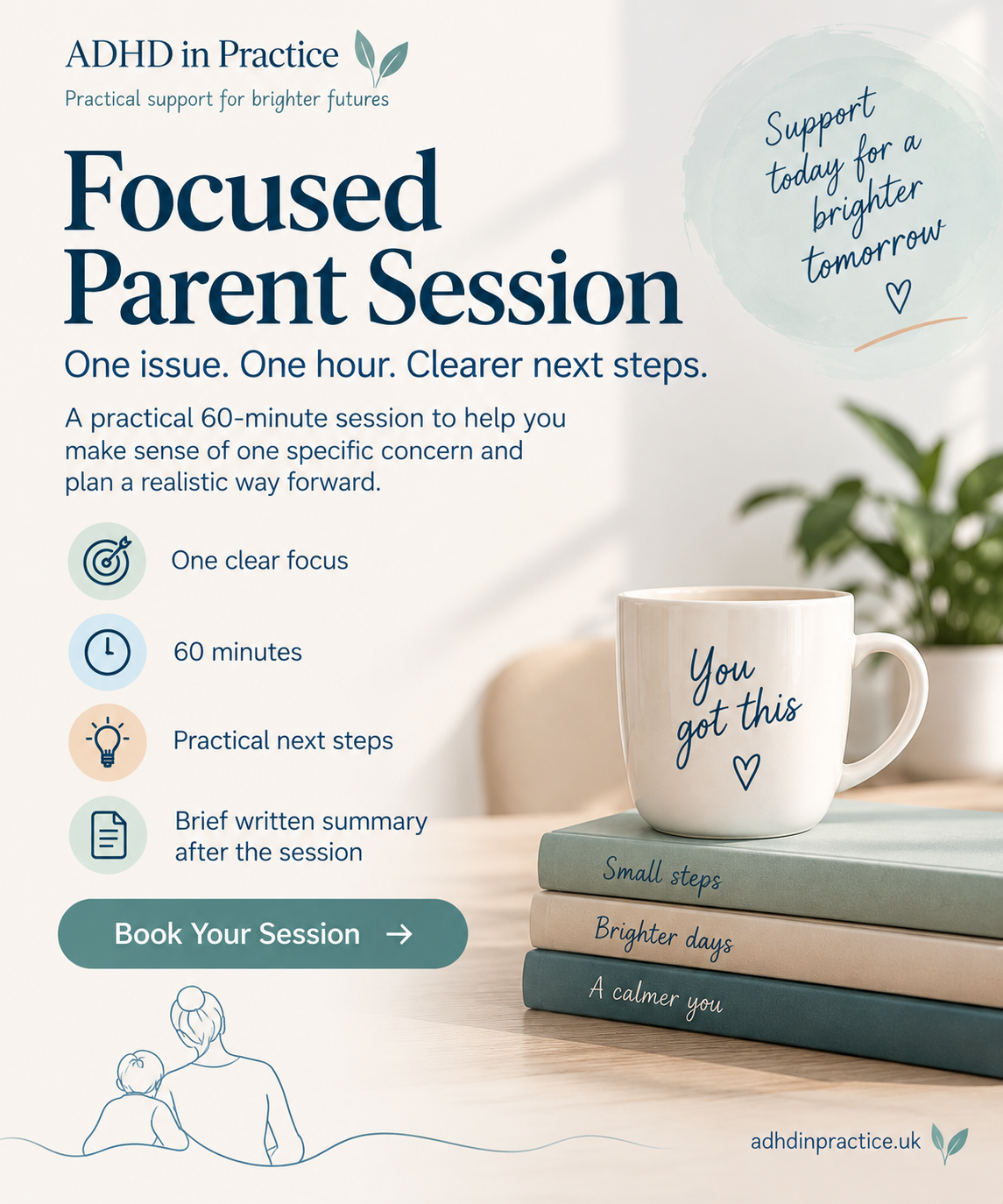
The Focused Parent Session is designed for exactly that.
This is a practical 60-minute session centred on one clearly defined issue. Zoom or telephone call.
We will look at what is happening, what may be underneath it, what has already been tried and what would be most useful to do next.
This is not a full document review, EHCP review or wider case analysis.
It is a focused space to stop going round in circles and work out the next sensible step.
This may be right for you if...
You are dealing with one main concern and need help thinking it through.
That might be school morning distress, after-school dysregulation, masking, friendship difficulties, a difficult school conversation, reduced attendance, behaviour that does not make sense or simply not knowing what to do next.
You may already have spoken to school and still feel unclear.
You may have received lots of advice but no actual plan.
Or you may simply need an experienced outside view to help you separate what matters now from everything else competing for your attention.
What the session includes
Before the session, you will be asked to identify the one issue you most want help with and provide a short summary of what has been happening.
During the session we will explore the pattern, identify what may be contributing to the difficulty and look at what is realistic for home and school.
The focus is practical.
Not pages of theory.
Not another list of things you “should” be doing.
We will work towards a small number of useful next steps that fit your child and your situation.
After the session, you will receive a brief written action summary so you are not left trying to remember everything we discussed.
You will leave with
A clearer understanding of what may be happening.
A better idea of what needs attention first.
A small number of practical next steps.
Clearer wording for what to say or ask if school is involved.
And, importantly, less of that feeling of:
“I know something is not right, but I do not know what to do with it.”
This session is not designed for
Extensive document review.
EHCP evidence analysis.
Appeal preparation.
Complex multi-agency cases.
Or situations where several issues need to be worked through in depth.
If your situation is broader or more complex, the full Parent Clarity Consultation is likely to be the better fit.
Focused Parent Session
60 minutes
£135
Includes a brief written action summary after the session.
One issue.
One clear focus.
One practical way forward.
Do you already know the problem you need help with?
Book a Focused Parent Session.
This is a 60-minute session for one clearly defined issue. We focus on the problem in front of you, work through what may be happening and identify practical next steps you can actually use.

Zoom or telephone call
A focused, parent support session to help you cut through the noise and work out what needs to change first.
Includes:
I will analyse your completed form and use it it to prepare guidance for telephone call or Zoom,
Zoom or call 60-minute online consultation;
individual discussion of your child’s needs and current difficulties;
clear priorities and recommended next steps;
a concise written follow-up summary;
20-minute review call within four weeks.
This session is for parents who know something is not working, but are not sure what the next step should be.
You may be dealing with emotional outbursts, morning battles, school worries, homework stress, anxiety, suspected ADHD, autism, dyslexia, sensory needs, friendship difficulties, sleep issues, behaviour concerns, masking, low confidence or a child who seems overwhelmed by everyday demands.
You do not need to arrive with a diagnosis, a folder of reports or a perfect explanation.
You can start with:
“I know something is wrong, but I don’t know what to do next.”
That is enough.
Best for parents who:
feel overwhelmed and do not know where to start
are constantly firefighting behaviour at home
have tried strategies that worked for a week, then disappeared into the void
are unsure whether the difficulty is ADHD, anxiety, autism, dyslexia, school stress, sensory overload or something else
need help understanding what may be driving their child’s behaviour
want practical next steps, not judgement or generic advice
need someone experienced to help them see the wood for the trees
What we can explore
Depending on what is happening for your child, we may look at:
behaviour patterns at home or school
emotional meltdowns and regulation difficulties
morning routines, homework, bedtime or transitions
possible ADHD traits
anxiety, masking or school-related stress
dyslexia, learning difficulties or confidence issues
sensory needs or overwhelm
communication with school
whether further support, assessment or SEND advice may be needed
This is not about jumping to a label.
It is about understanding the barrier.
Once the barrier is clearer, the next step becomes much easier to choose.
You leave with:
a clearer picture of what may be driving your child’s behaviour
practical, realistic next steps
ideas you can actually use at home or in school conversations
a better sense of what to prioritise first
less guilt and more direction
This session may help if you are thinking:
“I don’t know if this is ADHD or something else.”
“School says things are fine, but home feels impossible.”
“We have tried reward charts and nothing sticks.”
“I am tired of guessing what my child needs.”
“I need help before I speak to school.”
“I just need someone to help me make sense of it all.”
Your starting point when everything feels too much
The Parent Clarity Call gives you space to pause, talk through what is happening, and leave with a clearer plan.
No judgement.
No jargon.
No pretending one sticker chart will fix family life by Friday.
Just practical parent support, clear thinking and a sensible next step.
The Parent Clarity Consultation includes a focused discussion, a concise written summary of the key priorities and agreed next steps, and one 20-minute review call to be used within four weeks. It does not include a formal assessment, diagnosis, detailed report, legal advice, extensive document review or ongoing email support. Any additional sessions or written work are booked separately.
When you know what you want
A 60-minute consultation for parents facing several overlapping concerns about their child's learning, behaviour, emotional wellbeing or school support. We'll identify what's happening, where support may be missing and what to prioritise.
You'll receive: Personalised advice, practical strategies, questions to raise with school and a brief written action plan outlining your next steps.
Online parent support across the UK, school and EHCP guidance focuses on England.
Why emotional regulation can be harder with ADHD
Emotional reactions may be affected by:
Impulse control: the response may happen before the child has time to think.
Executive overload: once mental capacity is used up, coping becomes harder.
Difficulty shifting attention: moving away from a disappointment or perceived injustice may take time.
Lower frustration tolerance: small setbacks can feel disproportionately intense.
Sensory overload: noise, touch, hunger and tiredness can reduce emotional capacity.
What can emotional dysregulation look like?
Explosive responses
shouting or screaming
sudden anger
throwing or breaking things
running away
arguing
hitting out
intense crying
reactions that appear much bigger than the immediate proble
Quieter responses
shutting down
hiding
becoming unable to speak
going under a table
withdrawing
appearing blank or frozen
agreeing at school but falling apart later
struggling to explain what happened afterwards
This matters because a focus on visible emotional reactions alone leaves out children who freeze, mask, or shut down. Dysregulation is not always loud — for many children it is quiet, and easy to miss or misread as calm.
What may be underneath the behaviour?
The wrong cup, a request to put shoes on or a change of plan may be the final trigger. It is rarely the whole story.
Underneath the reaction there may be tiredness, sensory overload, anxiety, hunger, shame, confusion, social stress, difficult schoolwork, a transition or the effort of holding everything together all day.
At school
Ask any child to follow instructions that were said once, quietly, over the general hum, then hand them a worksheet that feels suspiciously like yesterday's worksheet. Add a playground with no plan and forty moving parts, a friendship that wobbled at breaktime, a timetable that rearranged itself without warning, the same correction for the third time today, and the constant background hum of not wanting to get it wrong. By 3pm, something has usually got to give.
At home
Home is where the mask comes off, which is exactly why it often looks like home is the problem when really it is just the first safe place to fall apart. The front door barely shuts before there is a demand (homework), a physiological demand (hunger), a screen switched off mid-level, a sibling being a sibling, a bedtime looming like a deadline, a barrage of well-meaning questions, and a plan that changes without notice. None of it is unreasonable on its own. All of it adds up fast.
Inside the child
Some of the heaviest lifting happens where nobody can see it: anxiety humming away in the background, sensory input turned up too loud, the sting of rejection or embarrassment, tiredness sitting bone-deep, medication quietly clocking off for the day, and the simple, exhausting difficulty of finding words for any of it. This is the part of the iceberg under the waterline — invisible, but doing most of the work.
What helps before, during and after?
Before
identify common triggers;
give warnings before transitions;
reduce unnecessary demands;
prepare for changes;
offer food, quiet and decompression after school;
agree a safe regulation space;
notice the child’s early warning signs.
During
use fewer words;
lower your voice;
reduce noise and audience;
stop asking repeated questions;
give physical space where safe;
prioritise safety;
avoid demanding an apology or explanation;
do not begin a lecture about consequences.
A child who is overwhelmed is not available for a lecture, an interrogation or a lesson in better choices.
After
allow recovery;
reconnect before analysing;
keep the first conversation brief;
talk later about what happened beforehand;
record patterns;
repair without shame;
decide what adults can change next time.
What school should understand about emotional dysregulation
Dysregulation:
behaviour is often communication;
a child’s body may communicate distress before their words can;
questioning a dysregulated child may increase the pressure;
masking can mean school and home see very different presentations;
repeated sanctions may increase shame without addressing the cause;
adjustments need to be planned before incidents occur;
support should be recorded, reviewed and changed when it is not reducing the child’s distress.
Five questions to ask school:
What usually happens immediately before the incident?
What early signs do staff notice?
Who is the child’s trusted adult?
Where can the child go to regulate safely?
What support has been tried and reviewed?
Preparing for a school meeting can help you describe what is happening, challenge vague responses and secure clearly recorded actions.
When further help may be needed
Incidents occur more frequently or have become more severe. School attendance is noticeably impacted. Your child is harming themselves or other people. Recovery is taking much longer than expected.
Your child says they are bad, that they are hated, or that they don’t want to be here. Sleep, appetite, or family routines are being seriously disrupted. Support from the school is not relieving the child’s distress.
Anxiety, autism, sensory processing needs or learning difficulties may also be contributing factors.
If there is an immediate risk to your child or someone else, seek urgent support through NHS 111, your child’s clinical team or emergency services.
Explore what fits your child
Emotional dysregulation does not look the same in every child. Choose the situation that feels closest to what you are seeing.
Meltdown or tantrum?
Similar-looking behaviour can have very different causes. Learn how overwhelm, distress, protest and loss of control may require different adult responses.
Emotionally
Low self-esteem
Feeling “not good enough” or “too much”
Friendship difficulties
Risk of anxiety and depression
Free emotional-regulation guides

FREE - Parent Pattern Snapshot
A simple starting point for when you know something is happening, but you cannot yet see the pattern clearly. It helps you gather what you are noticing, compare home and school, spot possible triggers, and work out what to ask next.

What you’ll get
A clearer picture of what is happening
Prompts to spot when and where difficulties show up
Space to compare what school sees with what happens at home
Clues to possible triggers, demands and pressure points
A simple way to record what helps and what makes things harder
Questions to take into conversations with school, the SENCo or your GP
A final “what do I ask next?” page so you are not left with a pile of notes and no plan
Still unsure where to start? Ask me directly.
I will get back to you within 1-2 working days.
Work out whether your child’s behaviour is demand overload, sensory overwhelm, transition panic, masking collapse, hunger, tiredness, anxiety or executive function overload — before everyone ends up crying in the hallway.
Still unsure what to do next?
If you've spotted a pattern but don't know what to ask school for, book a Focused Parent Session.
£135 | 60 minutes | one issue | practical next steps.