

SEND & ADHD Support for Parents
Support that fits your family
My SEND & ADHD school advocacy in the UK focuses on helping parents talk to schools when they say ‘no concerns’ but home tells a very different story. Together we put the home version in writing and get your child’s needs taken seriously.
Whether you’re looking for clarity, preparing for a school meeting, navigating an EHCP or need ongoing support at home - I’m here to help you find the next step.
Not sure where to start? Start with a totally free introductory call where you can get the “ball rolling.” I am here to support and guide your next steps.
No pressure. Just clarity.
What do you need help with today?
Choose support for you, your school conversations or your child.
I need help with one main issue
A focused 60-minute session to talk through one concern, understand what may be driving it and work out practical next steps.
I need someone to help me understand what’s happening. In depth discussion to clarify what your concerns are and have a full plan to move things forward.

I need help with school.
Prepare, feel confident and be heard.
Clarification, guidance sound advice a way forward.

I need help with an EHCP.
Effective and sound guidance, exploring the evidence and successfully planning the next steps.

I need ongoing support.
You will learn strategies and provided with relevant guidance and strategies that work and help you in daily life. Over time you will develop greater understanding.

Online parent support across the UK, school and EHCP guidance focuses on England.
Choose Your Support
Practical support, expert guidance and real change for you and your family.
Sometimes you do not need a full review of everything.
You may have one problem that keeps circling in your head.
Perhaps mornings are becoming impossible.
Perhaps your child is falling apart after school.
Perhaps school keeps saying they are fine.
Perhaps you have a meeting coming up and you are not sure what to ask for.
Perhaps you are stuck between “wait and see” and “something needs to change”.
The Focused Parent Session is designed for exactly that.
This is a practical 60-minute session centred on one clearly defined issue. Zoom or telephone call.
We will look at what is happening, what may be underneath it, what has already been tried and what would be most useful to do next.
This is not a full document review, EHCP review or wider case analysis.
It is a focused space to stop going round in circles and work out the next sensible step.
This may be right for you if...
You are dealing with one main concern and need help thinking it through.
That might be school morning distress, after-school dysregulation, masking, friendship difficulties, a difficult school conversation, reduced attendance, behaviour that does not make sense or simply not knowing what to do next.
You may already have spoken to school and still feel unclear.
You may have received lots of advice but no actual plan.
Or you may simply need an experienced outside view to help you separate what matters now from everything else competing for your attention.
What the session includes
Before the session, you will be asked to identify the one issue you most want help with and provide a short summary of what has been happening.
During the session we will explore the pattern, identify what may be contributing to the difficulty and look at what is realistic for home and school.
The focus is practical.
Not pages of theory.
Not another list of things you “should” be doing.
We will work towards a small number of useful next steps that fit your child and your situation.
After the session, you will receive a brief written action summary so you are not left trying to remember everything we discussed.
You will leave with
A clearer understanding of what may be happening.
A better idea of what needs attention first.
A small number of practical next steps.
Clearer wording for what to say or ask if school is involved.
And, importantly, less of that feeling of:
“I know something is not right, but I do not know what to do with it.”
This session is not designed for
Extensive document review.
EHCP evidence analysis.
Appeal preparation.
Complex multi-agency cases.
Or situations where several issues need to be worked through in depth.
If your situation is broader or more complex, the full Parent Clarity Consultation is likely to be the better fit.
Focused Parent Session
60 minutes
£135
Includes a brief written action summary after the session.
One issue.
One clear focus.
One practical way forward.

When home feels unmanageable, one conversation may not be enough.
These sessions provide practical, ongoing support to help you understand what is driving the difficulties, introduce realistic strategies and adjust them as your child’s needs change.
Support may focus on:
emotional regulation and meltdowns;
difficult mornings, homework and bedtime;
routines, transitions and executive functioning;
anxiety, masking or sensory overload;
school concerns and communication;
rebuilding confidence after repeated difficulties.
New families begin here
Parent Clarity Session
60 minutes | £200
This is the starting point for new families.
We look at what is happening at home, at school or both, identify the main pressure points and decide what needs attention first.
Includes:
one 60-minute Zoom or telephone session;
a clear understanding of the main concerns;
practical priorities and next steps;
a concise follow-up email confirming the discussion, agreed actions and recommendations.
Book a Parent Clarity Session
Ongoing Parent Support Session
1 session £165
Includes a 60-minute session and concise follow-up email.
A focused follow-up session to review progress, adjust strategies and respond to new concerns.
Includes:
review of what has been tried;
strategy refinement;
support with new home or school developments;
a concise follow-up email confirming agreed actions.
Parent Progress Package
3 sessions | £465
Ideal for parents implementing strategies, managing school concerns or navigating a period of change.
Includes:
three individual sessions;
practical actions after each session;
concise follow-up emails;
review and refinement of strategies.
Equivalent to £155 per session.
Saving: £30
Parent Partnership Package
For families needing consistent support across a school term or significant period of change.
Includes:
six individual sessions;
concise follow-up emails;
ongoing strategy development;
accountability and problem-solving;
support responding to changing home or school circumstances.6 sessions | £870
Equivalent to £145 per session.
Saving: £120
What you should gain
a clearer understanding of your child’s needs;
practical ADHD and SEND parenting strategies;
realistic next steps;
written clarity after each session;
greater confidence and less guilt;
ongoing support rather than being left to work everything out alone.
Important
Sessions provide practical ADHD, SEND and parenting guidance. They do not include diagnosis, therapy, medical or legal advice, formal reports, extensive document review or unlimited email support. Additional written work or support outside booked sessions is charged separately.

60 minutes | Zoom or telephone
School meetings can feel overwhelming, especially when concerns are dismissed, support remains vague or home and school see very different versions of your child.
This focused consultation helps you organise your concerns, prepare what to say and decide what you need to ask for next.
It may be helpful when you are concerned about:
learning, behaviour or emotional regulation;
ADHD, autism, dyslexia or sensory needs;
anxiety, attendance or reduced timetables;
masking and after-school distress;
inconsistent or unclear SEN Support;
repeated promises to “monitor the situation” without a clear plan.
What we work on
Together, we will:
identify the main concerns and possible barriers;
organise the evidence that matters;
prepare your key questions;
develop clear, professional wording;
consider reasonable adjustments and support;
decide what actions and review dates to request.
This is not about preparing for a battle. It is about entering the conversation calm, focused and clear about what your child needs.
Your package includes
a 60-minute individual consultation;
a clear meeting plan;
questions and wording you can use;
a concise follow-up email confirming priorities and recommended actions;
one 20-minute review call within four weeks.
What you should leave with
You should feel clearer about:
what the main issues are;
what evidence to present;
what to ask school;
what support may be reasonable;
what should be recorded;
what needs to happen next.
Monitoring is not a plan unless everyone knows what is being monitored, how it will be recorded and when it will be reviewed.
Important boundaries
This package does not include attendance at the school meeting, legal representation, diagnosis, a formal report, extensive document review or ongoing email support. Additional sessions, written work or meeting attendance must be agreed and booked separately.
Not sure whether this is the right service? Start with a free 30-minute call.

Zoom or telephone call
A focused, parent support session to help you cut through the noise and work out what needs to change first.
Includes:
I will analyse your completed form and use it it to prepare guidance for telephone call or Zoom,
Zoom or call 60-minute online consultation;
individual discussion of your child’s needs and current difficulties;
clear priorities and recommended next steps;
a concise written follow-up summary;
20-minute review call within four weeks.
This session is for parents who know something is not working, but are not sure what the next step should be.
You may be dealing with emotional outbursts, morning battles, school worries, homework stress, anxiety, suspected ADHD, autism, dyslexia, sensory needs, friendship difficulties, sleep issues, behaviour concerns, masking, low confidence or a child who seems overwhelmed by everyday demands.
You do not need to arrive with a diagnosis, a folder of reports or a perfect explanation.
You can start with:
“I know something is wrong, but I don’t know what to do next.”
That is enough.
Best for parents who:
feel overwhelmed and do not know where to start
are constantly firefighting behaviour at home
have tried strategies that worked for a week, then disappeared into the void
are unsure whether the difficulty is ADHD, anxiety, autism, dyslexia, school stress, sensory overload or something else
need help understanding what may be driving their child’s behaviour
want practical next steps, not judgement or generic advice
need someone experienced to help them see the wood for the trees
What we can explore
Depending on what is happening for your child, we may look at:
behaviour patterns at home or school
emotional meltdowns and regulation difficulties
morning routines, homework, bedtime or transitions
possible ADHD traits
anxiety, masking or school-related stress
dyslexia, learning difficulties or confidence issues
sensory needs or overwhelm
communication with school
whether further support, assessment or SEND advice may be needed
This is not about jumping to a label.
It is about understanding the barrier.
Once the barrier is clearer, the next step becomes much easier to choose.
You leave with:
a clearer picture of what may be driving your child’s behaviour
practical, realistic next steps
ideas you can actually use at home or in school conversations
a better sense of what to prioritise first
less guilt and more direction
This session may help if you are thinking:
“I don’t know if this is ADHD or something else.”
“School says things are fine, but home feels impossible.”
“We have tried reward charts and nothing sticks.”
“I am tired of guessing what my child needs.”
“I need help before I speak to school.”
“I just need someone to help me make sense of it all.”
Your starting point when everything feels too much
The Parent Clarity Call gives you space to pause, talk through what is happening, and leave with a clearer plan.
No judgement.
No jargon.
No pretending one sticker chart will fix family life by Friday.
Just practical parent support, clear thinking and a sensible next step.
The Parent Clarity Consultation includes a focused discussion, a concise written summary of the key priorities and agreed next steps, and one 20-minute review call to be used within four weeks. It does not include a formal assessment, diagnosis, detailed report, legal advice, extensive document review or ongoing email support. Any additional sessions or written work are booked separately.
EHCP support and guidance

Clear guidance when you do not know where to start
70 minutes | Online
For parents who feel confused about EHCPs, SEN Support or whether school provision is enough.
You may be asking:
Does my child need an EHCP?
Can I request an EHC needs assessment?
What evidence do I need?
What should I ask school?
What happens next?
What we cover
We look at:
your child’s needs;
support already in place;
gaps in provision;
evidence from home, school and professionals;
whether an EHC needs assessment may be appropriate;
your clearest next step.
Your package includes
one 70-minute consultation;
practical EHCP guidance;
a concise follow-up email confirming priorities and actions;
one 20-minute review call within four weeks.
What you should leave with
a clearer understanding of the EHCP process;
what evidence you already have;
what information is missing;
what to ask school;
what to do next.
Important
This consultation provides educational and procedural guidance. It does not include legal representation, tribunal preparation, extensive document review, a formal report, meeting attendance or ongoing email support. Additional work is booked separately.
If you are still unsure Book a FREE call
Start with a free 30-minute call

Turn complex paperwork into clear, usable evidence
From £295 | Online consultation
For parents who already have school records, reports or EHCP paperwork but are unsure what the evidence shows, what is missing or what needs to happen next.
This service is particularly helpful when you are:
preparing an EHC needs assessment request;
reviewing an existing EHCP;
preparing for an annual review;
gathering evidence of unmet need;
trying to understand professional reports;
unsure whether current provision is specific or sufficient.
What is included
Your package includes:
up to 60 minutes of document review;
one 70-minute online consultation;
identification of strengths, gaps and vague wording;
guidance on what evidence matters most;
questions to ask school or professionals;
a concise written summary of priorities and recommended next steps.
How document review is priced
Document-review time depends on the length, complexity and purpose of the paperwork.
As a guide:
an existing EHCP usually requires at least 60 minutes to review;
a detailed Educational Psychologist report may require three hours or more;
shorter school plans, emails or professional letters may require less time.
Before confirming your booking, I will review what you wish to submit and provide a clear quotation. No additional work will be completed or charged without your agreement.
What we may review
This could include:
an EHCP;
Educational Psychologist reports;
SEN Support plans, One page profiles, IEPs or ISPs;
annual-review paperwork;
attendance or behaviour records;
dyslexia, ADHD or autism reports;
CAMHS, paediatric or GP letters;
school emails and meeting notes;
parent timelines or written concerns.
What you should leave with
You should feel clearer about:
what the evidence already shows;
where needs or provision are described vaguely;
what may be missing;
what to ask for next;
what evidence needs strengthening;
whether further EHCP or school support may be appropriate.
The aim is not to submit a mountain of paperwork. It is to present a clear picture of your child’s needs, the support already tried and where provision remains insufficient.
Important boundaries
This service provides educational and procedural guidance. It does not include legal advice, tribunal preparation, a formal legal opinion, rewriting a full EHCP request, attendance at meetings or unlimited email support. Complex or lengthy documents, additional written work and further consultations are quoted separately.
Still unsure
Not sure whether this is the right EHCP service? Start with a free 30-minute call.
What parents say
-
"For the first time school actually listened to us."
Sarah and Adam, parents of two girls
-
"I finally understood what the EHCP process actually needed."
Jo, mum of 9 year old girl
-
"The scripts changed every meeting after that."
Raj, dad of 14 year old girl
-
"Before this, I felt like I was guessing. Now I actually understand what's going on for my son and why the old advice never worked for him."
Olivia, mum of 12 year boy
When you have to speak to school, the SENCo, GP, CAMHS or an educational psychologist, and your brain goes blank.
Clear, personalised scripts to help you explain your concerns, ask the right questions and say what your child needs without rambling, apologising or leaving the meeting thinking, “I wish I’d said that.”
For parents who know something isn’t right, but need the words to make professionals listen.
School Scripts
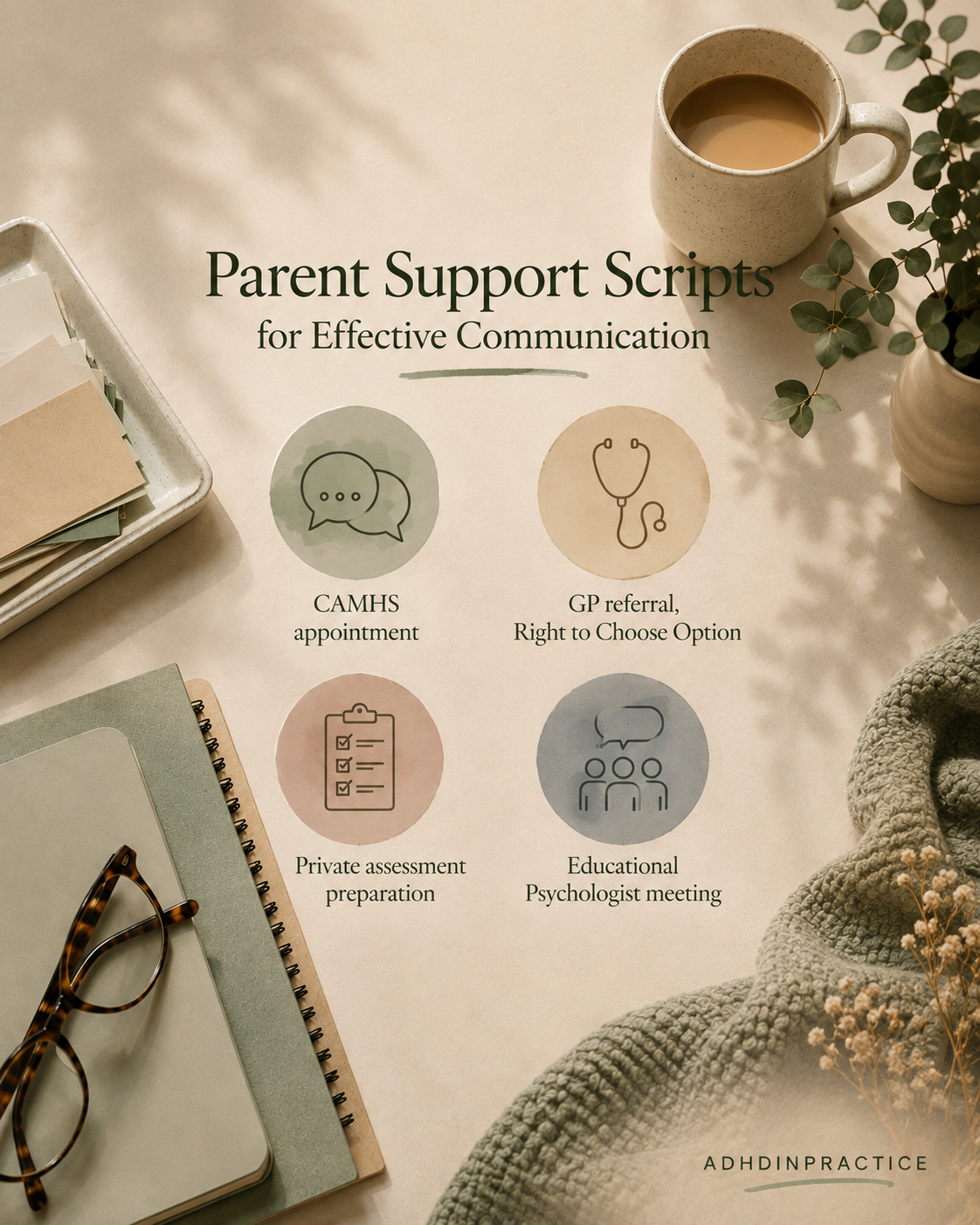
CAMHS appointment
GP referral, Right to Choose Option
Private assessment preparation
Educational Psychologist meeting
Navigate crucial conversations with confidence using our School / Parent Support Script, designed for effective communication with healthcare professionals about your child's needs and available options. Transform your concerns into clear, impactful dialogues that drive results.
Personalised scripts to effectively communicate with professionals.
Guidance on navigating CAMHS, GP, and Right to Choose pathways.
Confidence-boosting strategies for follow-up conversations.
Gain control and clarity in crucial conversations about your child's health, ensuring they receive the support they need. Our service empowers you with the right tools to advocate for their wellbeing confidently.
Once you have ordered your Parent Script, you will be asked to complete a short form so I can understand your child’s situation, the meeting you are preparing for, and what you need help saying.
Please include as much helpful detail as you can. The better the information, the stronger and more accurate your script will be.
You do not need to write perfectly. Bullet points are absolutely fine. This is not an Ofsted inspection. Just tell me what is happening, what you are worried about, and what you want school to understand.
This service is designed to give you clarity, confidence and wording that helps you advocate for your child in important conversations with professionals.
It does not replace medical, legal or clinical advice, and it does not guarantee a referral, diagnosis or specific outcome. What it does give you is preparation — and preparation matters.

For parents who know what they want to say to school — but would quite like it to come out calm, clear and useful rather than as a 2am brain dump with bullet points and mild rage.
A School Script gives you carefully worded language for meetings, emails and conversations with teachers, SENCOs or school leaders. It helps you explain your child’s needs, raise concerns, ask for support, request adjustments and follow up professionally.
Useful for ADHD, autism, dyslexia, anxiety, masking, meltdowns, behaviour concerns, friendship issues, homework battles and unmet SEND needs.
You leave with wording that is firm, respectful and practical — so you can advocate for your child without feeling overwhelmed, dismissed or put on the spot.
Once you have ordered your Parent Script, you will be asked to complete a short form so I can understand your child’s situation, the meeting you are preparing for, and what you need help saying.
Please include as much helpful detail as you can. The better the information, the stronger and more accurate your script will be.
You do not need to write perfectly. Bullet points are absolutely fine. This is not an Ofsted inspection. Just tell me what is happening, what you are worried about, and what you want school to understand.

Navigate the EHCP process with ease and confidence using our specialised support scripts designed to advocate for your child's needs in education.
The questions to ask are the ones that are hardest to dismiss. The ones that require a specific answer. The ones that move the conversation forward rather than allowing it to go in circles.
How to handle the most likely pushback because they will say something. "We don't have the budget." "They're fine in school." "Let's monitor the situation." "They don't meet the threshold." For each one — what to say next.
What to ask for before you leave the room: Written agreement. Named person responsible. Specific timescale. Next steps confirmed because a meeting with no written outcome is a meeting that never happened.
A closing statement is something that confirms what has been agreed, signals that you will follow up in writing, and closes the meeting professionally without burning any bridges you may need later.
Once you have ordered your Parent Script, you will be asked to complete a short form so I can understand your child’s situation, the meeting you are preparing for, and what you need help saying.
Please include as much helpful detail as you can. The better the information, the stronger and more accurate your script will be.
You do not need to write perfectly. Bullet points are absolutely fine. This is not an Ofsted inspection. Just tell me what is happening, what you are worried about, and what you want school to understand.
After the script but before the meeting, allows for extra clarity
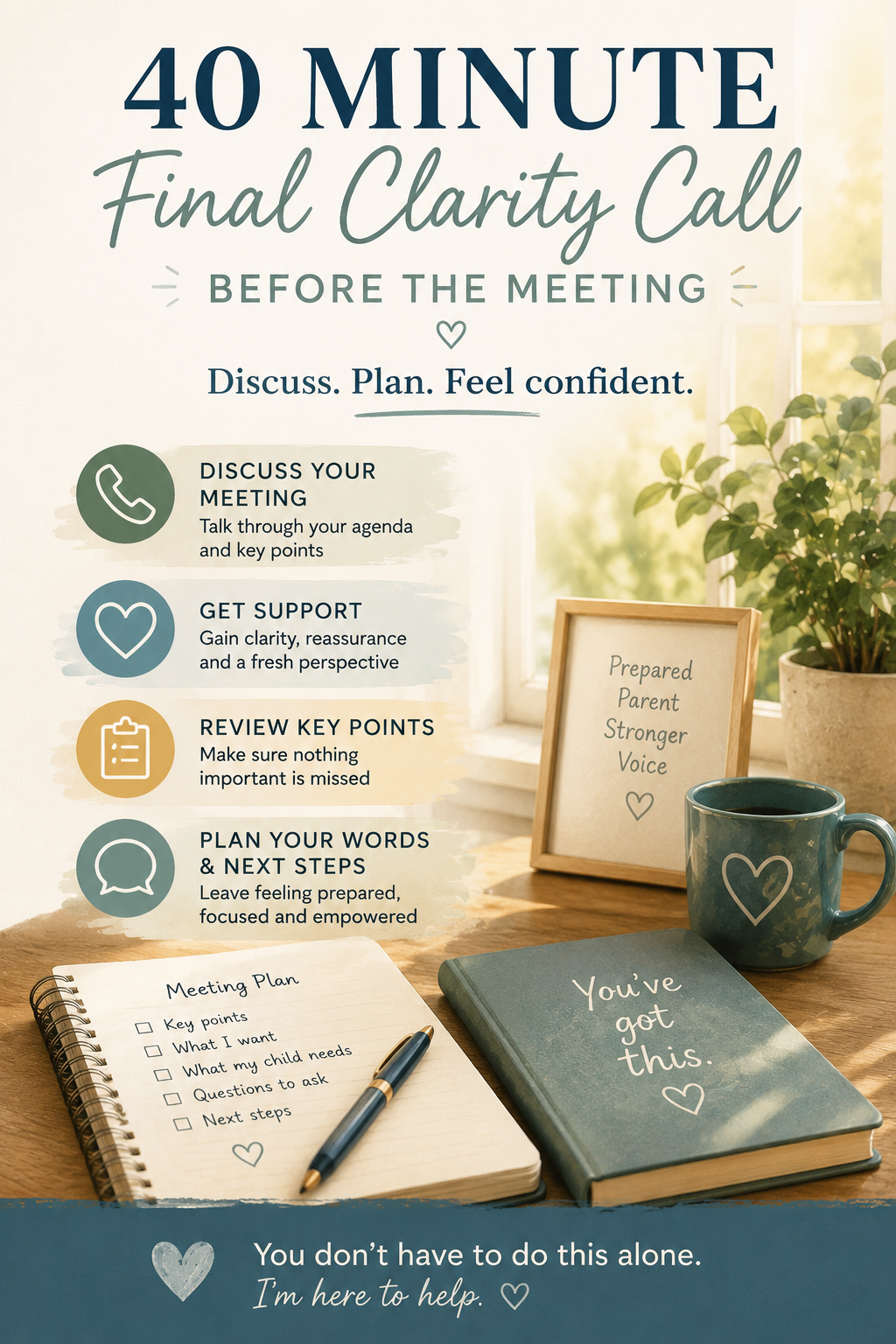
Script Clarification Call
For parents who have purchased a Parent Script and want to talk it through before the meeting, call or review.
This 40-minute session gives you the chance to go over your script with me so you feel clear, prepared and confident before you use it. We look at what the script says, why it is worded that way, what points matter most, and how to deliver it without sounding apologetic, overwhelmed or ready to launch yourself across the table.
This is ideal if you have read your script and thought:
“Yes, this is exactly what I need to say… but I want to make sure I understand how to use it properly.”
What this session gives you
You will leave with:
A clear understanding of your script
We go through the wording so you know what each section is doing and why it matters.Confidence about what to say first
Because the opening of a meeting often sets the tone — and “I’m not sure where to start” is not the energy we are aiming for.Help to prioritise the key points
We identify what must be said, what can wait, and what should not get lost in the meeting fog.Preparation for possible responses
We talk through what school or professionals may say back, and how you can respond calmly and firmly.Support with tone and delivery
So you sound clear, reasonable and prepared — not defensive, rushed or accidentally too soft.A stronger sense of your next step
You know what you are asking for, what outcome you want, and what needs to be confirmed after the meeting.
This is useful if:
You have an upcoming meeting with school, SENCo, local authority or another professional
You want reassurance that you understand the script properly
You are worried you may get emotional, sidetracked or talked over
The situation feels sensitive, tense or complicated
You want to feel more prepared before walking into the room
The aim
This session is not about rewriting the whole script from scratch.
It is about making sure you understand it, can use it confidently, and know how to hold your ground in the meeting.
You already have the words.
This call helps you feel ready to use them.
40 minutes. Script-focused. Calm, clear and practical.
Free guides

When friendships get complicated, feelings get big, and you don't know what to do next.
A FREE 21-page friendship and feelings guide for girls aged 10–13
One day, they're best friends. The next day, someone isn't speaking, the group chat goes quiet, or she's left out at lunchtime.
For some girls, particularly those with ADHD, friendship difficulties can feel overwhelming.
What looks like a small disagreement to an adult can leave a girl questioning herself, replaying conversations, worrying about rejection or dreading school the next morning.
The Friendship Fallout Decoder helps girls make sense of what happened, understand how they feel and work out what to do next.
Created by Janine M Nesbitt, an experienced SEND specialist and former SENCo with over 34 years in education, this practical, reassuring guide combines relatable friendship situations, emotional literacy activities and straightforward strategies that girls can use in everyday life.
What's inside this free guide?
Across 21 thoughtfully designed pages, girls can explore:
Friendship fallouts: Understanding disagreements, misunderstandings and changing friendships.
Big feelings: Recognising disappointment, jealousy, anger, embarrassment and rejection.
Facts or worries? Learning to separate what actually happened from what they think might have happened.
Group chats and social pressures: Navigating messages, exclusion and the feeling of being left out.
Healthy friendships and boundaries: Understanding kindness, respect and when a friendship doesn't feel right.
Finding the right words: Practical phrases for difficult conversations, asking questions and repairing friendships.
When to ask for help: Recognising bullying, repeated exclusion or situations that feel unsafe.
Five ready-to-use scripts: Helping girls reach out to a trusted adult when it feels difficult to talk about what is happening.
There is also guidance to help parents and carers respond with understanding rather than rushing to fix everything.
Who is it for?
This guide is designed for girls aged 10–13, particularly those who:
Find friendships confusing or emotionally exhausting.
Worry about being left out or losing friends.
Replay conversations and wonder what they've done wrong.
Struggle to explain how they feel.
Find it difficult to speak up or set boundaries.
Need reassurance that they are not alone.
It may be particularly helpful for girls with ADHD, but a diagnosis isn't needed. Friendship difficulties and big emotions can affect anyone.
Why I've made it free
Friendships are an important part of growing up. They help children develop confidence, identity and a sense of belonging.
But when friendships become difficult, children don't always have the words or emotional tools to explain what they're experiencing.
After more than 34 years working in education, I believe girls deserve practical, age-appropriate support that helps them feel heard, understood and more confident.
Parents deserve that support too.
That's why I've made this comprehensive 21-page guide available completely free.
Because every girl deserves to feel that she belongs, without having to change who she is.
Download your free copy
21 pages | Printable PDF | Ages 10–13 | Completely FREE
A guide girls can explore independently, share with a trusted adult or work through together with a parent or carer.
If you need more help see below.
For parents of secondary-age children (roughly eleven to sixteen) whose attendance has become a daily struggle, a source of fines, or both.
Secondary school changes the shape of the problem. There's rarely one teacher who really knows your child any more, and a struggling teenager has far more room to hide it than a struggling six-year-old does, right up until they can't.
Inside: what the attendance and fines data actually says about children with SEN, why the secondary years look different (masking, subject-hopping, GCSE pressure, part-time timetables), the signs worth naming to the school, how to open a meeting and get it properly documented, with a ready-to-use actions table and follow-up emails.
Still unsure what to do next?
Read below, book an introductory call or a more focused call to talk through one concern.
Product description:
For parents of primary-age children (roughly four to eleven) whose mornings have become a battle, and who may already be facing a fine for it.
This isn't a guide about getting your child to try harder. It starts from a simple idea: children do well if they can, and if they're not managing to get through that door, something specific is making it impossible, not a lack of willingness.
Inside: what the attendance and fines data actually says about children with SEN, why the primary years look different (drop-off dynamics, sensory overwhelm, the timing of SEN Support and EHC assessments), the signs worth naming to your child's school, how to open a meeting and get it properly documented, with a ready-to-use actions table and follow-up email script, and what to know if a penalty notice arrives.
Why not book a free 15-minute call or an in-depth focused call see below.
Practical guidance for UK parents and carers
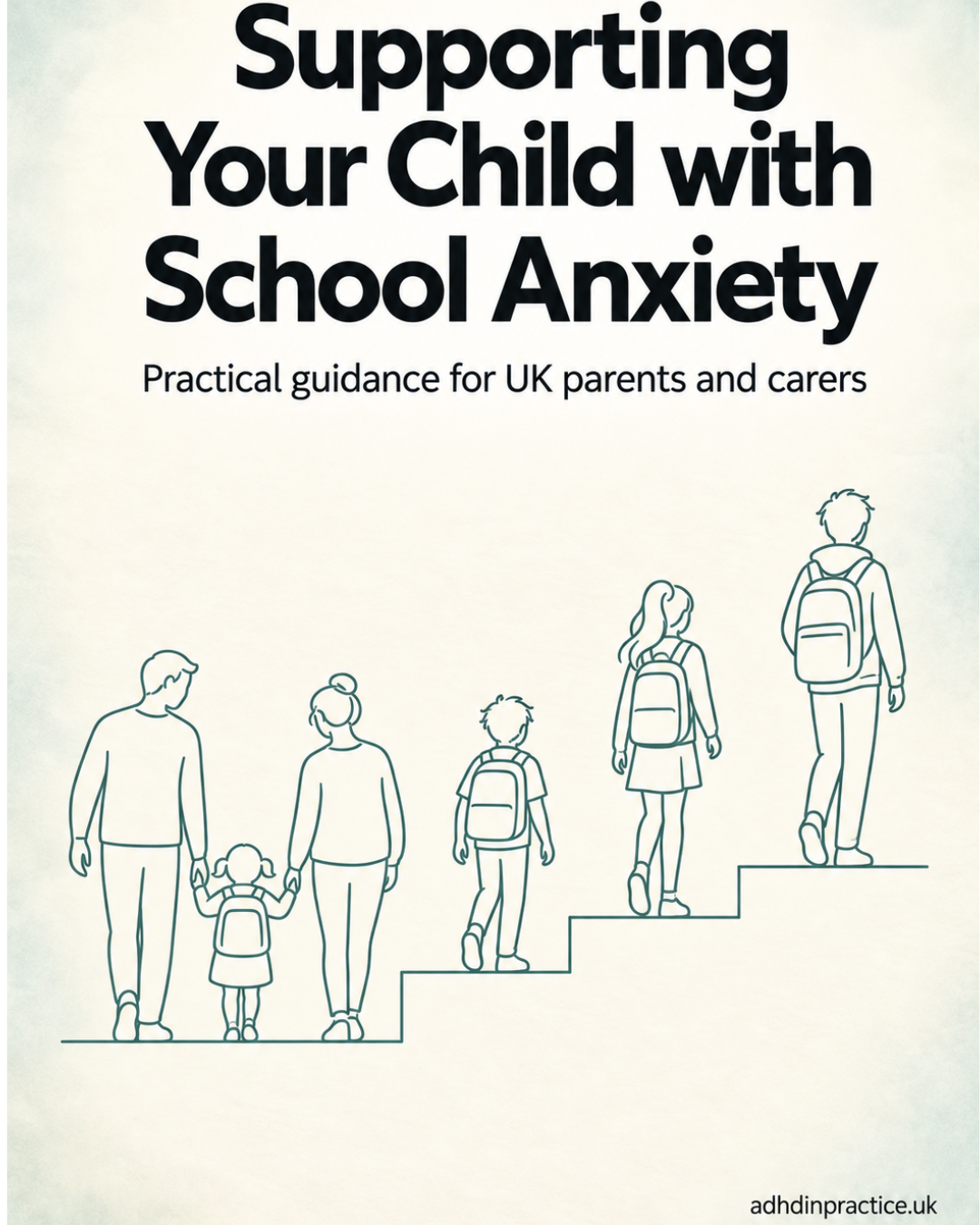
I have created another free guide for parents/c arers to download and use. When a child is struggling to attend school, the problem is rarely solved by simply telling them they must go in.
School anxiety can appear as tears, anger, shutdown, physical symptoms, sleepless nights, difficult mornings or complete refusal. Some children manage to enter school and appear fine, only to fall apart when they return home.
This practical guide helps you look beyond the behaviour, identify what may be making school feel unsafe or overwhelming and take clear, manageable action.
Inside the guide
You will find:
Signs of school anxiety across different ages
Possible reasons behind distress and non-attendance
Questions to help you identify patterns and pressure points
Practical steps for difficult mornings and recovery after school
Ways to listen without turning every conversation into an interrogation
Reasonable adjustments that may reduce anxiety in school
Parent-teacher conversation scripts
Questions to ask the teacher, SENCo or pastoral team
Space to record concerns, agreed actions and review dates
Guidance on what to do when support is vague or progress stalls
This guide will help you
Describe what is happening clearly
Separate anxiety from assumptions about behaviour
Gather useful information from home and school
Prepare for a constructive school meeting
Ask for specific support rather than being told to wait and see
Keep your child’s experience at the centre of decisions
Who is it for?
This guide is for parents and carers of children and young people experiencing anxiety connected with school, including those with ADHD, autism, SEND, EBSA or no diagnosis at all.
You do not need to wait for a diagnosis before discussing your child’s needs or asking school what support can be put in place.
What this guide is not
This is practical general guidance, not individual legal advice, a diagnosis or a treatment plan. The conversation scripts are examples to adapt to your child, school and circumstances.
Education systems and legal duties differ across the UK. Year groups and statutory references within the guide follow England unless stated otherwise.
Free download
Download the guide, choose the section that matches what is happening now and begin with one action. You do not need to solve everything in one meeting.

Something feels different, but you cannot quite put it into words. Perhaps communication is tricky, everyday routines feel overwhelming, or nursery has raised a concern. You do not need all the answers—or a paperwork folder with its own postcode—to take the next step.
This warm, practical guide helps you explore your child’s strengths and emerging needs without jumping to a diagnosis. Written for parents and carers in England, it covers communication, attention, play, sensory experiences and everyday development.
Inside, you’ll find:
Reassurance and clear guidance on what to notice.
Examples that help you put concerns into words.
Conversation prompts for nursery and health appointments.
An explanation of local authority differences and England’s national SEND Code of Practice.
A printable strengths-and-needs profile.
A simple observation sheet.
An appointment preparation worksheet.
Links to trusted information and further support.
Suitable for families with children from birth to starting school, including those exploring possible ADHD, autism/ASC or other special educational needs and disabilities.
Format: 16-page downloadable PDF.
Please note: This guide provides general information. It is not a diagnostic tool or personalised medical or legal advice.
You have explained your concerns to school. Everyone has listened. Then the conversation ends with:
“We’ll monitor it.”
But what will be monitored? What support will happen now? Who is responsible, and when will it be reviewed?
Beyond “We’ll Monitor It” is a free 20-page ADHD and SEND parent toolkit designed to turn vague school conversations into clear, recorded next steps.
It helps you:
Choose up to three priorities.
Explain the difficulty and its impact on your child.
Prepare clear questions for the teacher or SENCo.
Record what support was requested and agreed.
Identify who is responsible for each action.
Flag questions that still need answering.
Request a start date and review date.
Send a clear follow-up email after the meeting.
Check whether the agreed support happened and helped.
By the end, you will have a practical one-page meeting record showing what was discussed, what was agreed, who will act and what happens next.
Suitable for parents of children with ADHD, autism or other SEND, including children without a diagnosis.
Format: Free 20-page digital toolkit
UK focus: School terminology and SEND guidance relate primarily to England
Created by: Janine M. Nesbitt, ADHD in Practice
School says your child is settled, coping or doing fine.
But at home, you are seeing exhaustion, tears, shutdowns, irritability, anxiety, explosive behaviour or a child who needs hours to recover from the school day.
Both experiences can be real.
This free 20-page ADHD and SEND parent toolkit helps you move beyond vague descriptions and record what is happening in a calm, useful and manageable way.
Across five school days, you will record brief observations about:
What happened before, during and after the difficulty.
What your child said or communicated.
How long recovery took.
What became difficult at home.
What support your child needed.
What appeared to help.
What was different on easier days.
The toolkit then helps you look across the five days, identify recurring patterns and prepare a clearer conversation with school.
By the end of the toolkit, you will have:
A completed five-day observation record.
Two or three clear examples to share.
A one-page summary of your concerns.
Your child’s views, where they are comfortable sharing them.
Questions to ask their teacher or SENCo.
A ready-to-personalise school email.
A record of any agreed actions and review arrangements.
You do not need a diagnosis to use this toolkit.
You also do not need to prove that school is wrong. The purpose is to help home and school build a fuller picture of your child’s needs and decide what should happen next.
Format: Free 20-page digital Word document
Suitable for: Parents and carers of children with ADHD, autism or other SEND, including children without a diagnosis
UK focus: School guidance and terminology relate primarily to England

Something does not add up, but you cannot quite explain why
You may be seeing difficult school mornings, after-school meltdowns, shutdowns, anxiety, friendship problems, sensory overload, behaviour changes or a growing gap between what school sees and what happens at home.
The Parent Pattern Snapshot helps you gather those pieces in one place.
It is not a diagnosis tool and it is not a behaviour chart.
It is designed to help you notice what keeps happening, when it happens, what may be increasing the difficulty, what appears to help, and what questions may be useful to ask next.
What you will get
A clearer picture of what is happening
Prompts to spot when and where difficulties show up
Space to compare what school sees with what happens at home
Clues to possible triggers, demands and pressure points
A simple way to record what helps and what makes things harder
Questions to take into conversations with school, the SENCo or your GP
A final “What do I need to ask next?” section to help you move from noticing to action
Who is it for?
This guide may be useful if:
you know something is not quite right but cannot clearly explain the pattern
school says your child is fine, but home sees something very different
you are preparing to speak to a teacher, SENCo, GP or other professional
your child is struggling with school, behaviour, emotions, learning, friendships or sensory demands
you are waiting for assessment and want to start gathering useful information now
you do not yet know whether ADHD, autism, dyslexia, anxiety, sensory differences or another SEND need may be involved
What this guide is not
The Parent Pattern Snapshot does not diagnose ADHD, autism, dyslexia or any other condition.
It does not replace professional assessment, medical advice or school-based support.
Its purpose is simpler and more practical:
to help you notice patterns clearly enough to have better conversations and ask better questions.
How to use it
Complete it over several days rather than trying to remember everything at once.
Look for repetition.
Notice what happens before the difficulty, what your child does, what happens afterwards, and whether the same triggers or demands keep appearing.
Then use the final page to prepare for your next conversation with school, the SENCo, GP or another professional.

A practical UK checklist to help parents gather clear, real-life evidence before a school meeting, referral or ADHD assessment. Record patterns, impact, support needs and what helps across home, school and daily life. This is not a symptom quiz and cannot diagnose ADHD.
What to do while the diagnosis takes its sweet time — practical steps for getting your child support now, label or no label.
Right now, well over 800,000 people in England are waiting for an NHS ADHD assessment. Children's waits typically run from six months to three years; for adults it can stretch to two, five, even ten years in some areas. Somewhere in that number is you, checking the post and your phone what number are you now? chasing the SENCO, googling symptoms at 11pm, and being told to "wait and see."
Here's the thing nobody tells you: your child doesn't need a diagnosis to get support. They need it today, and the label if and when it arrives can catch up later.
What's inside
How to get your child support at home and at school before any diagnosis exists label or no label
What "Right to Choose" is, and how it can shorten the wait
Scripts for talking to schools, GPs, and SENCOs without a diagnosis in hand
How to build a paper trail that actually helps your case
What changes once the assessment happens and what stays the same either way
A reminder, in writing, that you're not overreacting and you're not alone
Who it's for
Parents and carers in the UK who suspect ADHD in their child (or themselves), who've been referred or are about to be, and who are tired of being told there's nothing to do until the letter arrives.
Credibility line
Written by ADHD in Practice Janine Nesbitt honest, neuroaffirming support for ADHD families, without the jargon or the guilt.
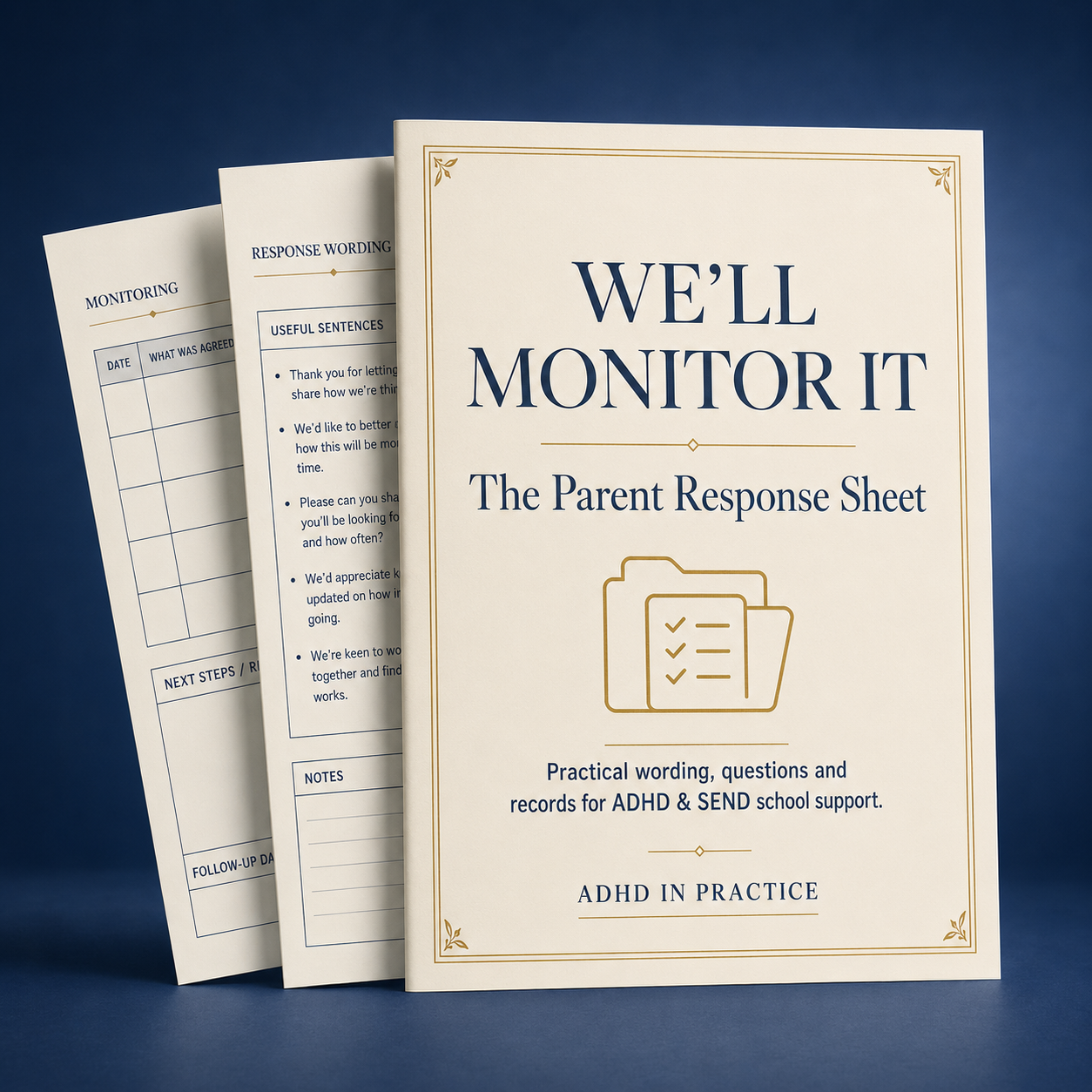
Has school said, “We’ll monitor it,” without explaining what will be monitored, what support will happen or when anyone will review it?
The free “We’ll Monitor It” Parent Response Sheet helps UK parents, grandparents and carers turn a vague promise into a practical, reviewable plan.
Created for families navigating ADHD, autism, dyslexia, dyscalculia, anxiety, sensory needs, emotional regulation, attendance difficulties and wider SEND concerns.
The resource includes:
a school-meeting preparation sheet;
questions to ask before the meeting ends;
an actions and responsibilities record;
space to record support and adjustments;
a review-date planner;
child-voice prompts;
home and school evidence logs;
follow-up email wording;
guidance about what to do if concerns continue.
Your child does not need a diagnosis before you can raise concerns or ask school to respond to identified needs.
Free download • UK-focused • Practical and easy to use

The exact words to use when you walk into that meeting, so you leave with a plan instead of a "we'll monitor it."
You've got the diagnosis. Now you need the school to actually do something with it. This is the word-for-word script for the support meeting: what to say, what to ask for, and how to handle "he seems fine in class" without losing your thread or your nerve.
Free example.
This guide is written for UK parents navigating the NHS ADHD assessment pathway. Everything in here is grounded in UK government guidance, the SEND Code of Practice 2015, and the Children and Families Act 2014.
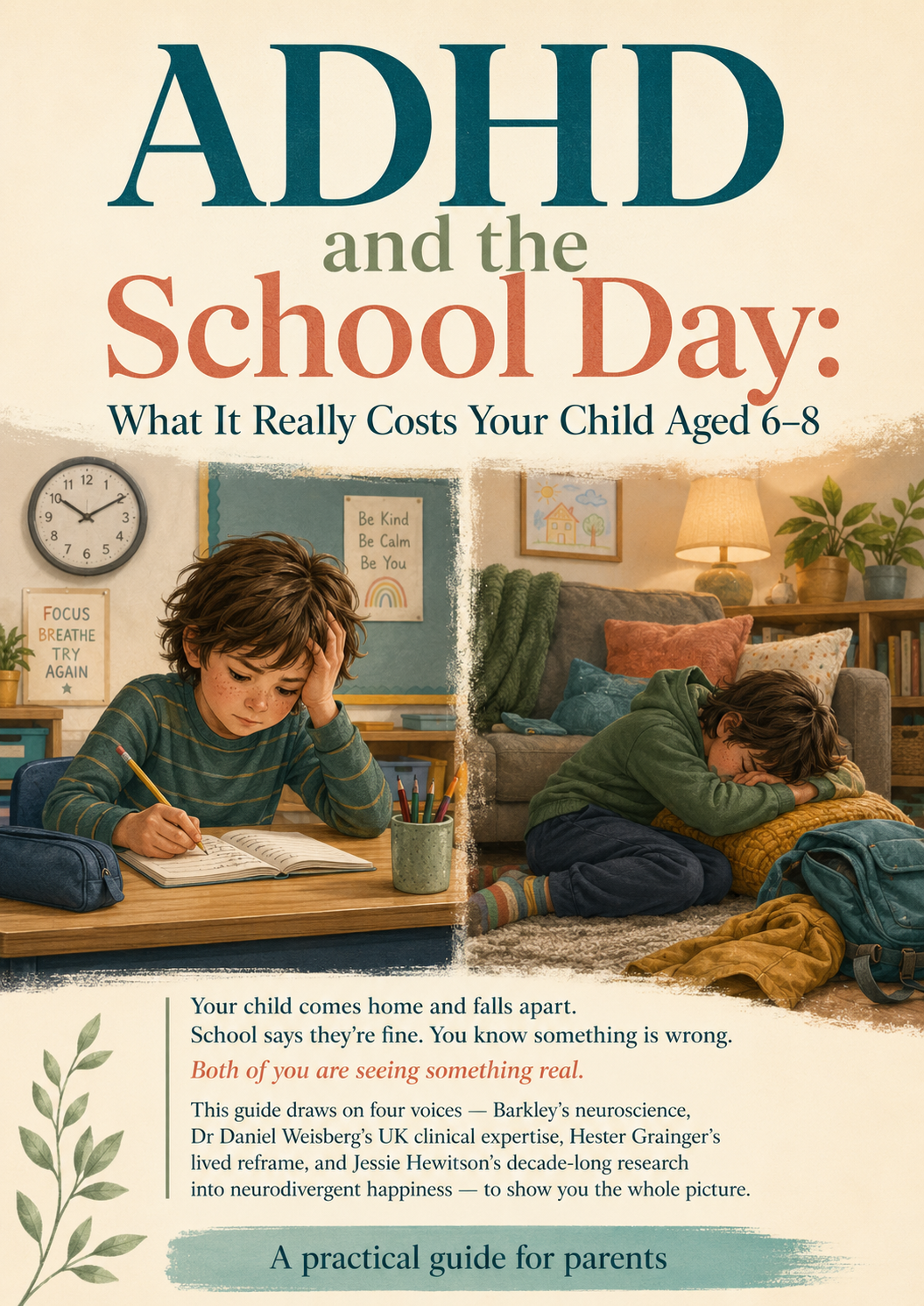
ADHD and the School Day: What It Really Costs Your Child Aged 6–8 Your child comes home and falls apart. School says they're fine. You know something is wrong. Both of you are seeing something real. This guide draws on four voices —
Barkley's neuroscience, Dr Daniel Weisberg's UK clinical expertise, Hester Grainger's lived experience.
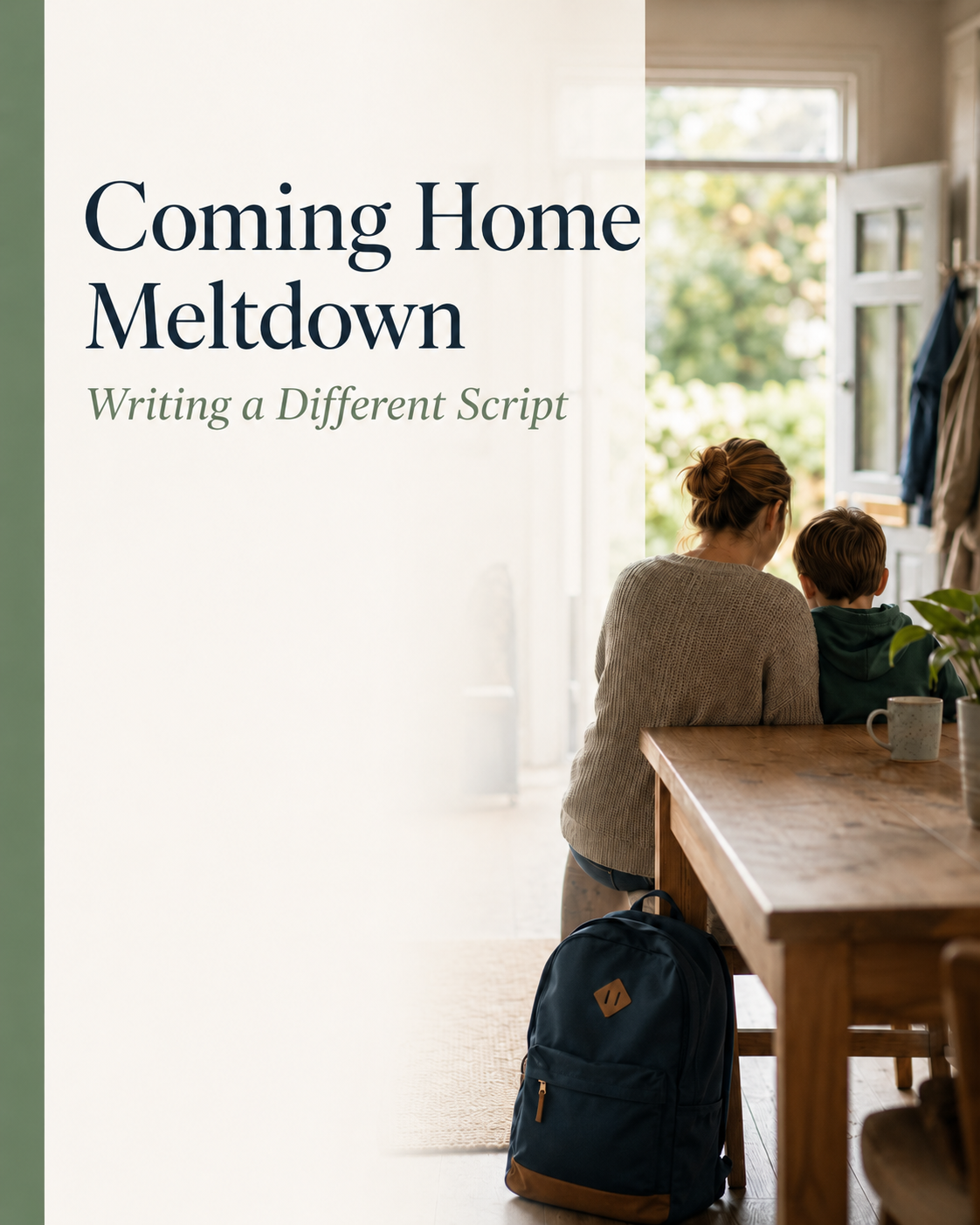
A reset plan for parents whose child holds it together at school and explodes at home. If your child walks out of school looking “fine” and falls apart over shoes, snacks, homework, noise, questions or the wrong cup, this guide gives you a calm starting point for the first 30 minutes after school.
Inside, you’ll get: what to do before pickup.

This guide covers the middle of primary school, roughly Year 4 to Year 5. It picks up where the early-years guide left off, because ADHD does not stay still. It changes shape as the demands change, and the demands change a great deal around now. Where a point rests on research, you will find a short note showing where it comes from.
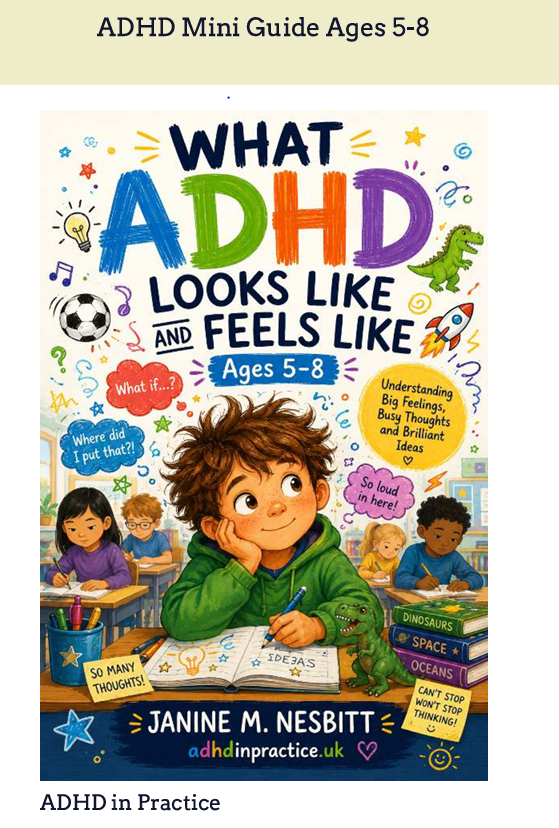
What it looks like. At this age, ADHD often looks like the child who can't sit on the carpet, blurts out, bounces off the walls, or melts down over small things. Or the quiet one who drifts off and gets missed. It gets called naughty, immature or "a handful." It's usually none of those.
What it feels like. Inside, it's a brain with everything turned up at once and no off switch. Big feelings that arrive fast and hard. Knowing the rule but not being able to do it in the moment. Working twice as hard as everyone else, and still being told to try harder.
That gap, between how it looks and how it feels, is where so many little ones get missed.
Books I would highly recommend

Written by Mr G — TikTok's ADHD teacher and Sunday Times bestselling author. Raps, movement breaks and a fidget feature help kids see their ADHD brain as a superpower, not a problem.
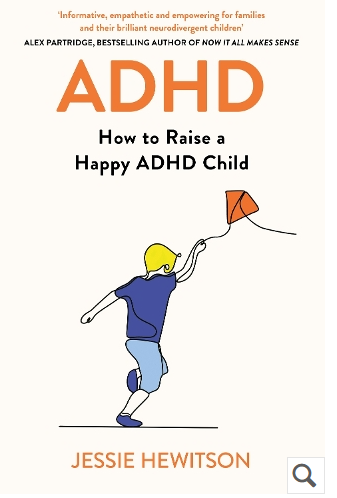
By Jessie Hewitson, The Times' SEND Agony Aunt and ADHD parent herself practical, honest answers on school, friendships and screen time battles, backed by leading researchers.

By ADHD therapist Sarah Templeton, diagnosed with ADHD herself at 51. Covers all three ADHD types, the traits nobody warns you about, and how to handle 30+ real-life meltdown moments — turning ADHD chaos into calm.

By Alex Partridge — UNILAD founder turned ADHD podcaster, diagnosed at 34. Raw, honest and expert-backed, covering everything from parenting to finances, with the reminder that ADHD brains aren't broken.
ADHD in Practice Downloads
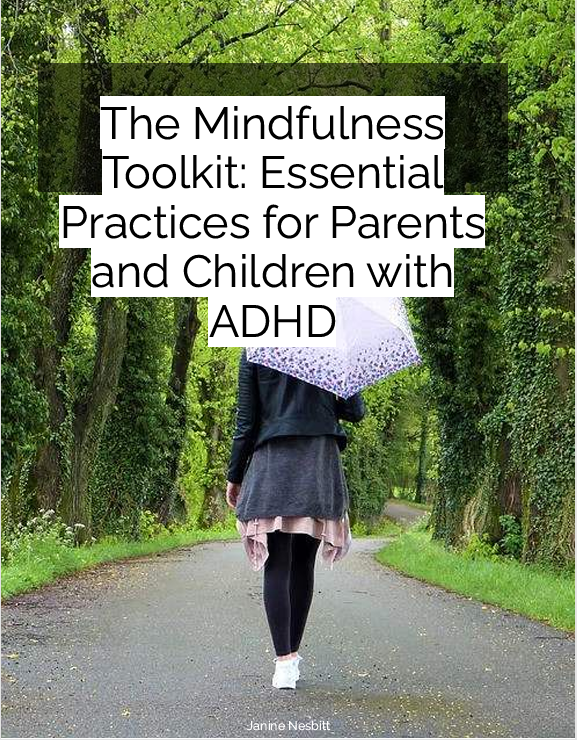
A downloadable product straight to your computer, tablet or phone. The Mindfulness Toolkit for ADHD families gives you simple, realistic strategies to help your child calm their body, settle their mind and regulate emotions - without expecting stillness, silence or long meditaton sessions.
Designed for busy UK parents, this toolkit includes quick mindfulness exercises, sensory grounding tools, ADHD friendly breathing techniques and easy scripts you can use during meltdowns, transitions or after-school overwhelm. Every activity is short, playful and tailored to how ADHD brains regulate best.
Perfect for parents, carers, teachers and SENDCOs who want practical emotional regulation tools that work in real life - at home, in school or on the go. More products coming soon.
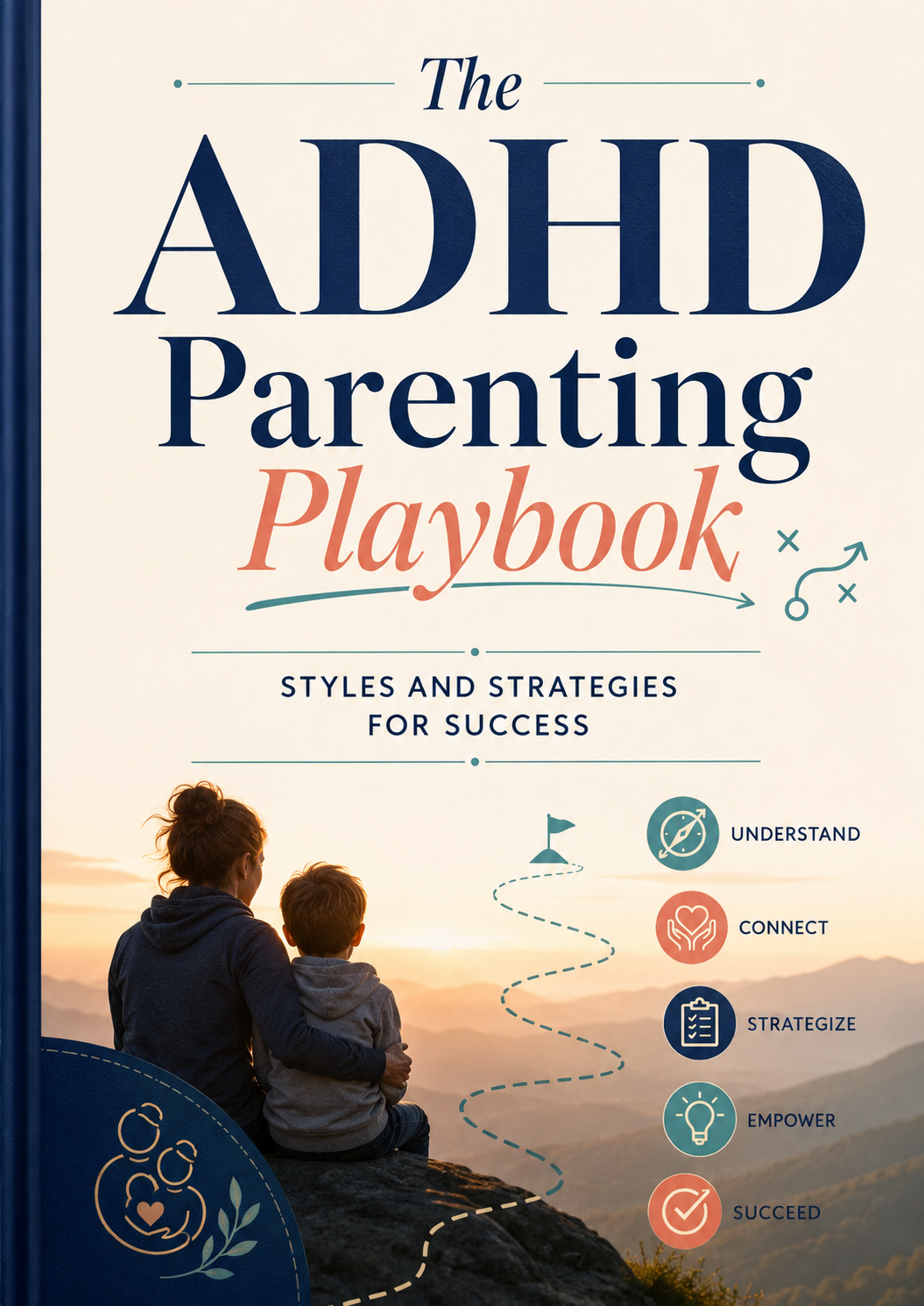
The ADHD Parent Playbook: Practical Strategies for Calmer Days, Stronger Connections and Less Conflict
Parenting a child with ADHD can feel relentless.
You may be dealing with emotional outbursts, difficult mornings, battles over homework, constant reminders, impulsive behaviour, sleep struggles, forgotten instructions and the feeling that everyone else seems to find family life easier.
The ADHD Parent Playbook is a practical, compassionate guide for parents who want to understand what is really happening beneath their child’s behaviour and know what to do next.
This is not about stricter parenting, more consequences or trying to force an ADHD child to fit strategies that were never designed for them.
It is about understanding the ADHD brain and using practical approaches that make everyday life more manageable.
Inside, you will learn how to:
understand ADHD behaviour and what may be driving it
support emotional regulation and reduce escalation
make mornings, routines and transitions easier
handle homework and everyday demands with less conflict
respond to impulsivity, frustration and overwhelm
recognise patterns before situations reach breaking point
build your child’s confidence, resilience and self-understanding
strengthen communication and connection at home
create realistic ADHD-friendly routines that your family can actually sustain
Whether your child has an ADHD diagnosis, is waiting for assessment, or you are beginning to wonder whether ADHD may explain what you are seeing, The ADHD Parent Playbook gives you practical ADHD parenting strategies you can start using immediately.
You do not need another parenting book telling you to be more consistent.
You need to understand why your child is struggling, what their behaviour may be communicating, and which strategies are most likely to help.
The goal is not perfect behaviour.
It is fewer battles, better understanding, stronger relationships and a home that works better for both you and your child.

Your child is struggling. You can see it. School can see it. You’ve filled in the forms, chased the SENCO, spoken to the GP — and now you’re in the NHS referral queue. A queue nobody warned you about. A queue with no updates, no timeline, and no professional checking in. A queue where your child is expected to “cope” while you wait… and wait… and wait.
Waiting Well is the guide every parent wishes they had the moment the referral goes in.
Inside, you’ll find clear, practical, evidence‑based strategies to help your child thrive during the long months (or years) before assessment — plus the tools you need to stay calm, confident, and informed while navigating a system that often leaves families in the dark.
This book gives you:
A realistic timeline of what the NHS referral process actually looks like
What schools can do now (and how to ask for it)
How to support emotional regulation without a diagnosis
Scripts, templates and checklists for meetings, teachers and GPs
What to track, what to ignore, and what actually matters
How to advocate without burning out
How to prepare for assessment long before you get the appointment
If your child is stuck in the gap between needing help and getting help, this guide shows you exactly how to bridge it.
You don’t have to wait helplessly. You can wait well.
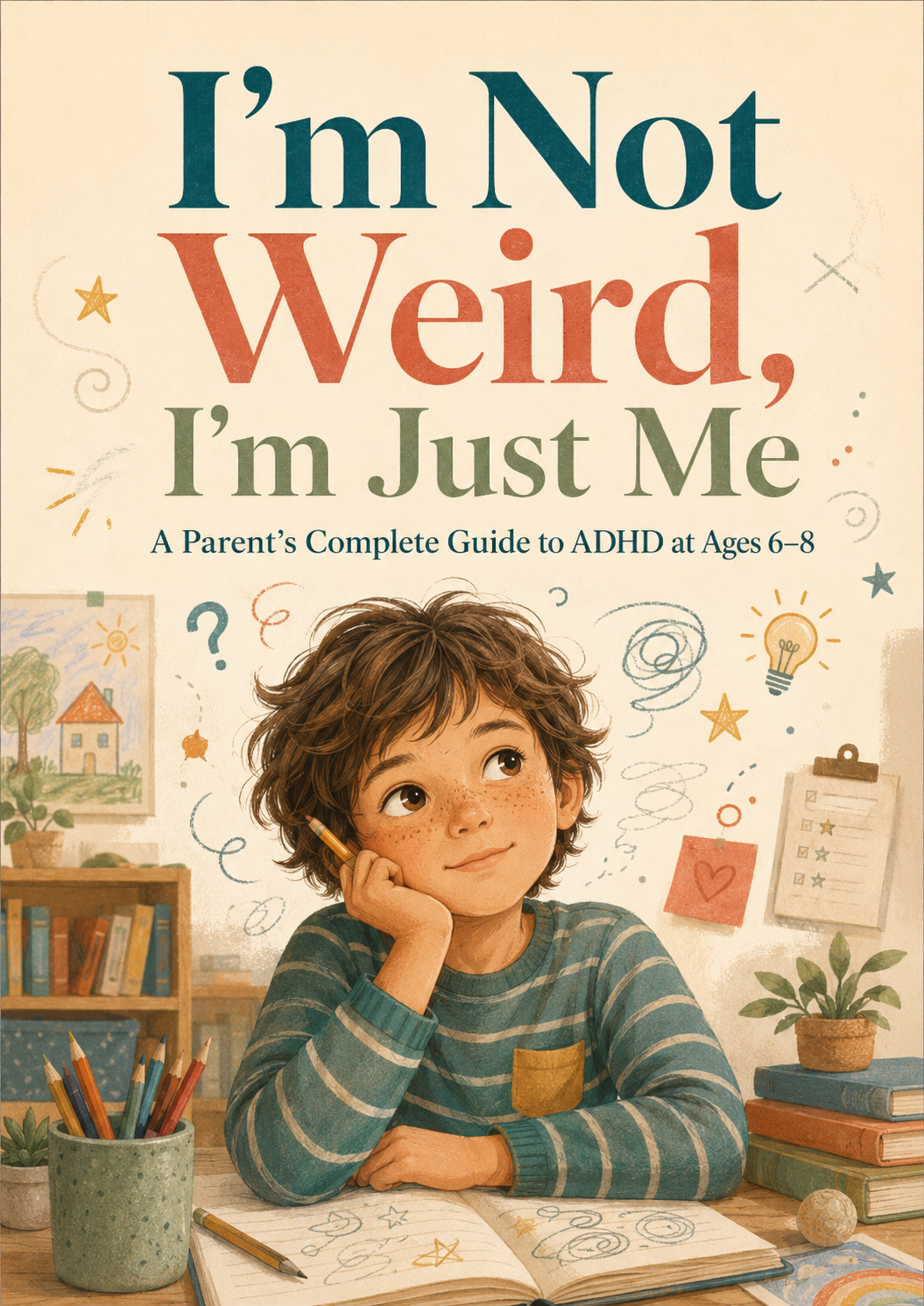
The guide for parents who knew something was different long before anyone else did. 100 pages. Ages 6–8. Five expert voices. UK-specific throughout. Written by a SENCo, a parent, and a late-diagnosed ADHDer who spent thirty-four years on the wrong side of this conversation. You can start right now — before any diagnosis.
Still not sure where to go see below.
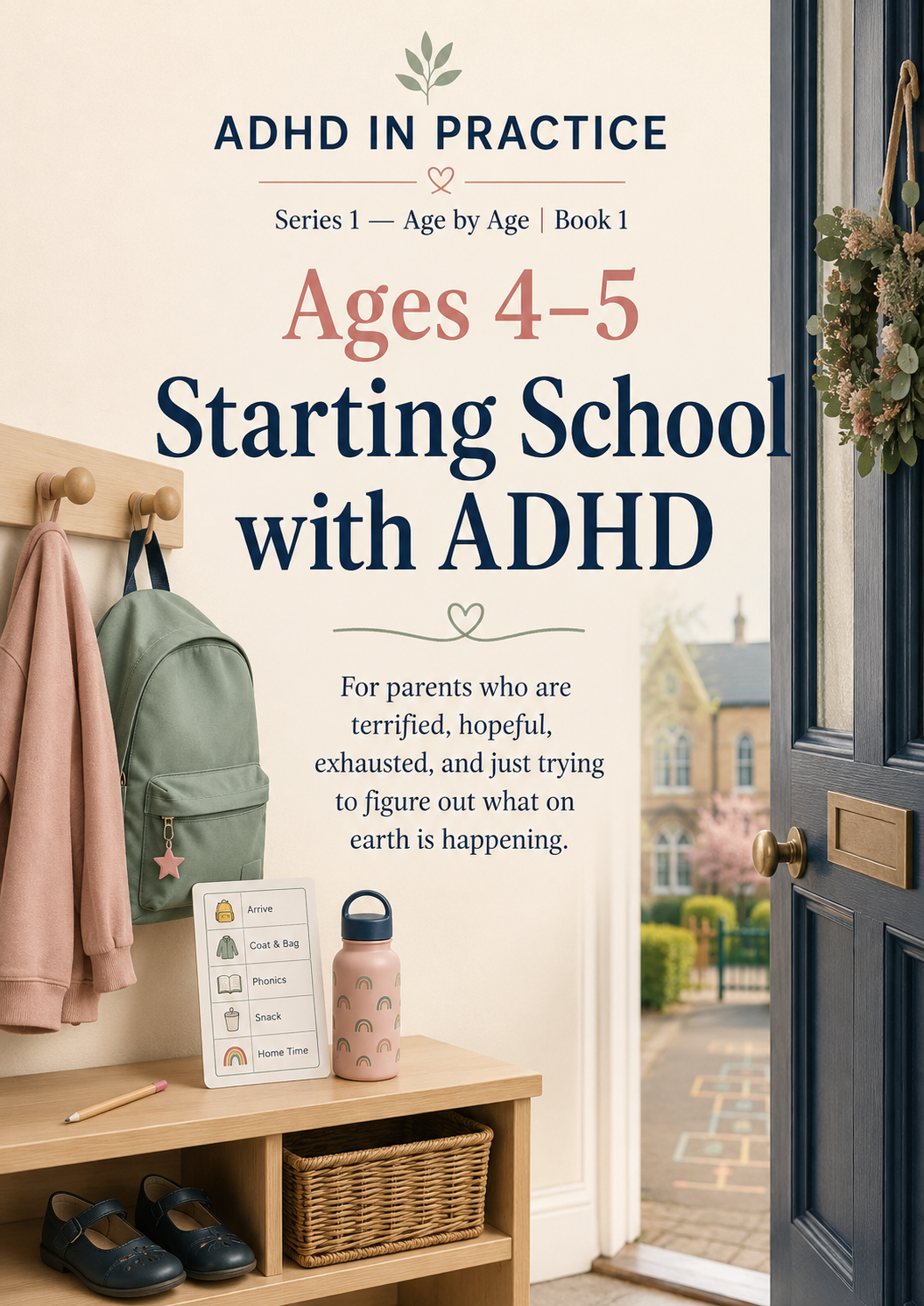
A practical UK parent guide for understanding ADHD in children aged 4–5 as they start nursery, Reception or school.
This guide explains what may be happening beneath the behaviour — from big emotions, impulsivity and after-school meltdowns to turn-taking, transitions, tiredness, sensory overload and the difference between how ADHD can look in boys and girls.
Warm, clear and realistic, it helps parents make sense of the early school years without shame, blame or panic.
For parents who are terrified, hopeful, exhausted — and just trying to work out what on earth is happening.

Not sure where to start? Ask me directly.
I will get back to you within 1-2 working days.
A calm, no-pressure conversation giving you time to explain what is happening and work out what your next step could be.
This call is for parents, grandparents and carers of children with any diagnosed or suspected SEND—not only ADHD.
Your child may be experiencing difficulties connected with autism, dyslexia, dyscalculia, anxiety, sensory needs, communication, learning, school attendance, emotional regulation or executive functioning. They may have several overlapping needs, or no diagnosis at all.
Children’s needs rarely arrive in neat, separate boxes. ADHD may overlap with autism, dyslexia, anxiety or sensory differences. A dyslexic child may also experience frustration, emotional overwhelm, shutdowns or meltdowns when learning demands repeatedly exceed the support available.
This is not a sales call. There is no hard pitch, no awkward pressure and absolutely no “book before midnight” nonsense.
During the call, we can talk about your main concern which could be:
what is worrying you most right now;
what is happening at home, at school or both;
the difficulties or patterns you have noticed;
whether learning needs, masking, anxiety, sensory overload or emotional regulation may be part of the picture;
questions you may need to ask school, your GP, CAMHS or an assessment service;
which SEND, NHS or school-support pathway may be worth exploring;
whether ADHD in Practice is the right fit for your family.
Your child may already have a diagnosis, be waiting for an assessment or simply have you thinking, “Something isn’t adding up.”
You do not need to arrive knowing the correct terminology. You do not need to decide whether it is ADHD, autism, dyslexia or something else before speaking to me.
Just tell me what is happening. We can begin there.
BOOK A FREE 15-MINUTE CALL