
Something doesn’t add up.
You know your child better than anyone. Deep down, you know something isn’t quite making sense.
Maybe it looks like ADHD.
Maybe autism. Maybe both.
Maybe anxiety, dyslexia, sensory needs or a learning difficulty.
Or maybe every article you read sounds a bit like your child — but none of them fully fit.
This page will help you slow the panic, organise what you’re seeing and begin to understand what might be sitting underneath the behaviour.
You don’t need to have all the answers before asking for support.
Parent Pattern Snapshot a document to help you record what is happening and a working document to reflect on and take into any meetings. You will be saying this is what I see, where do we go from here?
Not sure what is going on or what to do next?
Book a free 15 minute introductory call and we will make sense together.
Start with a free call, then gather your information. It is so easy to forget what happened and when and patterns if we do not write it down.
A calm, no-pressure conversation giving you time to explain what is happening and work out what your next step could be.
This call is for parents, grandparents and carers of children with any diagnosed or suspected SEND—not only ADHD.
Your child may be experiencing difficulties connected with autism, dyslexia, dyscalculia, anxiety, sensory needs, communication, learning, school attendance, emotional regulation or executive functioning. They may have several overlapping needs, or no diagnosis at all.
Children’s needs rarely arrive in neat, separate boxes. ADHD may overlap with autism, dyslexia, anxiety or sensory differences. A dyslexic child may also experience frustration, emotional overwhelm, shutdowns or meltdowns when learning demands repeatedly exceed the support available.
This is not a sales call. There is no hard pitch, no awkward pressure and absolutely no “book before midnight” nonsense.
During the call, we can talk about your main concern which could be:
what is worrying you most right now;
what is happening at home, at school or both;
the difficulties or patterns you have noticed;
whether learning needs, masking, anxiety, sensory overload or emotional regulation may be part of the picture;
questions you may need to ask school, your GP, CAMHS or an assessment service;
which SEND, NHS or school-support pathway may be worth exploring;
whether ADHD in Practice is the right fit for your family.
Your child may already have a diagnosis, be waiting for an assessment or simply have you thinking, “Something isn’t adding up.”
You do not need to arrive knowing the correct terminology. You do not need to decide whether it is ADHD, autism, dyslexia or something else before speaking to me.
Just tell me what is happening. We can begin there.
BOOK A FREE 15-MINUTE CALL
What you will get
A practical, free parent guide to help you spot patterns, make sense of what is happening at home and school, and work out what to ask next.
Useful if something does not quite add up, but you are not yet sure whether the difficulty relates to ADHD, autism, dyslexia, sensory differences, anxiety or another SEN need.

What you’ll get
A clearer picture of what is happening
Prompts to spot when and where difficulties show up
Space to compare what school sees with what happens at home
Clues to possible triggers, demands and pressure points
A simple way to record what helps and what makes things harder
Questions to take into conversations with school, the SENCo or your GP
A final “what do I ask next?” page so you are not left with a pile of notes and no plan
Your next step doesn’t have to be complicated.
Here is the pathway we use to help families get clarity.
1
Download Parent Pattern Snapshot
Start the Snapshot and reflect on your findings.
2
Book a free call
We will talk through what is going on and what you are worried about.
3
Get some Clarity
We will help you understand what might be behind the difficulties.
4
Know your options
We will talk through the right next steps for your child and family.
5
Move forward with confidence
With a plan that feels right, not just more confusion.

You are in the right place.
ADHD in Practice is a specialist SEND, ADHD and neurodevelopmental advice and support service for children, teens, young adults and families.
Evidence-based. Neuro-affirming. Parent-focused.
Ready to take the first step?
Book your 15 -minute call today.
No waiting lists. No pressure. Just an honest conversation.
For parents, grandparents and carers
15 minutes
Phone call with clarity
Does this sound familiar?
Parent support may be helpful when you understand that something is wrong, but the next step still feels unclear.
School avoidance
School says your child appears fine, while home sees anxiety, exhaustion, anger, shutdown or collapse.
Sensory Overwhelm
Mornings, homework, transitions, screens and bedtime take far more effort than they seem to for other families.
Learning Struggles
If school feels harder than it should, a learning difficulty may be part of the picture.

ADHD DOESN’T HAVE ONE LOOK
Girls with ADHD can also be:
loud and impulsive
highly energetic
constantly talking
funny and entertaining
argumentative
emotionally explosive
physically restless
risk-taking
intensely sociable
Others may appear:
quiet
dreamy
anxious
perfectionistic
disorganised
forgetful
overwhelmed
extremely conscientious
There isn't a “girl version” of ADHD. There are just girls whose ADHD is easier to overlook.

Behaviour is the final chapter
What happended before?
What demand felt too much?
What helped afterwards?
Understand the barrier before choosing the response.
What Do I Do Next?
You don't need to work out whether this is ADHD, autism, dyslexia, anxiety or something else before you start.
For now, look for patterns rather than labels.
1. Notice what keeps happening
Write down a few specific examples. When does your child struggle most — mornings, school, homework, friendships, transitions or after school?
2. Look at what happened before
The thing that caused the explosion may simply have been the last straw. Look backwards: tiredness, hunger, noise, demands, change, difficult work or a long day of holding it together.
3. Compare home and school
If school says they're fine but you're seeing something very different, don't argue over which version is correct. Both pictures matter. Ask school what they notice around attention, learning, transitions, friendships and coping.
4. Notice what helps
Does your child manage better with fewer instructions, more preparation, movement, quiet, visual reminders or extra time?
You are not trying to diagnose your child.
You're building a clearer picture of what they find difficult, what it costs them and what support might help.

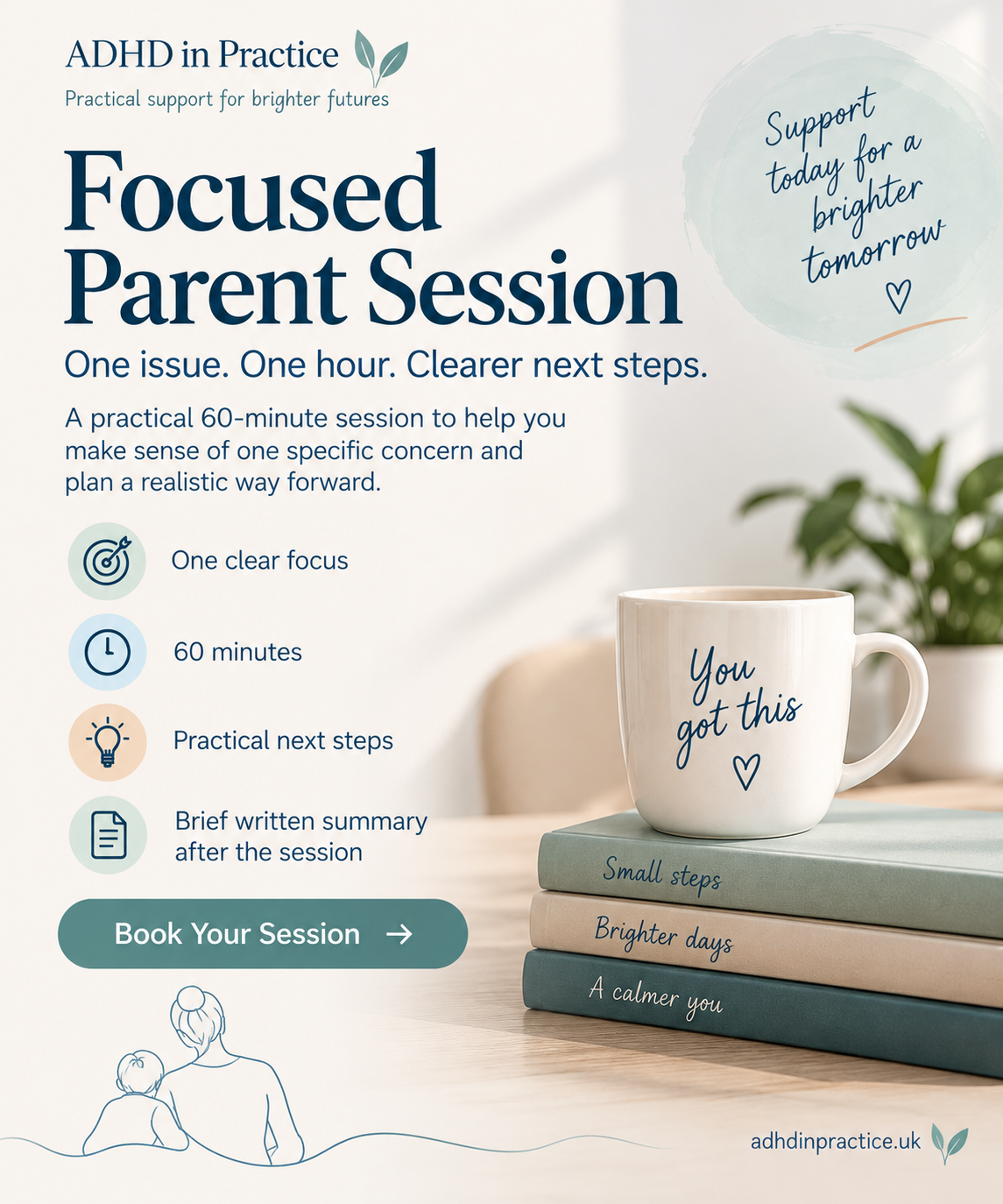
Still feeling stuck? How I can help you.
Book a focused call
What kind of support do you need?
You do not need to know exactly which service is right before you start.
Choose the option that sounds most like where you are now.
I need help with one main issue
You have one clear concern and want to talk it through properly.
This could be difficult mornings, after-school dysregulation, masking, friendship problems, a school conversation or another issue that keeps going round in circles.
Focused Parent Session
£135 | 60 minutes
How I can help
This is exactly what a Parent Clarity Session is for.
We look at what you are seeing at home, what school is reporting, what patterns are emerging and what the next sensible step may be.
That might involve:
ADHD support
SEND support
school meeting preparation
dyslexia concerns
autism traits
emotional regulation
EHCP questions
evidence gathering
referral pathways
No judgement.
No panic.
No twaddle.
Just a clearer picture and a plan.

Zoom or telephone call
A focused, parent support session to help you cut through the noise and work out what needs to change first.
Includes:
I will analyse your completed form and use it it to prepare guidance for telephone call or Zoom,
Zoom or call 60-minute online consultation;
individual discussion of your child’s needs and current difficulties;
clear priorities and recommended next steps;
a concise written follow-up summary;
20-minute review call within four weeks.
This session is for parents who know something is not working, but are not sure what the next step should be.
You may be dealing with emotional outbursts, morning battles, school worries, homework stress, anxiety, suspected ADHD, autism, dyslexia, sensory needs, friendship difficulties, sleep issues, behaviour concerns, masking, low confidence or a child who seems overwhelmed by everyday demands.
You do not need to arrive with a diagnosis, a folder of reports or a perfect explanation.
You can start with:
“I know something is wrong, but I don’t know what to do next.”
That is enough.
Best for parents who:
feel overwhelmed and do not know where to start
are constantly firefighting behaviour at home
have tried strategies that worked for a week, then disappeared into the void
are unsure whether the difficulty is ADHD, anxiety, autism, dyslexia, school stress, sensory overload or something else
need help understanding what may be driving their child’s behaviour
want practical next steps, not judgement or generic advice
need someone experienced to help them see the wood for the trees
What we can explore
Depending on what is happening for your child, we may look at:
behaviour patterns at home or school
emotional meltdowns and regulation difficulties
morning routines, homework, bedtime or transitions
possible ADHD traits
anxiety, masking or school-related stress
dyslexia, learning difficulties or confidence issues
sensory needs or overwhelm
communication with school
whether further support, assessment or SEND advice may be needed
This is not about jumping to a label.
It is about understanding the barrier.
Once the barrier is clearer, the next step becomes much easier to choose.
You leave with:
a clearer picture of what may be driving your child’s behaviour
practical, realistic next steps
ideas you can actually use at home or in school conversations
a better sense of what to prioritise first
less guilt and more direction
This session may help if you are thinking:
“I don’t know if this is ADHD or something else.”
“School says things are fine, but home feels impossible.”
“We have tried reward charts and nothing sticks.”
“I am tired of guessing what my child needs.”
“I need help before I speak to school.”
“I just need someone to help me make sense of it all.”
Your starting point when everything feels too much
The Parent Clarity Call gives you space to pause, talk through what is happening, and leave with a clearer plan.
No judgement.
No jargon.
No pretending one sticker chart will fix family life by Friday.
Just practical parent support, clear thinking and a sensible next step.
The Parent Clarity Consultation includes a focused discussion, a concise written summary of the key priorities and agreed next steps, and one 20-minute review call to be used within four weeks. It does not include a formal assessment, diagnosis, detailed report, legal advice, extensive document review or ongoing email support. Any additional sessions or written work are booked separately.
You are not overreacting.
If something feels wrong, it is worth exploring.
You do not need to know whether it is ADHD, autism, anxiety, dyslexia or something else before asking for help.
You just need a place to start.
Start with clarity. The labels can come later.