

Homework Without the Heartache
Homework should reinforce learning.
It should never damage confidence.
Every evening, thousands of families across the UK sit down with the best of intentions.
Within minutes, the tears begin.
Not because children don't care about learning.
Not because parents aren't trying hard enough.
But because homework often asks children to do one more difficult thing after they've already spent six hours working harder than most adults realise.
This isn't a page about abandoning homework.
It's about understanding when homework helps, when it doesn't, and how schools and families can work together to make learning come home without the nightly battles.
Whether you're a parent, teacher, SENCo or school leader, perhaps it's time we looked at homework through a different lens.
Learning should come home. Stress shouldn't.
The Homework We See and the Homework We Don't
Teachers often see tomorrow morning.
Parents see tonight.
School receives the completed worksheet.
Parents witness everything that happened before the first answer was written.
The procrastination.
The overwhelm.
The negotiation.
The frustration.
The tears.
The child who insists they can't do it.
The parent who slowly stops sounding like themselves.
Neither view is wrong.
They're simply looking at different parts of the same story.
Real collaboration begins when schools understand what happens after the school gates close, and parents understand the educational purpose behind the task.
Only then can homework become a bridge between home and school instead of another battleground.
By Home Time, Many Children Have Already Used Up Their Best Thinking
Imagine spending six hours concentrating on work that doesn't always come naturally.
Remembering instructions.
Ignoring distractions.
Navigating friendships.
Managing emotions.
Masking anxiety.
Trying not to get anything wrong.
For many children with ADHD, AuDHD, autism, dyslexia, dyscalculia and other SEND needs, that's not an occasional day.
That's every day.
Homework doesn't begin with a fresh brain. It begins with whatever energy is left. Sometimes that isn't much. Understanding this doesn't lower expectations.
It makes expectations realistic.


Perhaps We've Been Asking the Wrong Question
Parents often ask,
"How do I get my child to do their homework?"
Teachers often ask,
"Why isn't the homework being completed?"
I'd like to suggest a different question.
"What is this homework trying to achieve?"
If the answer is to practise spelling…Could that happen while playing a game?
If the answer is reading fluency…Could that happen by sharing a comic, football magazine or favourite story?
If the answer is practising number bonds…Could that happen through Uno, cards, dominoes or baking?
The learning objective matters.
The worksheet is simply one way of reaching it.
Sometimes it isn't the best way.
One Homework Sheet. Six Different Children.
The same worksheet can ask six completely different things of six different children.
A child with ADHD may struggle to get started.
A child with AuDHD may desperately want to complete it perfectly but feel paralysed by uncertainty.
An autistic child may become overwhelmed because the instructions feel unclear or the routine has changed.
A child with dyslexia may understand every concept but become emotionally drained trying to read and write it.
A child with dyscalculia may know what numbers represent yet struggle to manipulate them fluently.
Another child may complete it in five minutes without giving it a second thought.
The worksheet hasn't changed.
The demands it places on each brain have.
That's why fairness isn't always everyone doing the same thing.
Sometimes fairness means everyone having the best opportunity to succeed.
Homework That Builds Families Instead of Breaking Evenings
I'm not arguing that children should never practise outside school.
Far from it. Consolidation matters. Reading matters. Talking matters. Playing maths games matters. Sharing stories matters.
Helping to cook, measuring ingredients, keeping score in football, estimating shopping bills and reading bedtime stories all reinforce learning.
The difference is that these activities often build relationships at the same time.
Children remember how learning made them feel long after they've forgotten the worksheet.
The best homework leaves children feeling more capable.
Not more defeated.
Where Do We Go From Here?
Changing homework doesn't mean lowering standards.
It means raising our understanding.
Imagine if homework became an opportunity to share learning instead of simply proving it.
Imagine if schools and families worked together to find approaches that reinforced learning and protected childhood.
That's the conversation I want us to have.
Because education isn't just about preparing children for exams.
It's about preparing them for life.
And life is bigger than a worksheet.
Next Steps - Start here
A calm, no-pressure conversation giving you time to explain what is happening and work out what your next step could be.
This call is for parents, grandparents and carers of children with any diagnosed or suspected SEND—not only ADHD.
Your child may be experiencing difficulties connected with autism, dyslexia, dyscalculia, anxiety, sensory needs, communication, learning, school attendance, emotional regulation or executive functioning. They may have several overlapping needs, or no diagnosis at all.
Children’s needs rarely arrive in neat, separate boxes. ADHD may overlap with autism, dyslexia, anxiety or sensory differences. A dyslexic child may also experience frustration, emotional overwhelm, shutdowns or meltdowns when learning demands repeatedly exceed the support available.
This is not a sales call. There is no hard pitch, no awkward pressure and absolutely no “book before midnight” nonsense.
During the call, we can talk about your main concern which could be:
what is worrying you most right now;
what is happening at home, at school or both;
the difficulties or patterns you have noticed;
whether learning needs, masking, anxiety, sensory overload or emotional regulation may be part of the picture;
questions you may need to ask school, your GP, CAMHS or an assessment service;
which SEND, NHS or school-support pathway may be worth exploring;
whether ADHD in Practice is the right fit for your family.
Your child may already have a diagnosis, be waiting for an assessment or simply have you thinking, “Something isn’t adding up.”
You do not need to arrive knowing the correct terminology. You do not need to decide whether it is ADHD, autism, dyslexia or something else before speaking to me.
Just tell me what is happening. We can begin there.
BOOK A FREE 15-MINUTE CALL
Sometimes you do not need a full review of everything.
You may have one problem that keeps circling in your head.
Perhaps mornings are becoming impossible.
Perhaps your child is falling apart after school.
Perhaps school keeps saying they are fine.
Perhaps you have a meeting coming up and you are not sure what to ask for.
Perhaps you are stuck between “wait and see” and “something needs to change”.
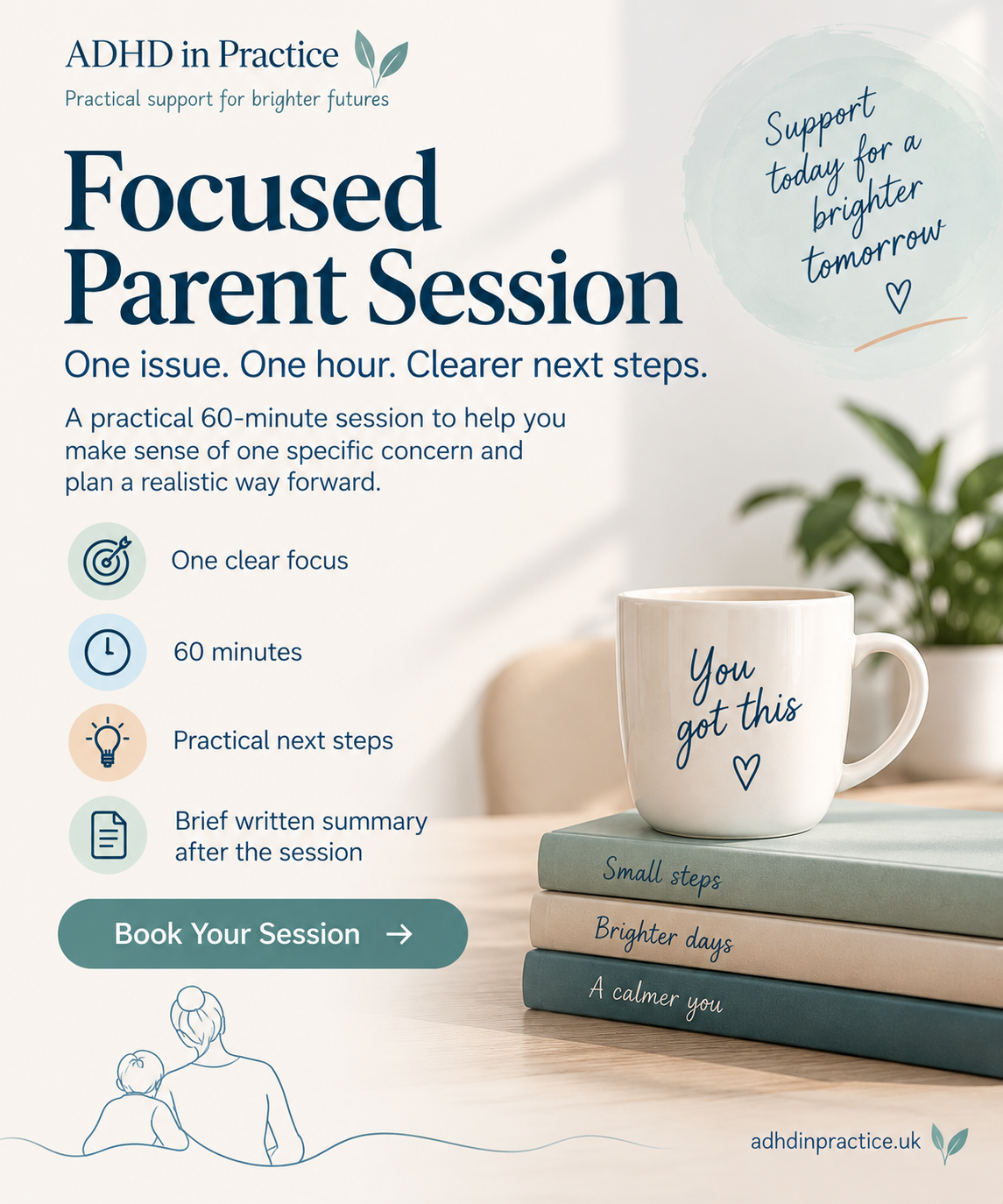
The Focused Parent Session is designed for exactly that.
This is a practical 60-minute session centred on one clearly defined issue. Zoom or telephone call.
We will look at what is happening, what may be underneath it, what has already been tried and what would be most useful to do next.
This is not a full document review, EHCP review or wider case analysis.
It is a focused space to stop going round in circles and work out the next sensible step.
This may be right for you if...
You are dealing with one main concern and need help thinking it through.
That might be school morning distress, after-school dysregulation, masking, friendship difficulties, a difficult school conversation, reduced attendance, behaviour that does not make sense or simply not knowing what to do next.
You may already have spoken to school and still feel unclear.
You may have received lots of advice but no actual plan.
Or you may simply need an experienced outside view to help you separate what matters now from everything else competing for your attention.
What the session includes
Before the session, you will be asked to identify the one issue you most want help with and provide a short summary of what has been happening.
During the session we will explore the pattern, identify what may be contributing to the difficulty and look at what is realistic for home and school.
The focus is practical.
Not pages of theory.
Not another list of things you “should” be doing.
We will work towards a small number of useful next steps that fit your child and your situation.
After the session, you will receive a brief written action summary so you are not left trying to remember everything we discussed.
You will leave with
A clearer understanding of what may be happening.
A better idea of what needs attention first.
A small number of practical next steps.
Clearer wording for what to say or ask if school is involved.
And, importantly, less of that feeling of:
“I know something is not right, but I do not know what to do with it.”
This session is not designed for
Extensive document review.
EHCP evidence analysis.
Appeal preparation.
Complex multi-agency cases.
Or situations where several issues need to be worked through in depth.
If your situation is broader or more complex, the full Parent Clarity Consultation is likely to be the better fit.
Focused Parent Session
60 minutes
£135
Includes a brief written action summary after the session.
One issue.
One clear focus.
One practical way forward.

Zoom or telephone call
A focused, parent support session to help you cut through the noise and work out what needs to change first.
Includes:
I will analyse your completed form and use it it to prepare guidance for telephone call or Zoom,
Zoom or call 60-minute online consultation;
individual discussion of your child’s needs and current difficulties;
clear priorities and recommended next steps;
a concise written follow-up summary;
20-minute review call within four weeks.
This session is for parents who know something is not working, but are not sure what the next step should be.
You may be dealing with emotional outbursts, morning battles, school worries, homework stress, anxiety, suspected ADHD, autism, dyslexia, sensory needs, friendship difficulties, sleep issues, behaviour concerns, masking, low confidence or a child who seems overwhelmed by everyday demands.
You do not need to arrive with a diagnosis, a folder of reports or a perfect explanation.
You can start with:
“I know something is wrong, but I don’t know what to do next.”
That is enough.
Best for parents who:
feel overwhelmed and do not know where to start
are constantly firefighting behaviour at home
have tried strategies that worked for a week, then disappeared into the void
are unsure whether the difficulty is ADHD, anxiety, autism, dyslexia, school stress, sensory overload or something else
need help understanding what may be driving their child’s behaviour
want practical next steps, not judgement or generic advice
need someone experienced to help them see the wood for the trees
What we can explore
Depending on what is happening for your child, we may look at:
behaviour patterns at home or school
emotional meltdowns and regulation difficulties
morning routines, homework, bedtime or transitions
possible ADHD traits
anxiety, masking or school-related stress
dyslexia, learning difficulties or confidence issues
sensory needs or overwhelm
communication with school
whether further support, assessment or SEND advice may be needed
This is not about jumping to a label.
It is about understanding the barrier.
Once the barrier is clearer, the next step becomes much easier to choose.
You leave with:
a clearer picture of what may be driving your child’s behaviour
practical, realistic next steps
ideas you can actually use at home or in school conversations
a better sense of what to prioritise first
less guilt and more direction
This session may help if you are thinking:
“I don’t know if this is ADHD or something else.”
“School says things are fine, but home feels impossible.”
“We have tried reward charts and nothing sticks.”
“I am tired of guessing what my child needs.”
“I need help before I speak to school.”
“I just need someone to help me make sense of it all.”
Your starting point when everything feels too much
The Parent Clarity Call gives you space to pause, talk through what is happening, and leave with a clearer plan.
No judgement.
No jargon.
No pretending one sticker chart will fix family life by Friday.
Just practical parent support, clear thinking and a sensible next step.
The Parent Clarity Consultation includes a focused discussion, a concise written summary of the key priorities and agreed next steps, and one 20-minute review call to be used within four weeks. It does not include a formal assessment, diagnosis, detailed report, legal advice, extensive document review or ongoing email support. Any additional sessions or written work are booked separately.