
ADHD is more than
what you see.
Your child may look settled at school but struggle at home. Or perhaps the everyday things other children manage seem so difficult. Understand the patterns, see beyond behaviour and find a sensible next step.
Guidance from a former SENCo and dyslexia specialist with 34+ years' experience in UK education.
Guidance from a former SENCo and teacher, dyslexia specialist, ADHD and SEND advocate with 34+ years’ experience in UK education.
AT SCHOOL
“They seem absolutely fine.”
AT HOME
“Something isn't adding up.”
Same child. Different demands.
ADHD EXPLAINED | Parent Guidance
Understanding ADHD is the beginning. What happens next?
See beyond the behaviour.
Practical support for parents noticing ADHD signs, awaiting assessment or navigating a diagnosis.
ADHD Evidence Checklist
FREE
Record patterns and prepare for school or an ADHD assessment.
The 3:45pm Survival Guide
FREE
Understand after-school meltdowns and support recovery.
Parent Clarity Consultation
£200 | 60 minutes
Make sense of overlapping concerns and plan next steps.
Focused Parent Session
£135 | 60 minutes
Practical advice for one specific ADHD challenge.
.
Parent Pattern Snapshot
FREE
Explore patterns in your child's behaviour, emotions and everyday challenges to identify where support may help.
Button: Explore my child's patterns
Understanding what ADHD really is — and what it isn't
Practical guidance for parents from a former SENCo, dyslexia specialist and ADHD advocate with 34 years of experience supporting children and families.
Start Understanding ADHD
If you've landed here, you're probably trying to make sense of things
Maybe your child:
forgets everything
loses everything
melts down over tiny things
never stops moving
seems constantly exhausted
struggles with friendships
appears fine at school but falls apart at home
Or perhaps somebody has mentioned ADHD and you're wondering whether that's really what is going on.
The truth is ADHD is one of the most misunderstood conditions in childhood.
It isn't a parenting problem.
It isn't caused by too much sugar.
It isn't laziness.
And it certainly isn't a child choosing to be difficult.

Attention in ADHD: Why It’s About Regulation, Not Willpower
One of the most common myths about ADHD is that children “can’t pay attention.” Any parent knows that isn’t true. The same child who forgets three instructions before reaching the kitchen can spend hours building Lego, researching dinosaurs, memorising football statistics or watching YouTube videos about their latest obsession.
The issue isn’t attention. It’s attention regulation.
The ADHD Attention “Spotlight”
Think of attention as a spotlight. Most people can move that spotlight where they need it to go. Children with ADHD often struggle to control it.
Sometimes the spotlight becomes too bright and locked on something interesting — this is hyperfocus. Other times it jumps rapidly from one thing to another, especially when a task feels boring, repetitive, difficult or emotionally unrewarding.
This is why ADHD can look so inconsistent from the outside. A child may seem capable and focused one moment, then completely overwhelmed the next. It’s not about “focusing when they want to.” ADHD is not a choice. It’s a difficulty regulating attention consistently.
Why Emotion and Attention Are Connected
Research increasingly shows that attention regulation is closely linked to emotional regulation. Children naturally pay attention to things that feel emotionally important.
Attention is pulled in by:
excitement
curiosity
novelty
urgency
genuine interest
Attention is pushed away by:
boredom
frustration
uncertainty
anxiety
This is why many children with ADHD appear highly motivated in some situations and completely shut down in others. It’s rarely about intelligence. It’s rarely about effort. It’s about a brain that struggles to regulate where attention goes, how long it stays there, and how easily it can move on.
A More Helpful Question for Parents and Schools
Understanding this changes everything. Instead of asking:
“Why won’t they pay attention?”
We start asking:
“What is making it hard for them to regulate their attention right now?”
That question leads to far more useful answers — and far more compassionate support.

What is ADHD?
Impulsivity: When Thoughts Move Faster Than Brakes
Impulsivity is one of the most misunderstood traits of ADHD. We often picture a child bouncing off walls, taking physical risks, or acting out. While that can happen, the reality is much deeper.
At its core, impulsivity is a glitch in timing. It is a neurological difficulty in creating a pause between a thought, an emotion, and an action.
In a neurotypical brain, an automatic safety switch asks: "Should I say this?" or "Is this a good idea?" Children with ADHD usually know the correct answers to these questions. Their challenge is that the action happens before the thinking catches up. The brain's brakes simply fail to engage in time.
How Impulsivity Manifests
Because impulsivity is fundamentally a missing internal pause, it drives everyday behaviors at school and home:
Overt Behaviors: Blurting out answers, interrupting conversations, grabbing items without asking, and acting on sudden ideas without considering the consequences.
Internal Whirlwinds: Jumping rapidly between thoughts, making snap assumptions, and abandoning tasks the moment frustration hits.
The Emotional Surge: Experiencing instant frustration, sudden tears, explosive anger, or overwhelming excitement. The child often knows they are overreacting, but their nervous system cannot regulate the emotional response in real time.
Thought or Emotion next Missing Pause ───► Immediate Action the impulse.
The Hidden Profile: Boys vs. Girls
Because society expects hyperactive disruption, gender bias often leaves struggling children unsupported.
The Visible Profile (More Common in Boys): This looks like calling out, physical risk-taking, and disrupting lessons. Because these behaviors interrupt the classroom, boys are usually referred for assessments early.
The Masked Profile (More Common in Girls): This looks like saying things they instantly regret, intense emotional volatility, and turbulent friendships. Many girls learn to suppress physical disruption to please adults, meaning their internal and social struggles are missed entirely.
Shifting the Perspective
When we understand the mechanics of ADHD, our approach changes entirely. Instead of looking at a disruptive event and asking, "Why did you choose to do that?", we look at the biology and ask:
"What happened to the pause between the feeling and the action?"
Impulsivity is rarely a child choosing to be difficult. It is the biological reality of a brain that is still learning how to build the crucial safety pause that others take for granted.
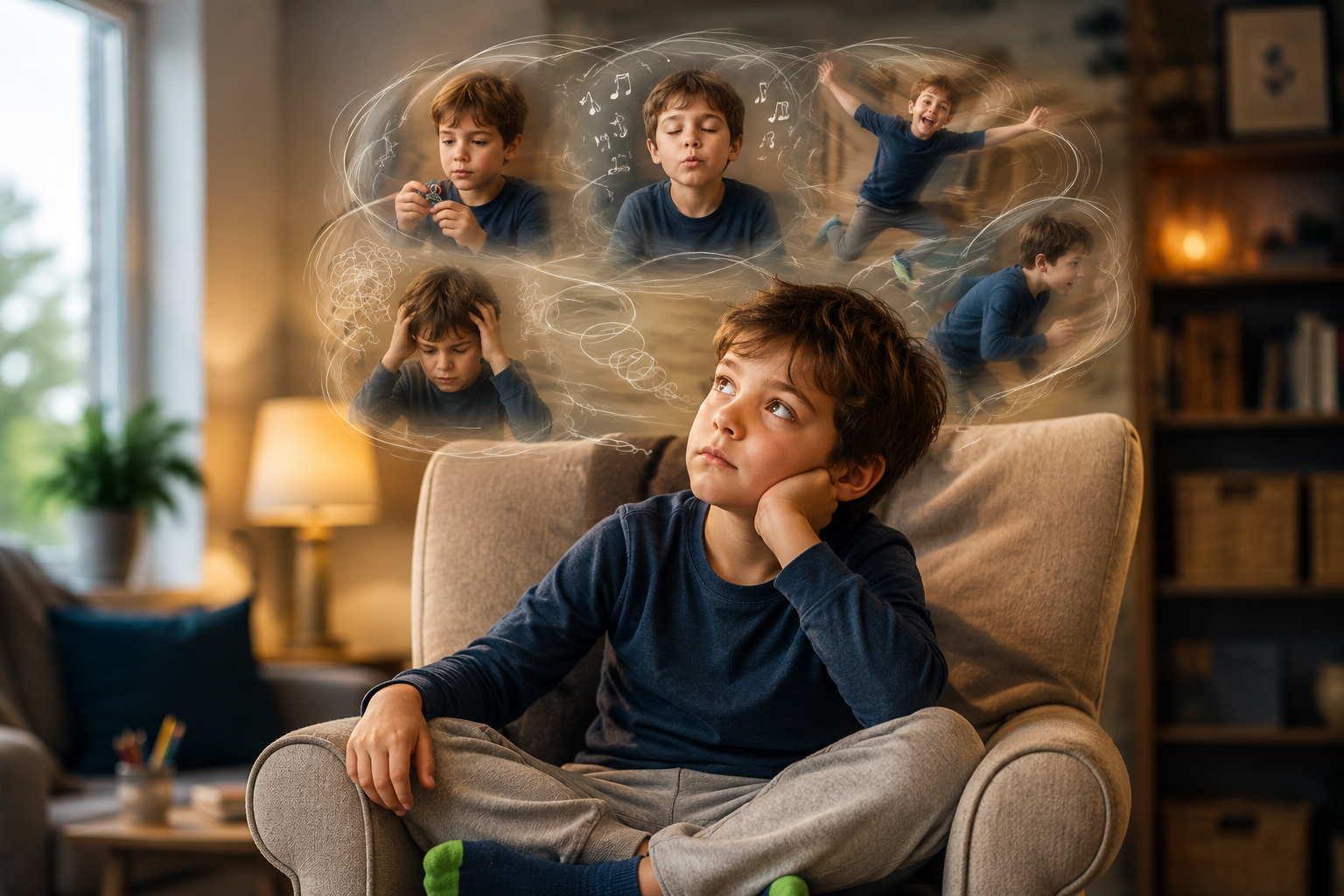
Hyperactivity: More Than Just School-Run Olympic Training
When people hear the word "hyperactivity," they usually picture a child running laps around the sofa, treating the living room curtains like an Olympic climbing wall, or vibrating at a frequency that could power a small village.
And look, sometimes ADHD is exactly that.
But very often, it isn’t. In fact, some of the most hyperactive children in the classroom barely move a muscle.
The real question we should be asking isn't "Why can't this kid sit still?" It's: "How much energy is this child wasting just trying to look normal?"
Hyperactivity isn’t a behavioral choice; it’s a nervous system that has been permanently wired to "high." Many children describe it as having a Ferrari engine for a brain, but bicycle brakes for a body. Some blast that energy outwards. Others keep the engine revving completely out of sight.
The Two Flavors of Hyperactivity
1. The "Loud & Proud" Profile
This is the classic version that gets teachers writing worried emails home. It’s the child who runs when walking is perfectly fine, treats a standard chair like an unstable yoga ball, talks at supersonic speed without stopping for oxygen, and seeks physical movement 24/7. It’s exhausting to watch, and it’s the number one reason boys get flagged for assessment early.
2. The "Quiet & Stealthy" Profile
This is the hidden version. On the outside, the child is sitting quietly. On the inside, their brain is currently hosting a 10,000-person music festival.
Quiet hyperactivity looks like:
Constant internal monologue that never hits the pause button
Aggressive doodling, hair-twirling, or sleeve-chewing
Sub-harmonic humming or Morse-code foot-tapping
Picking at cuticles or repeatedly shifting positions in a chair
Adults see a compliant child sitting still. What they don’t see is that the child is using 95% of their willpower just to stay in that seat, leaving only 5% to actually listen to the lesson.
The Stealth Hyperactivity of Girls
Girls are the absolute masters of the "Quiet & Stealthy" profile, which is exactly why they are routinely diagnosed years later than boys.
Society teaches girls very early on that physical disruption isn't "ladylike," so they internalize the chaos. Their hyperactivity doesn't look like climbing trees; it looks like excessive talking, racing thoughts, deep overthinking, and intense social anxiety. The physical restlessness is suppressed, but the mental engine is still traveling at 70 miles per hour while they lie perfectly still in bed, overanalyzing a conversation they had in 2021.
Plot Twist: Movement is the Medicine
Here is the biggest misconception in the UK school system: Adults think movement is a distraction. For an ADHD child, movement is the fuel for concentration.
When a child swings on their chair, taps their pen, or paces around the room, they aren't trying to be annoying. They are instinctively trying to stimulate a dopamine-starved brain so they can actually pay attention.
If you force an ADHD child to stop all physical movement, their brain effectively goes to sleep. Taking away the fidget toy doesn't make them focus on the whiteboard; it guarantees they focus entirely on how uncomfortable it is to sit still.
Changing the Script
When we understand that hyperactivity is just a coping mechanism for an overstimulated or under-aroused nervous system, our language changes. We stop asking, "Why can’t you just sit still?" and start asking:
"What does your nervous system need right now to feel balanced?"
They aren't trying to disrupt the world. They are just trying to survive a world that expects stillness from a brain built for motion.
Need Help Navigating the School Pushback?
If your child's school is punishing them for "fidgeting," threatening exclusions over natural ADHD behaviour, or refusing to allow basic sensory adjustments, it's time to put the law on your side.
Option 1: The First Step (100% Free)
Book a Free 15-Minute SEND introductory call. We’ll look at what your school is doing, unpick the excuses, and give you an immediate plan.
👉 Book Your Free 15-minute call
Option 2: The Focus call
A focused 60-minute session to talk through one concern, understand what may be driving it and work out practical next steps.
You’ll leave with clearer direction and a brief written action summary.
👉Book Your Focused Parent Call
Option 3: The Deep Dive
Got a massive school meeting coming up? Step up to our 60-Minute Parent Power Call. We will review your paperwork, script your legal pushback using the SEND Code of Practice, and make sure you walk into that room completely bulletproof.
👉 Book Your 60-Minute Parent Power Call
ADHD Is More Than An Attention Problem
One of the biggest myths about ADHD is that children simply cannot pay attention.
If that were true, they wouldn't spend hours building Lego, memorising football statistics or talking endlessly about their favourite interests.
ADHD is not a lack of attention.
It is a difficulty regulating attention, emotions, motivation and behaviour.
The brain systems responsible for planning, organising, prioritising, remembering, managing emotions and getting started on tasks develop differently.
This is why a child may be highly intelligent yet constantly lose belongings, forget instructions or struggle to complete everyday tasks.
The problem is not ability.
The problem is regulation.
Researchers such as Russell Barkley describe ADHD as a condition affecting self-regulation and executive functioning rather than simply attention.
Many children with ADHD are:
creative
imaginative
curious
energetic
passionate
funny
innovative thinkers
The challenge is not understanding what needs to be done.
The challenge is consistently managing thoughts, emotions, attention and actions in a world that demands these skills every day.
ADHD is not laziness.
It is not poor parenting.
It is a different way of experiencing and navigating the world.
The 3 Official Types of ADHD (And Why Social Media Says There Are 7)
When you receive an ADHD diagnosis through the NHS, CAMHS, or a UK private clinic, the specialists use two official medical manuals: the DSM-5 and the ICD-11. These frameworks recognize exactly three presentations of ADHD.
It is the same internal wiring; the volume knobs are just twisted differently for each child:
1. Inattentive Presentation (The Quiet One): This is frequently missed, particularly in girls. It looks like daydreaming, a workspace that looks like a minor explosion, instructions that vanish from their brain halfway across the kitchen, and a monumental struggle to start or finish tasks. These children mask heavily to appear "fine," which is why they are utterly exhausted by 3:30 PM.
2. Hyperactive/Impulsive Presentation (The Loud One): This is the profile that gets noticed early because it is impossible to ignore. It looks like constant physical movement, treating classroom chairs like sports equipment, blurting out answers, and acting first while thinking somewhere around next Tuesday.
3. Combined Presentation (The Mix): This is the most common diagnosis in children. The child displays a distinct, daily cocktail of both inattentive and hyperactive-impulsive traits.
Why Do Some Clinics and TikTok Videos Claim There Are 7 Types?
If you have spent any time researching online, you have likely come across the "7 Types of ADHD" model (originally popularized by the Amen Clinics in America). Parents often read these seven expanded descriptions and think, "Oh wow, that perfectly describes my child!"
Here is the straightforward truth: The "7 Types" model is not part of any official medical diagnostic system, and it is completely unrecognized by UK healthcare or education systems.
However, your connection to it isn't silly. It resonates because the official medical criteria used by doctors were written decades ago. While the official checklists have stayed largely frozen in time, modern science has moved miles ahead. We now know that real-life ADHD is a deeply layered, complex ecosystem where executive dysfunction, dopamine drops, sensory processing differences, anxiety, and emotional regulation all tangle together.
As the saying goes: when you have met one person with ADHD, you have met exactly one person with ADHD. The official label is just the front door; your child is the whole, complex house.
A Note From Me to You
Everything on this site comes from my training, my years as a SENCo and ADHD coach, and my lived experience as a mum who didn't always join the dots right away. I am not a clinician, and I don't diagnose. But I am fiercely passionate about making ADHD support accurate, relatable, and free of useless bureaucratic jargon for UK families who are clean out of patience.
If something here just clicked for you, the story doesn't have to end on this webpage. Let's look at your child's unique profile together.

You Don't Need To Work This Out Alone
After 34 years working in schools, I know how confusing ADHD can feel for parents.
Whether your child has a diagnosis, is waiting for assessment, or you're simply trying to understand what is happening, support is available.
Free introductory call
Related Articles
Related Articles - free downloads
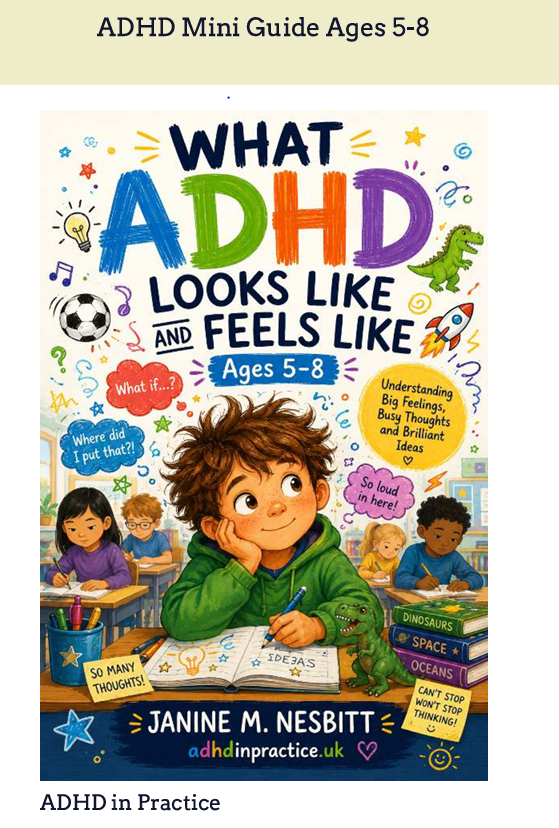
What it looks like. At this age, ADHD often looks like the child who can't sit on the carpet, blurts out, bounces off the walls, or melts down over small things. Or the quiet one who drifts off and gets missed. It gets called naughty, immature or "a handful." It's usually none of those.
What it feels like. Inside, it's a brain with everything turned up at once and no off switch. Big feelings that arrive fast and hard. Knowing the rule but not being able to do it in the moment. Working twice as hard as everyone else, and still being told to try harder.
That gap, between how it looks and how it feels, is where so many little ones get missed.

This guide covers the middle of primary school, roughly Year 4 to Year 5. It picks up where the early-years guide left off, because ADHD does not stay still. It changes shape as the demands change, and the demands change a great deal around now. Where a point rests on research, you will find a short note showing where it comes from.
ADHD Blog with a difference