

ADHD After School Meltdowns
School says they've had a great day. So why does everything fall apart when they get home?
Your child walks out of school apparently fine.
Ten minutes later they are crying in the car, shouting about the wrong snack, refusing to talk or collapsing on the sofa.
It can feel as though the meltdown came from nowhere.
Usually, it didn't.
For some children with ADHD, the school day involves hours of managing noise, instructions, transitions, friendships, executive-function demands and the effort of keeping themselves together.
The wrong snack may be the final trigger. It is rarely the whole story.
This guide explains why ADHD after-school meltdowns can happen, what to look for and what may help your child recover after the school day.
Think about how we can work together, helping you, your child and your family. You have googled help found me - take it one step further book a free call to start that journey.
Choose support for you, your school conversations or your child. You have to start somewhere. Start with a free 15 minute call.
A calm, no-pressure conversation giving you time to explain what is happening and work out what your next step could be.
This call is for parents, grandparents and carers of children with any diagnosed or suspected SEND—not only ADHD.
Your child may be experiencing difficulties connected with autism, dyslexia, dyscalculia, anxiety, sensory needs, communication, learning, school attendance, emotional regulation or executive functioning. They may have several overlapping needs, or no diagnosis at all.
Children’s needs rarely arrive in neat, separate boxes. ADHD may overlap with autism, dyslexia, anxiety or sensory differences. A dyslexic child may also experience frustration, emotional overwhelm, shutdowns or meltdowns when learning demands repeatedly exceed the support available.
This is not a sales call. There is no hard pitch, no awkward pressure and absolutely no “book before midnight” nonsense.
During the call, we can talk about your main concern which could be:
what is worrying you most right now;
what is happening at home, at school or both;
the difficulties or patterns you have noticed;
whether learning needs, masking, anxiety, sensory overload or emotional regulation may be part of the picture;
questions you may need to ask school, your GP, CAMHS or an assessment service;
which SEND, NHS or school-support pathway may be worth exploring;
whether ADHD in Practice is the right fit for your family.
Your child may already have a diagnosis, be waiting for an assessment or simply have you thinking, “Something isn’t adding up.”
You do not need to arrive knowing the correct terminology. You do not need to decide whether it is ADHD, autism, dyslexia or something else before speaking to me.
Just tell me what is happening. We can begin there.
BOOK A FREE 15-MINUTE CALL
Not sure what kind of help you need yet?
Start with a free 15-minute introductory call.
Tell me what is happening, what you are worried about and where you feel stuck. I’ll help you work out whether one of my services is the right next step for your family.
Already know the problem you need help with?
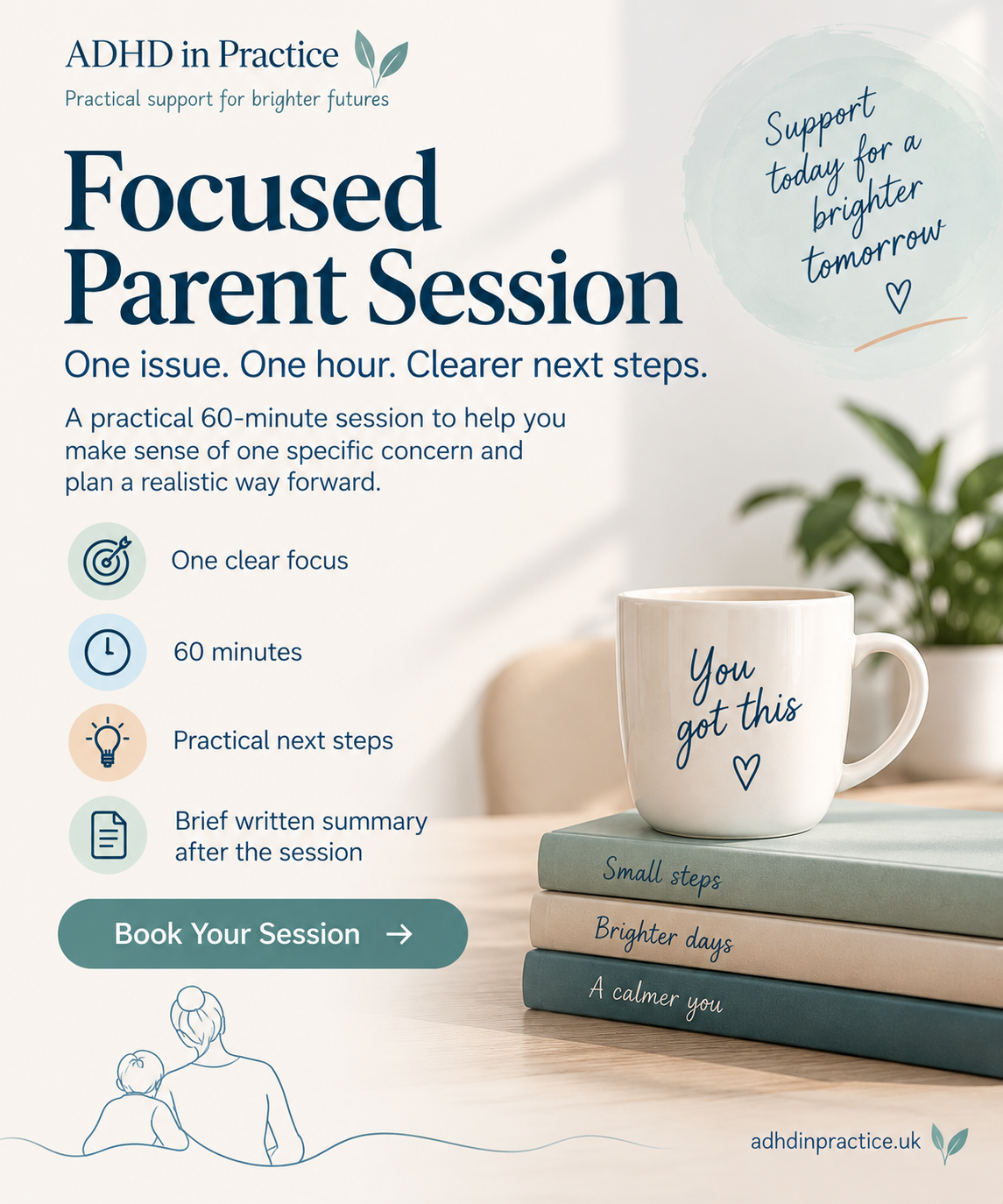
Book a Focused Parent Session.
This is a 60-minute session for one clearly defined issue. We focus on the problem in front of you, work through what may be happening and identify practical next steps you can actually use.
£135 | 60 minutes | One issue | Clear next steps
Sometimes you do not need a full review of everything.
You may have one problem that keeps circling in your head.
Perhaps mornings are becoming impossible.
Perhaps your child is falling apart after school.
Perhaps school keeps saying they are fine.
Perhaps you have a meeting coming up and you are not sure what to ask for.
Perhaps you are stuck between “wait and see” and “something needs to change”.
The Focused Parent Session is designed for exactly that.
This is a practical 60-minute session centred on one clearly defined issue. Zoom or telephone call.
We will look at what is happening, what may be underneath it, what has already been tried and what would be most useful to do next.
This is not a full document review, EHCP review or wider case analysis.
It is a focused space to stop going round in circles and work out the next sensible step.
This may be right for you if...
You are dealing with one main concern and need help thinking it through.
That might be school morning distress, after-school dysregulation, masking, friendship difficulties, a difficult school conversation, reduced attendance, behaviour that does not make sense or simply not knowing what to do next.
You may already have spoken to school and still feel unclear.
You may have received lots of advice but no actual plan.
Or you may simply need an experienced outside view to help you separate what matters now from everything else competing for your attention.
What the session includes
Before the session, you will be asked to identify the one issue you most want help with and provide a short summary of what has been happening.
During the session we will explore the pattern, identify what may be contributing to the difficulty and look at what is realistic for home and school.
The focus is practical.
Not pages of theory.
Not another list of things you “should” be doing.
We will work towards a small number of useful next steps that fit your child and your situation.
After the session, you will receive a brief written action summary so you are not left trying to remember everything we discussed.
You will leave with
A clearer understanding of what may be happening.
A better idea of what needs attention first.
A small number of practical next steps.
Clearer wording for what to say or ask if school is involved.
And, importantly, less of that feeling of:
“I know something is not right, but I do not know what to do with it.”
This session is not designed for
Extensive document review.
EHCP evidence analysis.
Appeal preparation.
Complex multi-agency cases.
Or situations where several issues need to be worked through in depth.
If your situation is broader or more complex, the full Parent Clarity Consultation is likely to be the better fit.
Focused Parent Session
60 minutes
£135
Includes a brief written action summary after the session.
One issue.
One clear focus.
One practical way forward.
Online parent support across the UK, school and EHCP guidance focuses on England.
Why does my ADHD child meltdown after school?
There is rarely one single cause. After-school meltdowns often happen when a child has spent the whole day managing noise, instructions, transitions, friendships, expectations and the effort of holding themselves together.
By the time they get home, their capacity may be almost used up.
The meltdown might appear to be about the wrong snack, a sibling speaking to them or being asked to take their shoes off. But that small moment is often the final straw, not the whole reason.
Understanding what has been building across the day can help you spot patterns, reduce unnecessary demands and work out what support your child may need.
-
Some children spend the school day working very hard to look as though they are coping.
They may stay quiet, follow instructions, copy what other children are doing, or suppress signs that they are overwhelmed. From the outside, this can look like a child who is managing well. On the inside, it may be taking a huge amount of effort.
By the time they get home, they may no longer have the energy to keep holding everything in. What looks like a sudden meltdown is often the release of a whole day of pressure.
-
School can be a very busy sensory environment.
Noise in the classroom, scraping chairs, crowded corridors, bright lights, lunch halls, playgrounds and PE changing rooms can all add to a child’s load. A child may cope with those sensations during the school day because they have to, but the effort of doing so can build up.
-
School places constant demands on the brain skills that are often harder for children with ADHD.
Planning, organising, remembering instructions, switching tasks, controlling impulses, ignoring distractions and getting started on work can all take more effort. These demands can build up across the day until the child is mentally drained.
By home time, they may have very little capacity left for another instruction, request or decision. What can look like defiance may actually be a child whose ability to manage one more demand has temporarily run out.
-
Some children eat or drink very little during the school day.
Lunch may be rushed, noisy or socially difficult. Some children are so busy coping with the day that they barely notice their own hunger until they get home. For children taking ADHD medication, appetite may also be reduced for part of the day.
By home time, they may be hungry, thirsty and tired, but not necessarily able to explain that clearly. A predictable snack and drink after school can sometimes make a surprisingly big difference.
-
School is tiring for most children. For a child who is also managing ADHD, anxiety, sensory demands or masking, the tiredness can be much greater.
They may look energetic right up until they suddenly are not. Tired children usually have less capacity to cope with disappointment, changes, questions and extra demands.
Sometimes the most useful question is not, “Why are they behaving like this?” but, “How much have they already had to manage today?”
-
Transitions can be difficult for some children with ADHD, and the school day is full of them.
Home to school. Lesson to lesson. Classroom to playground. Teacher to teacher. School to home. Even positive changes can take effort, especially when the child is already tired or overloaded.
If your child struggles particularly around pick-up time, the shift from holding it together at school to suddenly being back in their safe space may be part of the difficulty. Reducing demands during that transition can help.
Medication timing
For children who take ADHD medication, timing can sometimes affect what parents see after school.
If medication is wearing off towards the end of the school day, some children may experience a return or increase in ADHD symptoms, tiredness, irritability or emotional intensity. This can add to the strain of an already demanding day.
That does not mean medication is necessarily the cause of the meltdown. But if you notice a clear and repeated pattern at a particular time of day, it is worth recording and discussing with the child’s prescribing clinician. Do not change medication timing or dosage without medical advice.
But School Says They're Fine, Whilst Home Is Falling Apart
ADHD After-School Meltdowns
"School says they had a great day."
So why are they crying in the car, shouting over a snack or collapsing on the sofa the moment they get home?
After-school meltdowns are real - you are not alone - they are often not about what has just happened, the pick-up, the snack. They are the result of a child your child who has spent all of the day coping, masking and meeting expectations, according to school!
Learn what may be driving the behaviour and practical ways to help your child recover from the demands of the school day.
The wrong snack did not cause the meltdown. It is a build up over the day.
Difficult Lesson and a noisy classroom. “Too much noise.”
Friendship problems. She looked at me in the wrong way!
Change of timetable and maybe a supply teacher. I don’t know them.
Hungry, I hardly touched my lunch and now I am so hungry I can’t explain!
Journey home we went a different way. My sister sat in my seat.
Wrong cup, wrong plate, I did not go in the house first!
OVERFLOW Guaranteed
The journey home matters
-
![ADHD in Practice]()
Decompression does not start at the front door. It may need to begin when school finishes.
Quiet in the car or the walk home. No questions.
-
![ADHD headphones time to chill]()
Headphones
Peace and quiet.
-
![ADHD snacking]()
Snack
A healthy snack.
-
![ADHD and thirst]()
Drink
A healthy drink.
-
![ADHD conversation]()
Less conversation
Do not ask questions.
-
![ADHD music helps to relax a brain]()
Music
Play music to calm.
-
![A young boy sitting at a desk, leaning on one hand with eyes closed, holding a pencil, with colorful stationery in a container beside him, in front of bright window blinds.]()
Predictable routine
Keep things the same.


The first 30 minutes after school.
0-10 minutes
Food
Drink
Toilet
Shoes/uniform
fewer questions.
10-20 minutes
Movement
quiet
familiar activity
sensory regulation
20-30 minutes
Reconnect
Gentle connection
No interrogation
What If the Meltdown Has Already Started?
If your child is overwhelmed:
Reduce words.
This isn't the moment for a five-minute explanation.
Reduce demands.
Remove what can reasonably wait.
Reduce stimulation.
Noise, people and conversation may all add to overload.
Prioritise safety.
If behaviour is unsafe, safety comes first.
Don't insist on an apology immediately.
Repair matters.
But meaningful repair happens after regulation has returned.
For a fuller explanation of what happens during dysregulation, read:
What NOT to Do Straight After School
Where possible, avoid piling on:
lots of questions
immediate homework
lectures about something school reported
unnecessary decisions
demands to discuss feelings
interrogation about friendships
consequences while your child is already overwhelmed
There will be time for conversations.
Regulation first. Information later. mean that school is easy. The problem here is when “coping strategies” become the substitute for adults making reasonable changes.
Emotional Meltdowns: 10 Questions UK Parents Often Ask Me - so you know you are not alone.
Explore Emotional Regulation Further

3.45 Survival Guide. Read for free
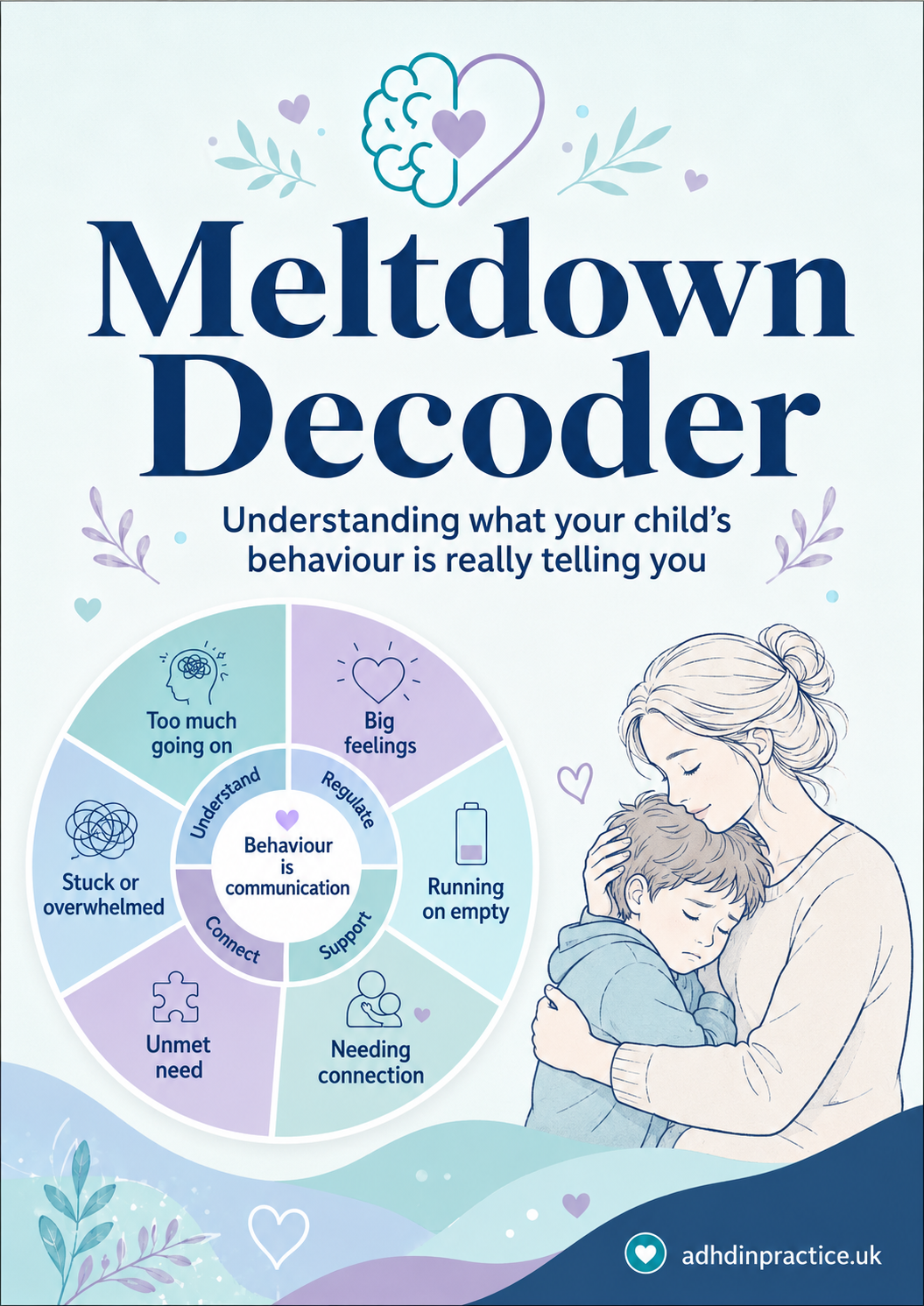
Meltdown Decoder Guide. Read for Free
Related Articles
Not sure where to start? Ask me directly.
I will get back to you within 1-2 working days.