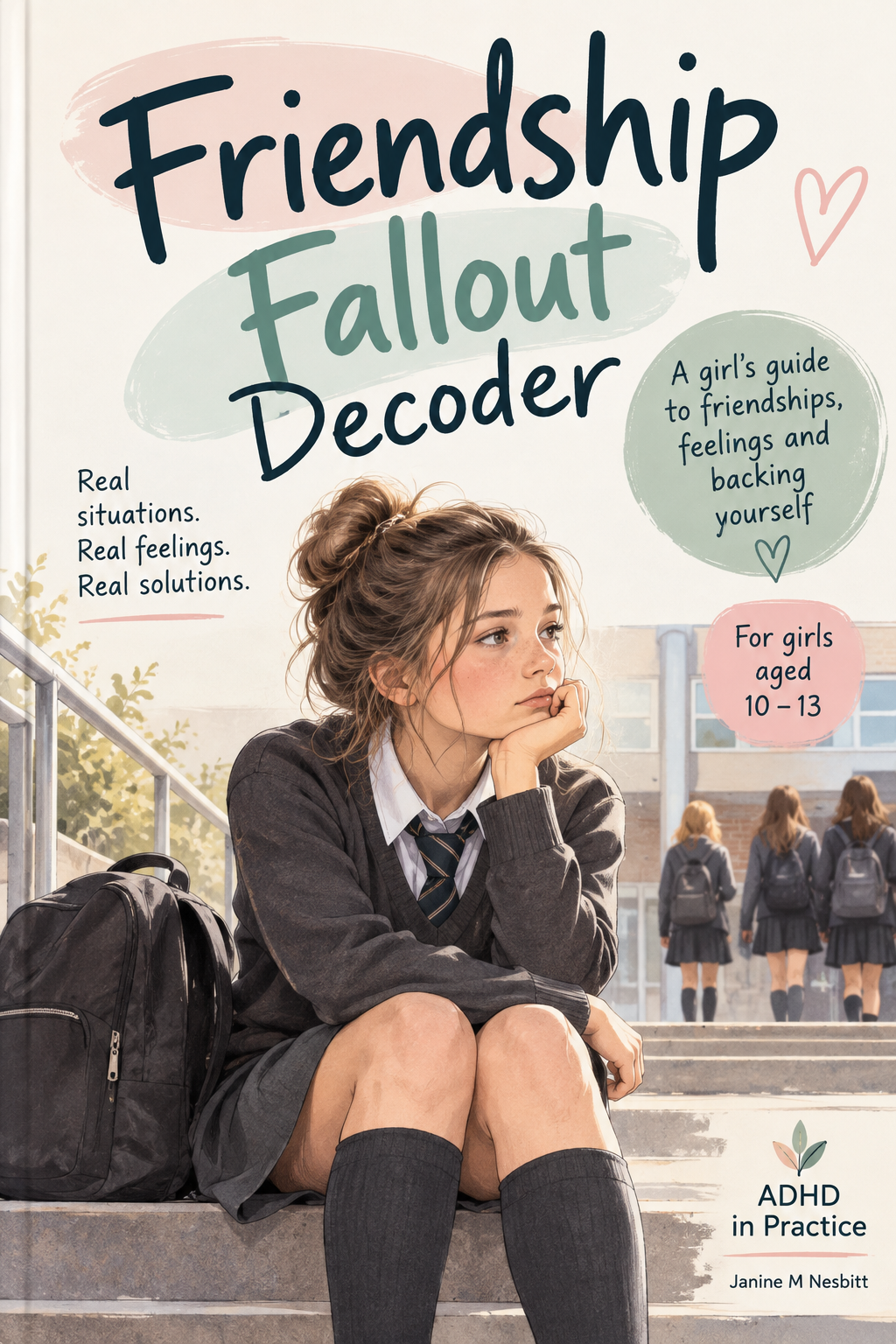
The Friendship Fallout Decoder

£0.00

When friendships get complicated, feelings get big, and you don't know what to do next.

A FREE 21-page friendship and feelings guide for girls aged 10–13

One day, they're best friends. The next day, someone isn't speaking, the group chat goes quiet, or she's left out at lunchtime.

For some girls, particularly those with ADHD, friendship difficulties can feel overwhelming.

What looks like a small disagreement to an adult can leave a girl questioning herself, replaying conversations, worrying about rejection or dreading school the next morning.

The Friendship Fallout Decoder helps girls make sense of what happened, understand how they feel and work out what to do next.

Created by Janine M Nesbitt, an experienced SEND specialist and former SENCo with over 34 years in education, this practical, reassuring guide combines relatable friendship situations, emotional literacy activities and straightforward strategies that girls can use in everyday life.

What's inside this free guide?

Across 21 thoughtfully designed pages, girls can explore:

  • Friendship fallouts: Understanding disagreements, misunderstandings and changing friendships.

  • Big feelings: Recognising disappointment, jealousy, anger, embarrassment and rejection.

  • Facts or worries? Learning to separate what actually happened from what they think might have happened.

  • Group chats and social pressures: Navigating messages, exclusion and the feeling of being left out.

  • Healthy friendships and boundaries: Understanding kindness, respect and when a friendship doesn't feel right.

  • Finding the right words: Practical phrases for difficult conversations, asking questions and repairing friendships.

  • When to ask for help: Recognising bullying, repeated exclusion or situations that feel unsafe.

  • Five ready-to-use scripts: Helping girls reach out to a trusted adult when it feels difficult to talk about what is happening.

There is also guidance to help parents and carers respond with understanding rather than rushing to fix everything.

Who is it for?

This guide is designed for girls aged 10–13, particularly those who:

  • Find friendships confusing or emotionally exhausting.

  • Worry about being left out or losing friends.

  • Replay conversations and wonder what they've done wrong.

  • Struggle to explain how they feel.

  • Find it difficult to speak up or set boundaries.

  • Need reassurance that they are not alone.

It may be particularly helpful for girls with ADHD, but a diagnosis isn't needed. Friendship difficulties and big emotions can affect anyone.

Why I've made it free

Friendships are an important part of growing up. They help children develop confidence, identity and a sense of belonging.

But when friendships become difficult, children don't always have the words or emotional tools to explain what they're experiencing.

After more than 34 years working in education, I believe girls deserve practical, age-appropriate support that helps them feel heard, understood and more confident.

Parents deserve that support too.

That's why I've made this comprehensive 21-page guide available completely free.

Because every girl deserves to feel that she belongs, without having to change who she is.

Download your free copy

21 pages | Printable PDF | Ages 10–13 | Completely FREE

A guide girls can explore independently, share with a trusted adult or work through together with a parent or carer.

If you need more help see below.

How I can help you and your family

Choose support for you, your school conversations or your child. You have to start somewhere. Start with a free 15 minute call.
Free 15-minute introductory call with ADHD in Practice Free 15-minute introductory call with ADHD in Practice
Quick View
Free 15-minute introductory call with ADHD in Practice
£0.00

A calm, no-pressure conversation giving you time to explain what is happening and work out what your next step could be.

This call is for parents, grandparents and carers of children with any diagnosed or suspected SEND—not only ADHD.

Your child may be experiencing difficulties connected with autism, dyslexia, dyscalculia, anxiety, sensory needs, communication, learning, school attendance, emotional regulation or executive functioning. They may have several overlapping needs, or no diagnosis at all.

Children’s needs rarely arrive in neat, separate boxes. ADHD may overlap with autism, dyslexia, anxiety or sensory differences. A dyslexic child may also experience frustration, emotional overwhelm, shutdowns or meltdowns when learning demands repeatedly exceed the support available.

This is not a sales call. There is no hard pitch, no awkward pressure and absolutely no “book before midnight” nonsense.

During the call, we can talk about your main concern which could be:

  • what is worrying you most right now;

  • what is happening at home, at school or both;

  • the difficulties or patterns you have noticed;

  • whether learning needs, masking, anxiety, sensory overload or emotional regulation may be part of the picture;

  • questions you may need to ask school, your GP, CAMHS or an assessment service;

  • which SEND, NHS or school-support pathway may be worth exploring;

  • whether ADHD in Practice is the right fit for your family.

Your child may already have a diagnosis, be waiting for an assessment or simply have you thinking, “Something isn’t adding up.”

You do not need to arrive knowing the correct terminology. You do not need to decide whether it is ADHD, autism, dyslexia or something else before speaking to me.

Just tell me what is happening. We can begin there.

BOOK A FREE 15-MINUTE CALL

Not sure what kind of help you need yet?

Start with a free 15-minute introductory call.

Tell me what is happening, what you are worried about and where you feel stuck. I’ll help you work out whether one of my services is the right next step for your family.

Book your free 15-minute call

Already know the problem you need help with?

Book a Focused Parent Session.

This is a 60-minute session for one clearly defined issue. We focus on the problem in front of you, work through what may be happening and identify practical next steps you can actually use.

£135 | 60 minutes | One issue | Clear next steps
Book a Focused Parent Session.

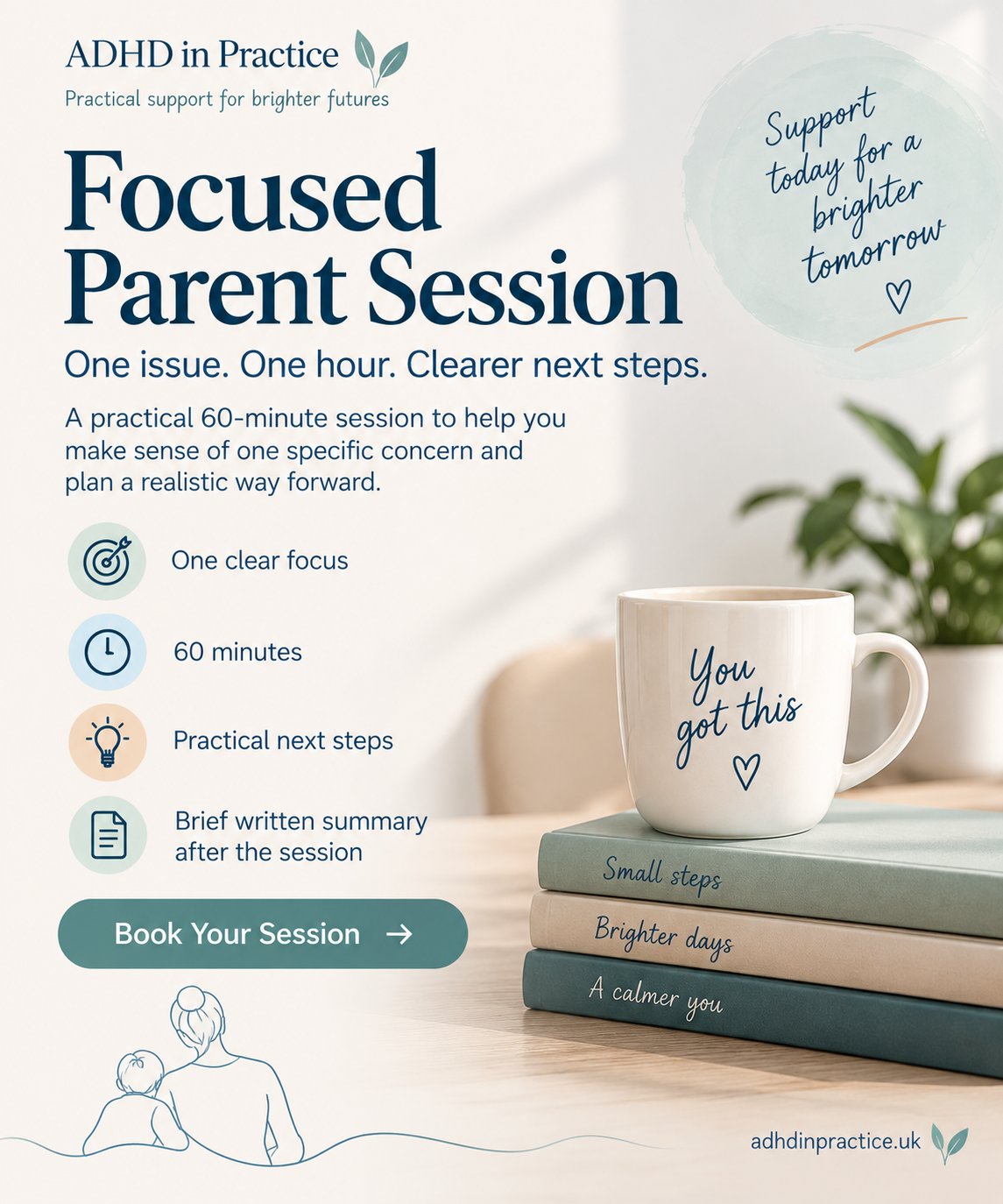
Focused Parent Session One issue. One hour. Clearer next steps.
£135.00

Sometimes you do not need a full review of everything.

You may have one problem that keeps circling in your head.

  • Perhaps mornings are becoming impossible.

  • Perhaps your child is falling apart after school.

  • Perhaps school keeps saying they are fine.

  • Perhaps you have a meeting coming up and you are not sure what to ask for.

  • Perhaps you are stuck between “wait and see” and “something needs to change”.

The Focused Parent Session is designed for exactly that.

This is a practical 60-minute session centred on one clearly defined issue. Zoom or telephone call.

We will look at what is happening, what may be underneath it, what has already been tried and what would be most useful to do next.

This is not a full document review, EHCP review or wider case analysis.

It is a focused space to stop going round in circles and work out the next sensible step.

This may be right for you if...

You are dealing with one main concern and need help thinking it through.

That might be school morning distress, after-school dysregulation, masking, friendship difficulties, a difficult school conversation, reduced attendance, behaviour that does not make sense or simply not knowing what to do next.

You may already have spoken to school and still feel unclear.

You may have received lots of advice but no actual plan.

Or you may simply need an experienced outside view to help you separate what matters now from everything else competing for your attention.

What the session includes

  • Before the session, you will be asked to identify the one issue you most want help with and provide a short summary of what has been happening.

  • During the session we will explore the pattern, identify what may be contributing to the difficulty and look at what is realistic for home and school.

  • The focus is practical.

  • Not pages of theory.

  • Not another list of things you “should” be doing.

  • We will work towards a small number of useful next steps that fit your child and your situation.

  • After the session, you will receive a brief written action summary so you are not left trying to remember everything we discussed.

You will leave with

  • A clearer understanding of what may be happening.

  • A better idea of what needs attention first.

  • A small number of practical next steps.

  • Clearer wording for what to say or ask if school is involved.

  • And, importantly, less of that feeling of:

  • “I know something is not right, but I do not know what to do with it.”

This session is not designed for

  • Extensive document review.

  • EHCP evidence analysis.

  • Appeal preparation.

  • Complex multi-agency cases.

  • Or situations where several issues need to be worked through in depth.

If your situation is broader or more complex, the full Parent Clarity Consultation is likely to be the better fit.

Focused Parent Session

60 minutes

£135

Includes a brief written action summary after the session.

One issue.

One clear focus.

One practical way forward.

Online parent support across the UK, school and EHCP guidance focuses on England.