
ADHD in Girls: When She Looks Fine But She’s Struggling
Signs, masking and practical support for UK parents
She remembers everyone else’s feelings but forgets her PE kit.
She holds it together at school and falls apart at home.
She may be quiet, capable, chatty, anxious, dreamy, perfectionistic or desperate to please.
ADHD in girls does not always look like the version people expect.
And when a girl becomes very good at hiding how hard things are, adults can underestimate just how much effort she is using to cope.
What will you find on this page?
✳︎
No two journeys are the same
✳︎
The impact
✳︎
ADHD and girls
✳︎
School says she is fine
✳︎
✳︎
What will you find on this page? ✳︎ No two journeys are the same ✳︎ The impact ✳︎ ADHD and girls ✳︎ School says she is fine ✳︎ ✳︎
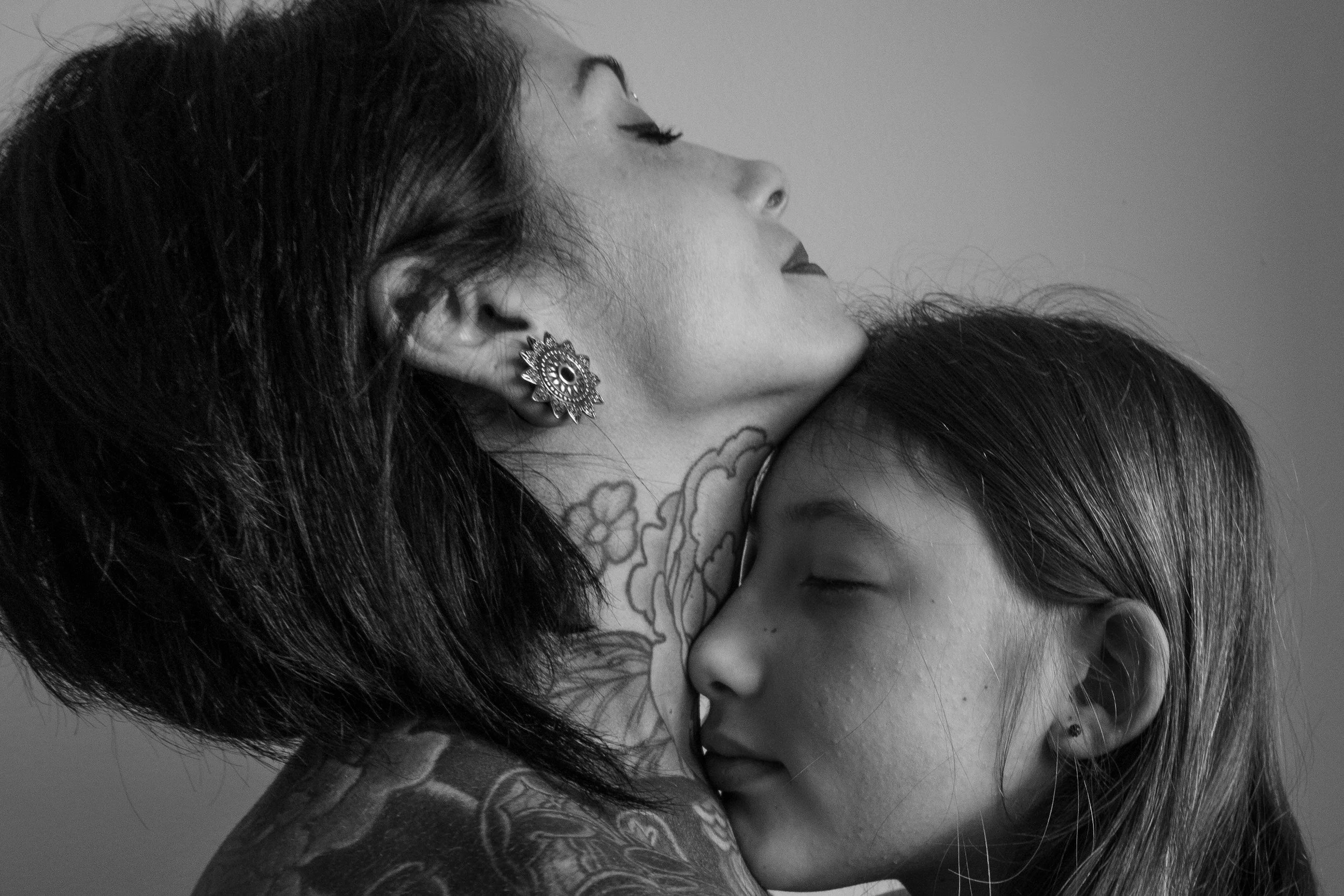
School Says She is Fine...
Home tells a very different story.
When school says your child is coping, but every afternoon ends in tears, meltdowns or complete exhaustion, it can leave you questioning everything. This page explains why it happens, what schools may not be seeing and how you can help both home and school understand the whole child.
She has friends
But friendships can be intense, confusing, exhausting or devastating when something goes wrong.
She isn't particularly hyperactive
But her mind may rarely be quiet.
She behaves beautifully at school
Then explodes, cries or completely shuts down when she gets home.
She is doing well academically
But homework takes hours, organisation is chaotic and everything seems to require enormous effort.
She is mature and helpful
Because being useful, agreeable and “good” can become part of how she stays safe.
She remembers incredibly specific things
Yet somehow cannot remember the water bottle she has taken to school 220 times.

ADHD DOESN’T HAVE ONE LOOK
Girls with ADHD can also be:
loud and impulsive
highly energetic
constantly talking
funny and entertaining
argumentative
emotionally explosive
physically restless
risk-taking
intensely sociable
Others may appear:
quiet
dreamy
anxious
perfectionistic
disorganised
forgetful
overwhelmed
extremely conscientious
There isn't a “girl version” of ADHD. There are just girls whose ADHD is easier to overlook.
The girl seen at school.
The girl you see at home.
SCHOOL MAY SEE
Polite
Helpful
Quiet
Hard-working
Chatty
Capable
Popular
“Sometimes a little distracted”
No significant behaviour problems
HOME MAY SEE
Exhaustion
Tears
Rage
Homework refusal
Sensory overload
Bedroom chaos
Arguments over tiny demands
“I can't do it”
“I hate myself”
Complete shutdown
Both versions can be real.
Coping at school does not automatically mean that school is easy. The problem here is when “coping strategies” become the substitute for adults making reasonable changes.
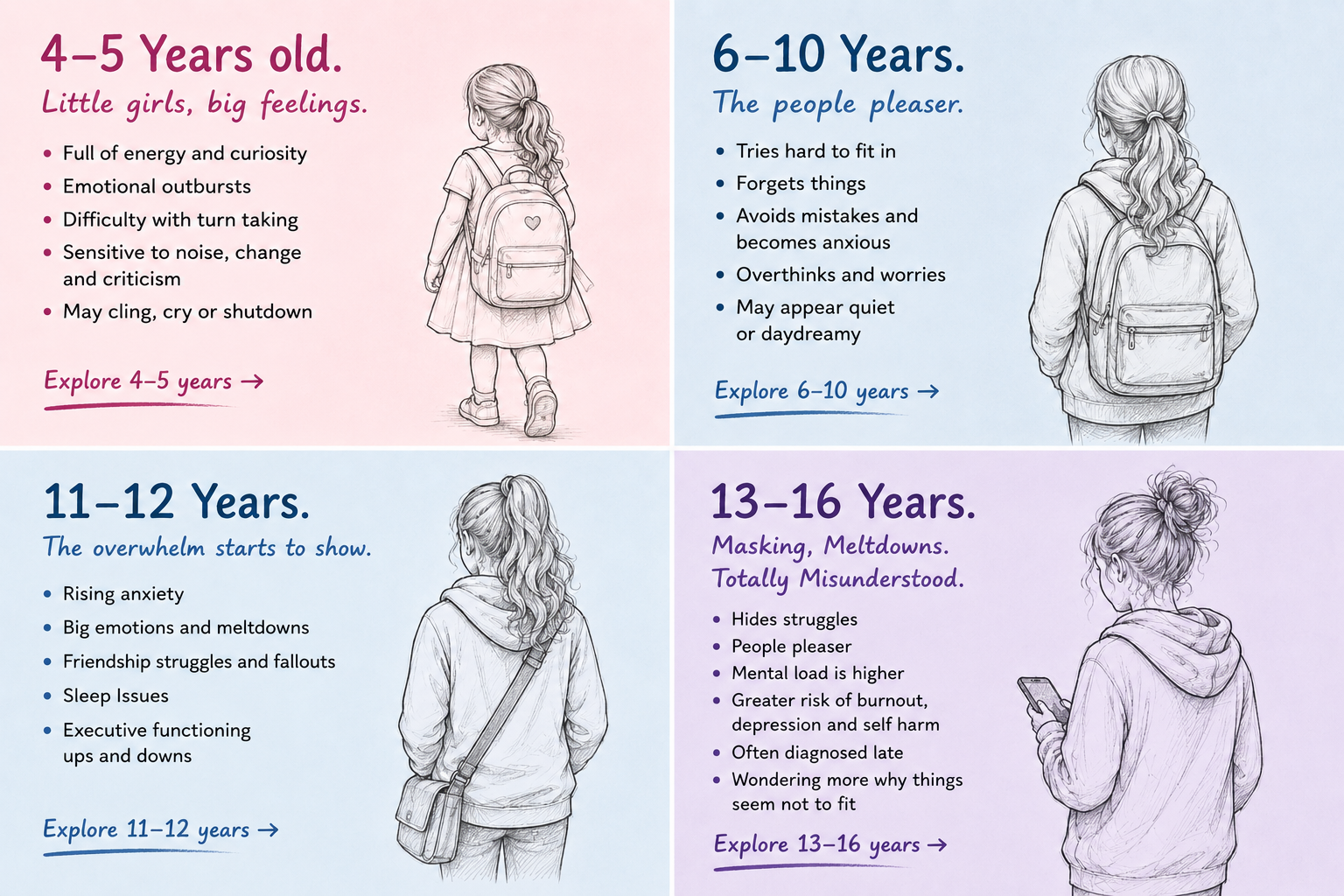
A girl doesn't have to match every item on a list for her difficulties to deserve attention.
FRIENDSHIPS
When friendships feel enormous
intense friendships
one “best friend”
fear of rejection
people pleasing
copying peers to fit in
misunderstanding social situations
impulsively saying too much
replaying conversations afterwards
feeling excluded
being vulnerable to controlling friendships
difficulty recognising unhealthy friendship dynamics
But be careful not to attribute all friendship difficulties to ADHD. ASC, anxiety, language or communication differences, developmental stage and ordinary friendship difficulties can overlap.
EXECUTIVE FUNCTION — MAKE THE INVISIBLE VISIBLE
She knows what she needs to do. So why can't she just do it?
ADHD can affect the brain's management system involved in:
Starting → Planning → Remembering → Prioritising → Managing time → Regulating emotions → Stopping/redirecting attention
You say.
“Go upstairs, get changed, put your uniform in the wash and bring your water bottle down.”
You said one sentence.
Her brain may have received a small administrative project.
EMOTIONAL REGULATION
Why can something tiny become something enormous?
Daily event
Wrong socks.
Lost pencil case.
Friend didn't reply.
Homework changed.
Someone looked at her “funny”.
And suddenly the entire evening has detonated.
The apparent size of the trigger does not necessarily reflect the load already being carried.
Before: notice overload accumulating
During: reduce demands and language
After: reconnect first, problem-solve later
OVERLAP MATTERS
Sometimes ADHD isn't travelling alone
You can discuss ADHD alongside:
autism
dyslexia
dyscalculia
developmental coordination difficulties
language and/or communication needs
anxiety
sensory differences
The aim isn't to collect labels. It's to understand your child well enough to give her the right support.
START WITH THE PATTERNS
Start with patterns, not a diagnosis
Consider the following:
How long has this been happening?
Where does it happen?
What is the impact?
What does she have to do to cope?
What happens afterwards?
What support already helps?

You are not alone. You just need the right support.
Understand what is really going on
Get a personalised plan
Feel confident in your next steps
Support at home, school and the wider community
Let’s create a plan that works for your daughter and your family.
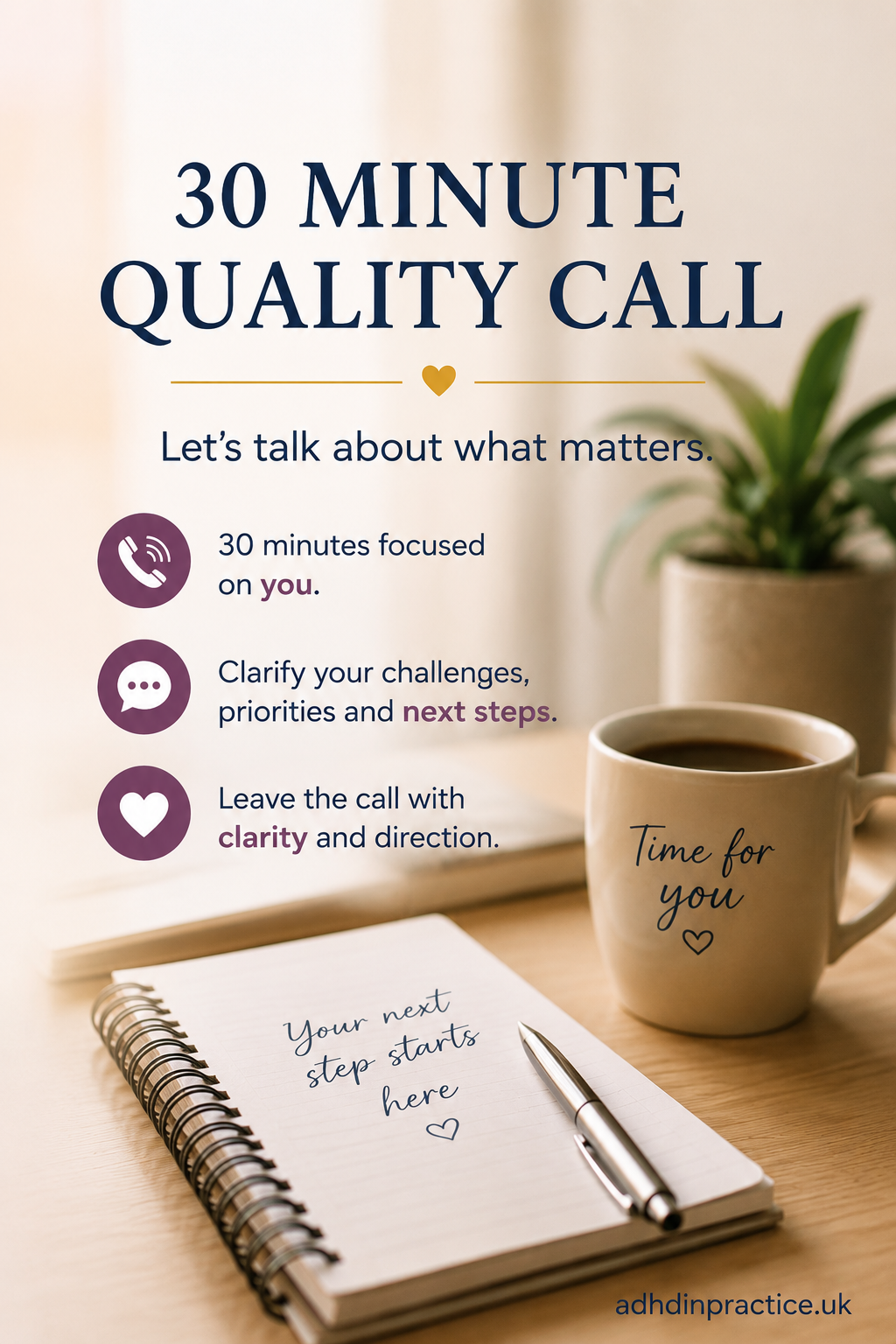
A calm, no-pressure conversation giving you time to explain what is happening and work out what your next step could be.
This call is for parents, grandparents and carers of children with any diagnosed or suspected SEND—not only ADHD.
Your child may be experiencing difficulties connected with autism, dyslexia, dyscalculia, anxiety, sensory needs, communication, learning, school attendance, emotional regulation or executive functioning. They may have several overlapping needs, or no diagnosis at all.
Children’s needs rarely arrive in neat, separate boxes. ADHD may overlap with autism, dyslexia, anxiety or sensory differences. A dyslexic child may also experience frustration, emotional overwhelm, shutdowns or meltdowns when learning demands repeatedly exceed the support available.
This is not a sales call. There is no hard pitch, no awkward pressure and absolutely no “book before midnight” nonsense.
During the call, we can talk about:
what is worrying you most right now;
what is happening at home, at school or both;
the difficulties or patterns you have noticed;
whether learning needs, masking, anxiety, sensory overload or emotional regulation may be part of the picture;
questions you may need to ask school, your GP, CAMHS or an assessment service;
which SEND, NHS or school-support pathway may be worth exploring;
whether ADHD in Practice is the right fit for your family.
Your child may already have a diagnosis, be waiting for an assessment or simply have you thinking, “Something isn’t adding up.”
You do not need to arrive knowing the correct terminology. You do not need to decide whether it is ADHD, autism, dyslexia or something else before speaking to me.
Just tell me what is happening. We can begin there.
BOOK A FREE 30-MINUTE CALL
Popular
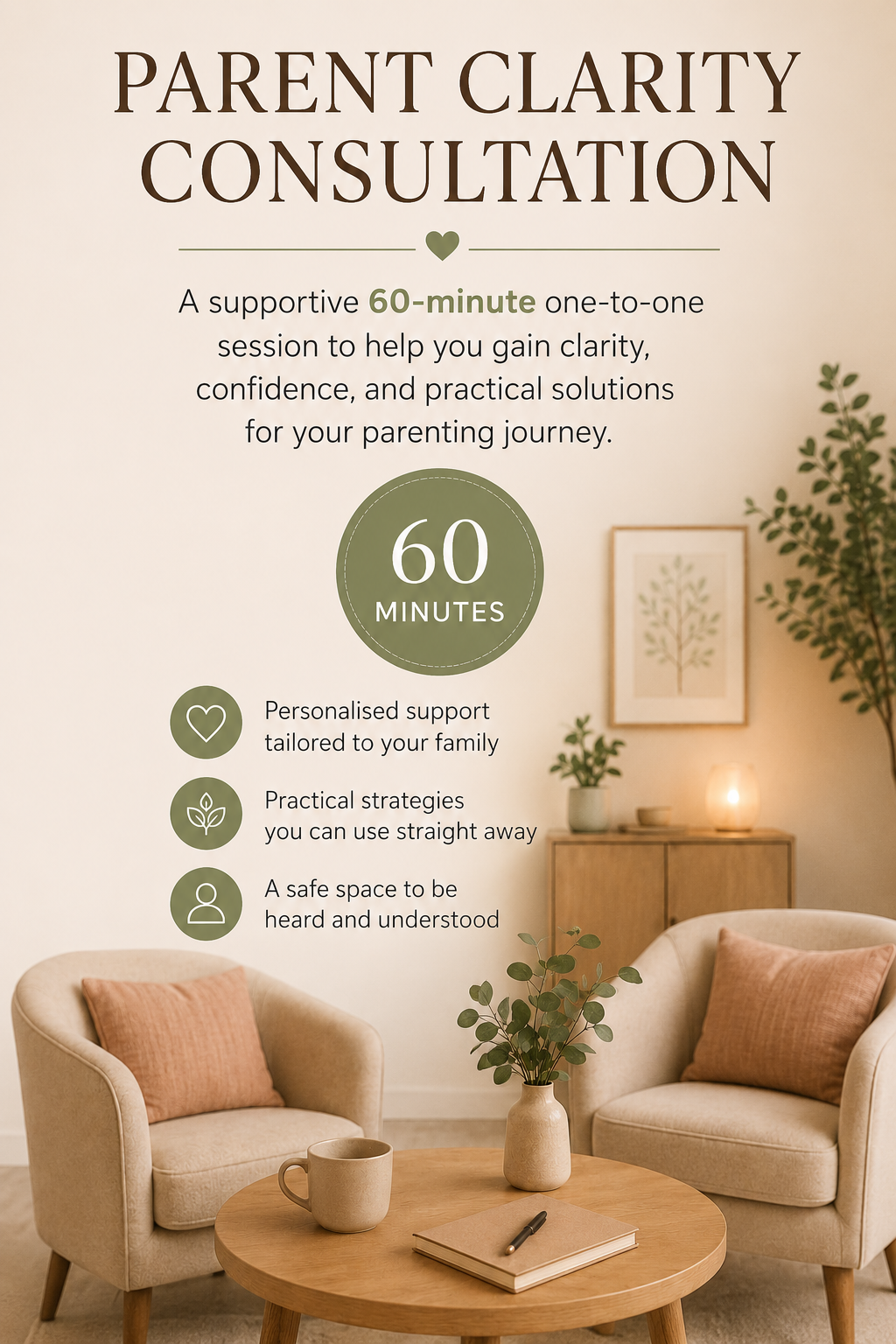
Zoom or telephone call
A focused, parent support session to help you cut through the noise and work out what needs to change first.
Includes:
60-minute online consultation;
individual discussion of your child’s needs and current difficulties;
clear priorities and recommended next steps;
a concise written follow-up summary;
20-minute review call within four weeks.
This session is for parents who know something is not working, but are not sure what the next step should be.
You may be dealing with emotional outbursts, morning battles, school worries, homework stress, anxiety, suspected ADHD, autism, dyslexia, sensory needs, friendship difficulties, sleep issues, behaviour concerns, masking, low confidence or a child who seems overwhelmed by everyday demands.
You do not need to arrive with a diagnosis, a folder of reports or a perfect explanation.
You can start with:
“I know something is wrong, but I don’t know what to do next.”
That is enough.
Best for parents who:
feel overwhelmed and do not know where to start
are constantly firefighting behaviour at home
have tried strategies that worked for a week, then disappeared into the void
are unsure whether the difficulty is ADHD, anxiety, autism, dyslexia, school stress, sensory overload or something else
need help understanding what may be driving their child’s behaviour
want practical next steps, not judgement or generic advice
need someone experienced to help them see the wood for the trees
What we can explore
Depending on what is happening for your child, we may look at:
behaviour patterns at home or school
emotional meltdowns and regulation difficulties
morning routines, homework, bedtime or transitions
possible ADHD traits
anxiety, masking or school-related stress
dyslexia, learning difficulties or confidence issues
sensory needs or overwhelm
communication with school
whether further support, assessment or SEND advice may be needed
This is not about jumping to a label.
It is about understanding the barrier.
Once the barrier is clearer, the next step becomes much easier to choose.
You leave with:
a clearer picture of what may be driving your child’s behaviour
practical, realistic next steps
ideas you can actually use at home or in school conversations
a better sense of what to prioritise first
less guilt and more direction
This session may help if you are thinking:
“I don’t know if this is ADHD or something else.”
“School says things are fine, but home feels impossible.”
“We have tried reward charts and nothing sticks.”
“I am tired of guessing what my child needs.”
“I need help before I speak to school.”
“I just need someone to help me make sense of it all.”
Your starting point when everything feels too much
The Parent Clarity Call gives you space to pause, talk through what is happening, and leave with a clearer plan.
No judgement.
No jargon.
No pretending one sticker chart will fix family life by Friday.
Just practical parent support, clear thinking and a sensible next step.
The Parent Clarity Consultation includes a focused discussion, a concise written summary of the key priorities and agreed next steps, and one 20-minute review call to be used within four weeks. It does not include a formal assessment, diagnosis, detailed report, legal advice, extensive document review or ongoing email support. Any additional sessions or written work are booked separately.
More helpful resources
-
![ADHD in girls.]()
ADHD in girls. Real life. Practical advice.
-
![Parent guides, books, tools and printables.]()
Parent guides, books, tools and printables
-
![School Support]()
School Support scripts.
-
![Book a Call 30 Minutes free]()
Book a free 30-minute call. Time to talk.
-
![Parent Clarity call]()
Parent Clarity Call - 60 minutes support.